Leonard A. Lauder, Collector
Henri Matisse
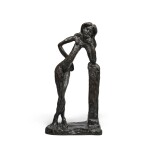
La Serpentine
Auction Closed
November 19, 12:41 AM GMT
Estimate
9,000,000 - 12,000,000 USD
Lot Details
Description
Leonard A. Lauder, Collector
Henri Matisse
(1869 - 1954)
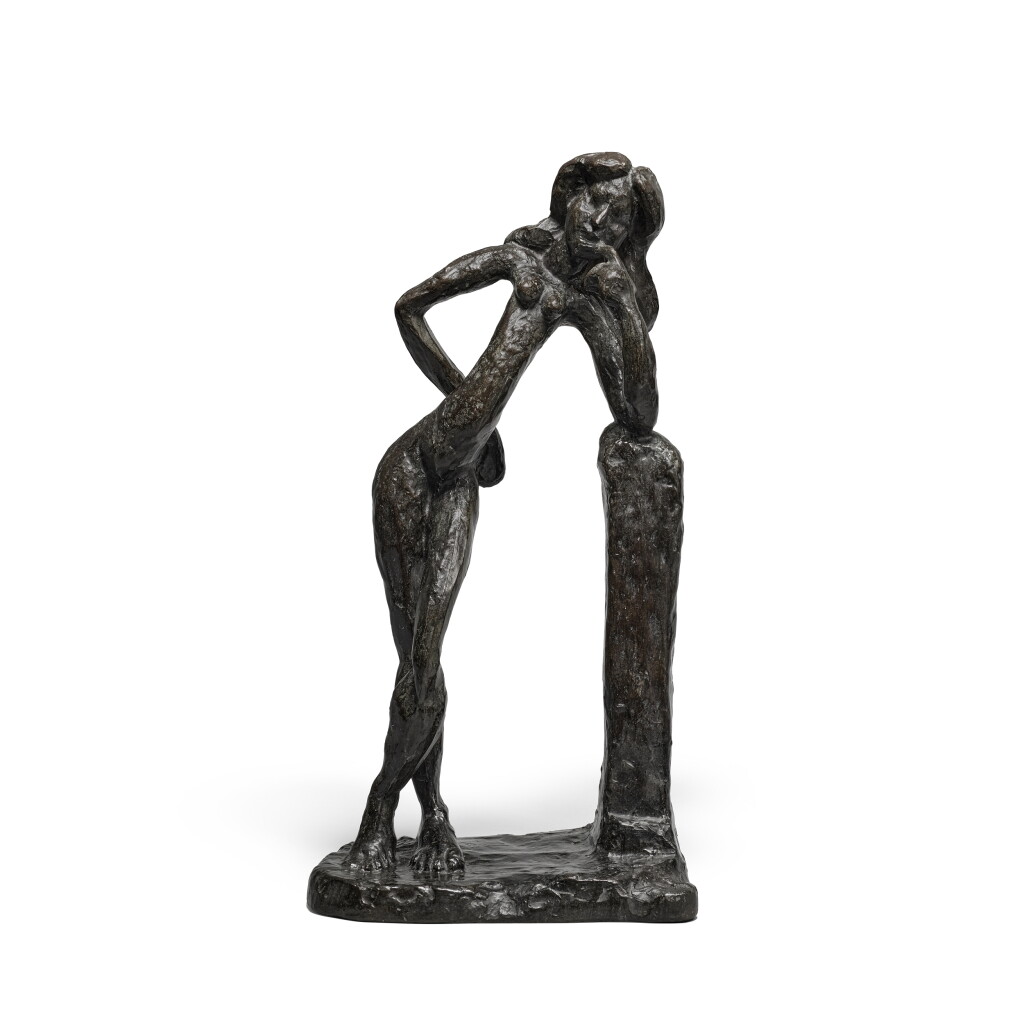
La Serpentine
inscribed Henri Matisse, numbered 10 and stamped with the foundry mark Valsuani cire perdue
bronze
height: 23 in. 56 cm.
Conceived in Issy-les-Moulineaux in 1909 and cast in 1951.
Estate of the artist
Pierre and Tana Matisse Foundation, New York
Acquired from the above on 18 June 2002 by the present owner
Ottawa, National Gallery of Canada, 2020-25 (long term loan)
Alfred Stieglitz, ed., Camera Work, nos. 42-43, April-July 1913, pl. IV, illustration of the clay (in photograph with the artist)
Elie Faure, Jules Romains, Charles Vildrac, et al., Henri Matisse, Paris, 1923, p. 23, illustration of the clay (in photograph with the artist)
Alfred H. Barr, Jr., Matisse: His Art and His Public, New York, 1951, p. 23, illustration of the clay (in photograph with the artist); pp. 104, 138-40, 148, 179-80; p. 367, illustration of another cast
Giulio Carlo Argan, “Matisse scultore,” Rivista trimestrale dell'Ente della Biennale, vol. 6, no. 26, December 1955, p. 34, illustration of another cast; p. 35
Gaston Diehl, Henri Matisse, Paris, 1958, pl. 2, p. 40, illustration of another cast; pp. 41 and 117
Raymond Escholier, Matisse: From the Life, London, 1960, pp. 15 and 79; pl. 40, illustration of another cast
Herbert Read, A Concise History of Modern Sculpture, New York, 1964, fig. 26, p. 35, illustration of another cast; pp. 38 and 298
Jean Guichard-Meili, Matisse, Paris, 1967, fig. 164, pp. 168, 170 and 250; p. 171, illustration of another cast
Herbert Read, Art and Alienation: The Role of the Artist in Society, London, 1967, pp. 119 and 171; pl. 29, illustration of another cast
H. H. Arnason, History of Modern Art. Painting, Sculpture, Architecture, New York, 1968, fig. 179, p. 115, illustration of another cast
John Russell, The World of Matisse 1869-1954, New York, 1969, p. 100, illustration of another cast and illustration of the clay (in photograph with the artist)
Henry Grosinsky, “The Sculpture of Matisse,” Life, vol. 69, no. 11, 11 September 1970, pp. 40-41, illustrations in color of another cast and illustration of the clay (in photograph with the artist)
Mario Luzi and Massimo Carrà, L’Opera di Matisse dalla rivolta ‘fauve’ all'intimismo 1904-1928, Milan, 1971, no. S6, p. 108, illustration of another cast; p. 109
Louis Aragon, Henri Matisse: A Novel, vol. II, New York, 1972, fig. 116, p. 134, illustration of another cast
Albert E. Elsen, The Sculpture of Henri Matisse, New York, 1972, nos. 116-17; pp. 20, 91, 93, 95-96 and 182; pp. 92 and 94, illustrations of another cast and illustration of the clay (in photograph with the artist); p. 111, illustration of another cast (in installation photograph of Paris, Galerie Pierre, Henri Matisse, 1930)
John Jacobus, Henri Matisse, New York, 1973, fig. 64, pp. 23, 25 and 54-55; p. 24, illustration of another cast
William Tucker, Early Modern Sculpture, New York, 1974, fig. 86, pp. 40, 91-92, 162 and 168; p. 93, illustration of another cast
John Elderfield, The Cut-Outs of Henri Matisse, New York, 1978, fig. 21, p. 27; p. 28, illustration of another cast
Lawrence Gowing, Matisse, New York and Toronto, 1979, no. 71, pp. 86, 88-89, 95 and 207; p. 87, illustration of another cast
Peter Selz, Art in Our Times. A Pictorial History 1890-1980, New York, 1981, figs. 174-75, pp. 78-79, illustrations of another cast
Douglas Mannering, The Art of Matisse, London and New York, 1982, p. 40, illustration of another cast; p. 41
Pierre Schneider, Matisse, Paris, 1984, p. 146, 544, 550, 557-58, 567, note 60, 675 and 711; p. 551, illustration of another cast
Nicolas Watkins, Matisse, New York, 1985, pl. 74, p. 94; p. 96, illustration of another cast
Jack Flam, Matisse: The Man and His Art 1869-1918, London, 1986, figs. 270, pp. 238, 260, 262, 269, 494, note 50, 495, note 39; p. 270 illustrations of another cast; p. 271, illustration of the clay (in photograph with the artist)
Jack Flam, ed., Matisse: A Retrospective, New York, 1988, p. 110, illustration of another cast and illustration of the clay (in photograph with the artist); p. 133, illustration of another cast (in installation image of Paris, Galerie Bernheim-Jeune, Tableaux du Maroc et sculptures, 1913)
Ernst-Gerhard Güse, ed., Henri Matisse, Drawings and Sculpture, Munich, 1991, fig. 12, pl. 116 and p. 17, illustrations of another cast; pp. 193 and 201; p. 200, illustration of the clay (in photograph with the artist)
Hayden Herrera, Matisse: A Portrait, New York, 1993, p. 76, illustration of another cast; p. 206
Xavier Girard, Matisse. Une splendeur inouïe, Paris, 1993, pp. 67-68
Walter Guadagnini, Matisse, Milan, 1993, p. 17, illustration of the clay (in photograph with the artist); pp. 262-63; p. 272, illustration of another cast
Guy Patrice Dauberville and Michel Dauberville, Matisse: Henri Matisse Chez Bernheim-Jeune, vol. I, Paris, 1995, p. 88, illustration of another cast (in installation photograph of Paris, Galerie Bernheim-Jeune, Tableaux du Maroc et sculptures, 1913); pp. 172 and 174, illustration of another cast (in installation photograph of Paris, Galerie Bernheim-Jeune, Chefs d’Oeuvre d’Henri Matisse, 1958); vol. II, no. 793, p. 1412, illustration of another cast (titled Jeune fille debout (La Serpentine))
Gilles Néret, Matisse, Cologne, 1996, p. 51, illustration of another cast; p. 57
Claude Duthuit and Wanda de Guébriant, Henri Matisse, Catalogue raisonné de l’oeuvre sculpté, Paris, 1997, no. 46, pp. XVI, XVII, 130 and 374; pp. 128-29 and 131, illustrations of another cast; p. 254, illustration of another cast (in photograph of the artist’s Paris residence); p. 259, illustration of the clay (in photograph with the artist)
Pierre Daix, Pour une histoire culturelle de l’art moderne: le XXe siècle, Paris, 2000, p. 140
Hilary Spurling, Matisse the Master: A Life of Henri Matisse, the Conquest of Color 1909-1954, New York, 2005, p. 34, illustration of the clay (in photograph with the artist)
Éric Alliez and Jean-Claude Bonne, La Pensée-Matisse: portrait de l'artiste en hyperfauve, Paris, 2005, vol. I, pp. 238-40; vol. II, pl. 43, illustration of another cast
The conception of La Serpentine in the autumn of 1909 coincided with one of the most consequential and ambitious moments of Henri Matisse’s career. Earlier that year in March, Russian collector Sergei Shchukin wrote to the artist to confirm his commission for two monumental canvases, La Danse and La Musique, destined for his Moscow home. This project represented the largest and most demanding pictorial undertaking the artist had yet attempted, and Matisse spent the following summer in the small town of Cavalière on the Côte d’Azur, painting and sketching the model whom he’d hired from Paris. He continued to work on La Danse II—the follow-up to La Danse I, which had earned him the commission—upon his return to Paris (see figs. 2 and 3). It was amidst this intensive project that Matisse created La Serpentine—a sculpture whose radical reimagining of the human figure would serve as both counterpart to and catalyst for the painterly innovations of La Danse II.
Unlike his studies of live models for the monumental painting, the genesis of La Serpentine reveals Matisse’s characteristic willingness to draw upon unconventional sources. The point of departure for this sculpture came in the form of a photograph of a nude model. As Ellen McBreen writes, “At least eight of Matisse’s sculptures from his most productive years of modeling, 1906-09, can be definitively traced to a far more prosaic source [than canonical art]: photographs of nude models in stock poses. He found them in revues such as Mes Modèles and L’Étude académique, titles in a burgeoning industry of erotica publications ostensibly aimed at artists who could not afford live models. The revues’ adoption of an ‘artistic’ pose was an alibi to elude censors, allowing publishers to exploit the new, inexpensive halftone screen and mass-produce images of the nude as never before. But the pretext also created a strange shadow of École des Beaux-Arts tradition, providing Matisse with a novel means of negotiating his response to it, through a caricatured condensation in a 50-centime commercial product” (Exh. Cat., Baltimore Museum of Art and Dallas Museum of Art, Nasher Sculpture Center, Matisse: Painter as Sculptor, 2007; see figs. 4 and 5).
Working from a photograph rather than a live model not only spared expense but also allowed Matisse unlimited access to source material as he reimagined and refined the female form in service of La Danse. The unknown model in the photograph, whose fulsome figure Matisse found “very harmonious in form and movement,” is pictured leaning against a studio prop with her ankles crossed and right arm drawn behind her back (quoted in Exh. Cat., Fort Worth, Kimbell Art Museum, Henri Matisse, Sculptor/Painter, 1984, p. 76). While her pose bears a distant resemblance to Classical sculpture and Neoclassical painting, the model for La Serpentine, like the finished sculpture itself, is decidedly modern. With the subtle, casual gestures of the crossed legs and finger to her lip, the model exudes a languid sensuality and self-awareness which Matisse would immortalize in bronze.
Edward Steichen’s celebrated photograph of the artist working on the clay form of La Serpentine in 1909 shows the sculpture at an early stage, still close to the proportions of the source image (see fig. 1). Yet this was only a provisional state. Matisse soon embarked on a process of systematic reorganization, in which the mass of the body was pared away, elongated, and recomposed to serve the sculpture’s underlying movement. He later explained “I thinned and composed forms so that the movement would be completely comprehensible from all points of view” (quoted in ibid., p. 78). The result was a revolutionary feat of sculpture—a human figure rendered in surreal proportion and erupting like an upward-coiling vine, its rhythms held in tension between the arabesque and the vertical.
In constructing La Serpentine’s form, Matisse amplified the dialogue between the figure’s sensuous curves and the supporting pillar’s steadfast verticality. This slender, erect column—transformed from a mere studio prop into a vital structural and symbolic element—anchors the twisting arabesque of the body. The pillar’s manifest phallic presence quietly heightens the tension within the composition, setting the softness and fluidity of the figure’s limbs and torso into sharper relief. Such interplay deepens the sculpture’s impact; as Matisse balances movement with stasis and form with space, he similarly juxtaposes the archetypal elements of the feminine with the masculine, conveying an overarching sense of unity. As Matisse himself insisted, “No lines can go wild; every line must have its function…All the lines must close around a center; otherwise your [work] cannot exist as a unit, for these fleeting lines carry the attention away—they do not arrest it” (quoted in Alfred H. Barr, Jr., Matisse: His Art and His Public, New York, 1951, p. 551).
Michael Mezzatesta equates the refinement of the sculpture from the clay form in the photograph to its final version with the progression of La Danse I and La Danse II (see figs. 2 and 3). “Significantly, both the Serpentine and Dance II had similar starting points: the thick-thighed, waistless girl in the [Steichen] photograph finds sisterly counterparts in Dance I, particularly the two figures placed frontally… The figures are summarily rendered, with contours loosely drawn and often reworked; the modeling is unaccented, with only the barest indication of interior forms on any one figure—a circle or semicircle for breasts, a short line for buttocks or a spine… In Dance II Matisse concentrated on individual figures, tightening the forms with strong, clear contours. Bodies are given greater resilience and relief by the definition of interior musculature—abdomen, back, shoulders, breasts, and knees are boldly indicated with dark lines. Limbs now taper emphatically at the joints, stressing the individual parts of the body and creating a rhythmic pulse, as forms contract and expand across the surface of the canvas. These dancers are no longer the fat paper dolls of Dance I but have a lean, sculptural quality. An analogous restructuring and tightening of form was achieved at the same time in the Serpentine. Matisse attacked the mass of the body until its forms were condensed into the ropelike limbs and torso. The body itself was elongated, and its mass was directed to the huge feet, calf, and forearms. That calf, as wide as the thigh is narrow, is one of the Serpentine’s most distinguished features. It reappears in the second figure to the left in Dance II. Indeed, the dancer’s posture has been compared to the sculpture’s and it provides additional evidence of the clarifying role that the Serpentine played in the evolution of the painting” (ibid., pp. 76-77).
The origins of this winnowing approach can be traced to Matisse’s sculptural experiments of the previous year. In the summer of 1908, following the completion of Figure décorative, he had begun exploring the figure as a self-contained arabesque. Working from a photograph of a crouching model, he produced Nu assis, main droite à terre as well as a version without the extended right arm, and subsequently Figure assise, progressively testing the relationship between curving forms and vertical alignment. In La Serpentine, this investigation reached its most audacious and compelling form. The leaning figure is stabilized by the strong vertical of the right leg and the parallel post, while the body’s looping contour is folded back into itself, conserving its energy rather than releasing it outward.
While deeply influenced by artists like Auguste Rodin, Matisse diverged sharply from the dominant sculptural tendencies of his time. Unlike Constantin Brancusi or Amedeo Modigliani, he did not reject traditional clay modelling before bronze casting. Yet he found Rodin’s compositional method—a “grouping of fragments”—to lack the structural unity he considered essential. Maillol’s placid, volumetric approach was equally alien to his aims: “Maillol’s sculpture and my work in that line have nothing in common. We never speak on the subject. For we couldn’t understand one another. Maillol, like the ancient masters, proceeded by volume; I am concerned with arabesque like the Renaissance artists. Maillol did not like risks and I was drawn to them” (quoted in Raymond Escholier, Matisse ce vivant, Paris, 1956, pp. 163-64). For Matisse, volume was not simply a self-contained mass to be circumnavigated by the eye; rather, it was a vehicle for rhythm, movement and the modulation of perspective.
Widely recognized today as one of Matisse’s most daring sculptures, La Serpentine was first met with deep skepticism and criticism when it was exhibited at New York’s Montross Gallery in 1915. Its attenuated proportions and calculated distortions provoked confusion and even ridicule. The thinning of the forms, however, was not an arbitrary stylization. Large, rounded masses would have obstructed the continuity of the arabesque Matisse so ardently sought, breaking the rhythm and obscuring the interplay of solid and void. By reducing the bulk of the torso and limbs, Matisse created an open lattice of form and space in which the linear flow of the work is as much defined by the negative intervals as by the positive volumes. In purely sculptural terms, La Serpentine reveals Matisse’s acute sensitivity to the formal demands of a figure in the round. The work invites, indeed requires, the viewer’s movement around it; each shift of position yields a new constellation of masses, arcs and voids.
In this respect, the sculpture embodies Matisse’s analytical engagement with the existence of the figure in space and its relationship to the surrounding environment. In his extensive monograph on the artist, Alfred Barr describes an early encounter which highlights the artistic genius underlying the form of La Serpentine and the transformation effect of experiencing it the round: “Roger Fry, Bryson Burroughs, the enlightened but often frustrated Curator of Painting at the Metropolitan Museum, and Henry McBride called on Matisse in his studio at Issy. As they were leaving, they caught sight of La Serpentine for the first time. ‘I was personally struck dumb,’ Henry McBride recalls, ‘by the Venus whose thighs were almost as thin as wires and whose lower legs were as thick as her thighs should have been.’…McBride, one of the most discerning American critics of modern art, then described how he came to understand the figure…only later when he chanced to see it in a ‘refracted light’ capable of putting in the streak of highlight on the thighs… and lengthening out the shadows on the lower legs… Matisse has merely ‘painted’ in sculpture but when seen in proper light, ‘the figure which at first seemed an ineffective joke, did actually resolve itself into an excellent interpretation of form. It would’ve been an easy matter for Matisse to have given Mr. Fry, Mr. Burroughs and myself a helpful clue to this Venus, but the bad boy in him tempted him to keep us mystified” (Alfred H. Barr, Jr., Matisse: His Art and His Public, New York, 1951, pp. 139-40).
Today, La Serpentine stands as one of Matisse’s most complete and self-aware reconfigurations of the human form. It reconciles oppositions—between vertical and curve, line and volume, sensuality and structural discipline—within a single, self-contained whole. It is both rooted in tradition yet defiantly modern in its abstraction. Far from mere accompaniment to his painted practice, three-dimensional forms like La Serpentine mark watershed moments in Matisse’s career.
Of the ten casts of La Serpentine, seven are held in museum collections including The Museum of Modern Art, New York, the Philadelphia Museum of Art, the Baltimore Museum of Art, the Moderna Museet, Stockholm, the Hirshhorn Museum and Sculpture Garden, Washington, D.C., the Statens Museum for Kunst, Copenhagen and the Musée Matisse, Nice.
You May Also Like