Leonard A. Lauder, Collector
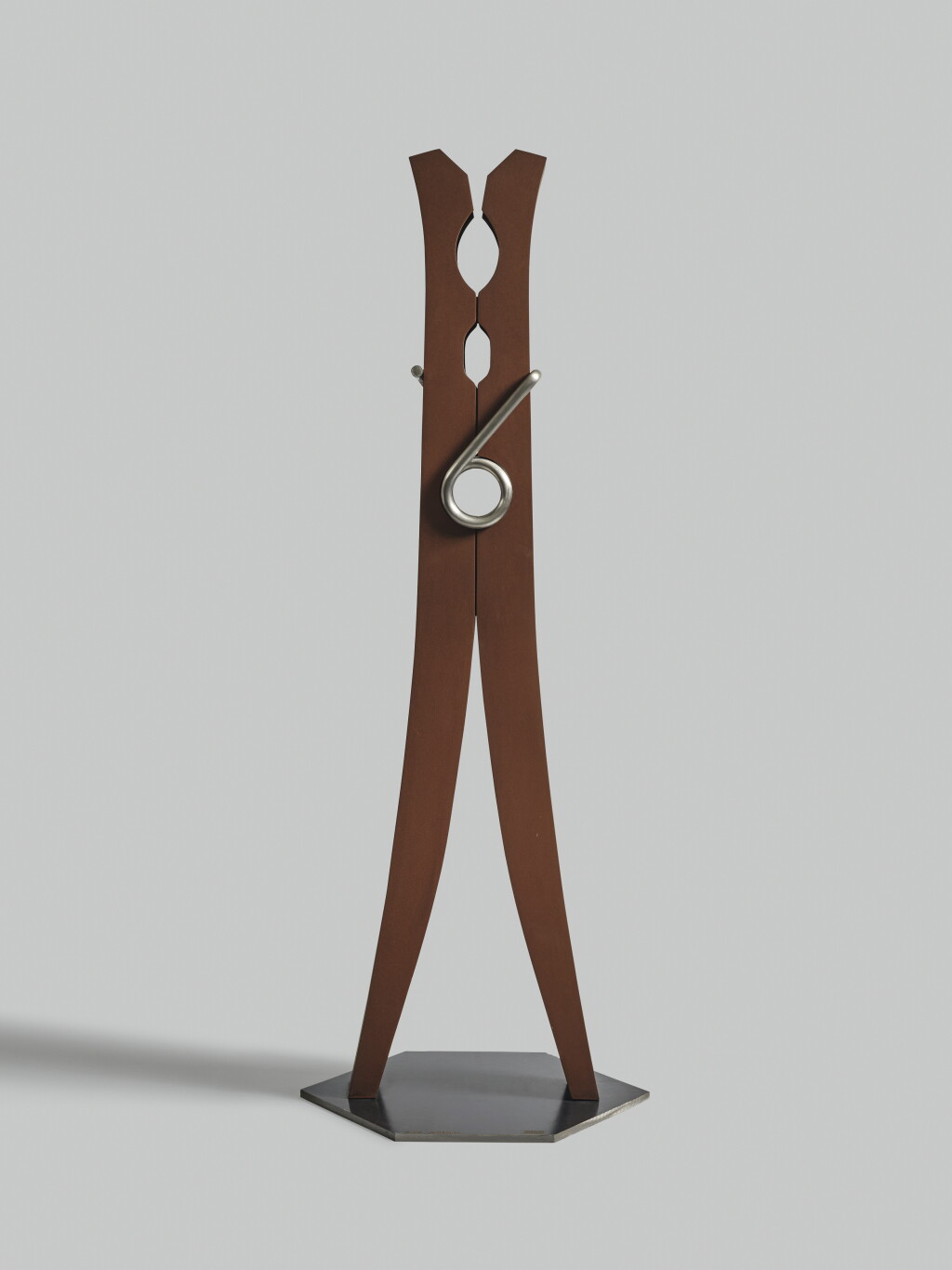
Clothespin—45 Foot Version (Model)
Auction Closed
November 19, 12:41 AM GMT
Estimate
600,000 - 800,000 USD
Lot Details
Description
Leonard A. Lauder, Collector
Claes Oldenburg
(1929 - 2022)
Clothespin—45 Foot Version (Model)
stamped with the signature Claes Oldenburg, title and foundry mark (on the base)
Cor-Ten, stainless steel and steel
61 by 20 by 22 ½ in. 154.9 by 50.8 by 57.2 cm.
Executed in 1976-79. This work is unique.
The Pace Gallery, New York
Private Collection, Los Angeles (acquired from the above by 1995)
PaceWildenstein, New York
The Bellagio Gallery of Fine Art, Las Vegas (acquired from the above by 1998)
PaceWildenstein, New York
Acquired from the above in February 1999 by the present owner
New York, PaceWildenstein, Claes Oldenburg/Coosje van Bruggen Large-Scale Projects: Drawings and Sculpture, 1994-95, p. 237, illustrated (with the artist at Lippincott Foundry in 1976 (in progress))
Washington, D.C., National Gallery of Art; Los Angeles, Museum of Contemporary Art; New York, Solomon R. Guggenheim Museum; Bonn, Kunst-und Ausstellungshalle der Bundesrepublik Deutschland; London, Hayward Gallery, Claes Oldenburg: An Anthology, 1995-96, no. 219, p. 384, illustrated in color
Las Vegas, The Bellagio Gallery of Fine Art, The Bellagio Gallery of Fine Art: Impressionist and Modern Masters, 1998, p. 214, illustrated in color; pp. 215-19
Johnathan D. Lippincott, Large Scale: Fabricating Sculpture in the 1960s and 1970s, New York 2010, illustrated (inside front cover) and p. 190, illustrated (with the artist at Lippincott Foundry in 1976)
Standing at over five feet tall, Clothespin—45 Foot Version (Model) transforms a commonplace household object, with whimsy and rigor, into an icon of postmodern sculpture. It is a critically important work: the prototype for one of Claes Oldenburg’s most beloved public monuments, his 45-foot-tall, ten-ton Clothespin, which soars above Philadelphia’s Centre Square Plaza, in front of City Hall (see fig. 4). Begun in 1976 and standing like a sentinel in the foundry while the large outdoor sculpture was being produced (see fig. 1), it was completed in 1979, when the artist affixed it to a bespoke hexagon steel base. The artist also created Clothespin – Four Foot Version (1974) in bronze, edition of 9; and Clothespin – Ten Foot Version (1975), in Cor-Ten and stainless steel, edition of 3. The present sculpture is unique.
“What I want to do is to create an independent object which has its existence in a world outside of both the real world as we know it and the world of art,” Oldenburg stated plainly. “It’s an independent thing which has its own power, just to sit there and remain something of a mystery… My intention is to make an everyday object that eludes definition.” (Claes Oldenburg quoted in: Germano Celant, “Claes Oldenburg and the Feeling of Things,” in: Exh. Cat., Washington, D.C., National Gallery of Art (and traveling), Claes Oldenburg: An Anthology, 1995-96, p. 12). In the case of the humble, utilitarian clothespin, the artist had many of them handy in his studio. “Clothespins are a studio necessity for me. With clothespins I join parts of soft sculptures in preparation for sewing. Clothespins also hold parts together while the glue is setting. They are instruments of connection which is why they are so important in the fabrication of my work” (Claes Oldenburg quoted in: Exh. Cat, Minneapolis, Walker Art Center, Oldenburg: Six Themes, 1975, p. 61).
He first conceived of the clothespin in monumental motif form a decade prior. “In October 1967,” Libby Lumpkin writes, “Oldenburg was flying from his home in New York to Chicago… as the plane neared the airport, he took out a clothespin he had brought along. He held the clothespin up to the window and compared it to the skyscrapers on the ground below” (Libby Lumpkin quoted in: Exh. Cat., Las Vegas, The Bellagio Gallery of Fine Art, The Bellagio Gallery of Fine Art: Impressionist and Modern Masters, 1998, p. 216). Soon after, his vision was realized by the developer Jack Wolgin on behalf of the Philadelphia Redevelopment Authority’s arts program. The commission was planned in tandem with the city’s year-long celebration of the American Bicentennial. It was to be placed in the vicinity of the Liberty Bell, the hallowed symbol of American independence. The import of the historic moment and the site was not lost on Oldenburg: despite his claim that it was mere coincidence, he manipulated the springs of the pin to read as a horizontal 7 on one side and a diagonal 6 on the other.
When Clothespin was first installed it was controversial for some. Oldenburg was one of several artists in the 1960s, who reconceived the traditional public monument, not only in the choice of subject matter but also material: industrial Cor-ten steel, versus stone, marble, or bronze. Steel allowed for even larger proportions and greater impact on the passerby (see fig. 4). In the case of the Clothespin, it also imposed a larger than life effigy of an inanimate item normally taken for granted, and even discarded. Oldenburg upended notions of decorum, yet in doing so, made strides in democratizing the august medium of sculpture, in another salute to the spirit of 1776.
Executed in a beautiful umber patina, Clothespin—45 Foot Version (Model) has the same anthropomorphic, upright posture as the full-scale version, which the artist achieved by simply using the conventional top of the hinged prongs as the “legs.” The two identical and symmetrical parts appear pinned together in an embrace; indeed, Oldenburg enjoyed the visible allusion to Constantin Brâncuși’s The Kiss, based on the abstracted forms of a clasping couple, and which he admired in the Philadelphia Museum of Art (see fig. 2). Not only is Clothespin a nod to one of the landmark works of modern sculpture, but it also likewise puns on Philadelphia’s moniker and its literal meaning: “the city of brotherly love.”
The functional clothespin belongs loosely to the category of small, handheld tools that inspired the creation of his largest outdoor works that grace plazas and parks across the world: Spoonbridge and Cherry (1985–1988; Minneapolis Sculpture Garden, Walker Art Center), Typewriter Eraser, Scale X (1999; National Gallery of Art Sculpture Garden, Washington, D.C.), Lipstick (Ascending) on Caterpillar Tracks (1969; Yale University, New Haven) and Shuttlecocks (1994; Nelson‑Atkins Museum of Art, Kansas City). Whereas the monumental Trowels and Saws stand upright by being “plunged” into the ground, and others such as the hammer, pliers, and screwdriver prod each other up in a tentative hold (Balancing Tools, 1984; Vitra Campus Weil am Rhein, Germany), the Clothespin stands gracefully on its own two “feet.” Oldenburg encourages us to gaze upwards, to acknowledge the outsized roles these well-designed, practical things play in our lives.
Of these many qualities and the public profile of the Clothespin, Leonard A. Lauder took note. He saw the public sculpture when he travelled regularly to Philadelphia as a co-founder and member of the Board of Governors of the University of Pennsylvania. (He was a leading philanthropic supporter of this institution, his alma mater.) Lauder lived day by working day with the Clothespin—45 Foot Version (Model) in his 767 Fifth Avenue office, where it gave a jaunty greeting to visitors coming in the door. The “76” steel spring reminded him of the nation’s origins. He placed it close to Kenneth Noland’s Plus 10, delighting in the “V” of the sculpture’s legs echoed in the painting’s chevon. Additionally, he was a key champion of Claes Oldenburg’s vision and acquired numerous of his drawings for the Whitney Museum of American Art. All told, he admired how Oldenburg’s larger-than-life objects recalibrate our perception of the world around us.
You May Also Like