
Bulova
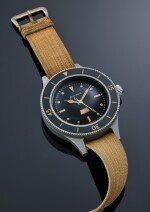
Reference MIL-SHIPS-W-2181 Prototype | A rare and historically important prototype anti-magnetic divers wristwatch with humidity indicator, Made for the U.S. Navy Circa 1958
Auction Closed
June 10, 05:33 PM GMT
Estimate
70,000 - 140,000 USD
Lot Details
Description
Dial: black
Caliber: cal. 10 BPCHN mechanical, 17 jewels
Movement number: 0’126
Case: stainless steel, two-piece screw down case back with brass antimagnetic case holder
Case number: 0’126
Closure: original nylon NATO strap and buckle
Size: 41 mm diameter
Signed: dial, and movement
Box: no
Papers: no
The evolution of warfare leading up to and during World War II lead to the creation of two distinct teams in the United States Navy: EOD Units (Explosive Ordnance Disposal) and UDT (Underwater Demolition Teams), who were elite teams critical to US military operations during WWII and the subsequent years that followed. The functions of these two elite taskforces required specific equipment that can withstand the demands of varying land, underwater, and amphibious missions. As the post war decades ushered in the Cold War era of brinkmanship and militarization, the U.S. government invested heavily in research and development to maintain its military supremacy and supply its troops with the most technologically advanced equipment the world has ever seen.
On December 5, 1955 the U.S. Bureau of Ships created Contract Specification: Wristwatch Submersible, MIL-SHIPS-W-2181 to meet the operational needs of EOD and UDT units. Some of the primary requirements of the watch were: watertight to the specified depth, impervious to water vapor for months, visibility in the dark, and a rotatable outer ring.
Bulova, an American watch company who manufactured thousands of watches for the U.S. Armed Forces during World War II, and whose Head of Research & Development was five-star General Omar S. Bradley at the time, proved to be the supplier of choice for the Pentagon.
Subsequently, in May of 1957, Bulova submitted the first batch of prototypes made to the specifications of SHIPS-W-2181 for testing at the Navy Experimental Diving Unit (NEDU). Bulova fitted these prototypes with a two-piece screw down case back, optimizing waterproofing, a thick brass anti-magnetic case holder to protect the movement and hold it in place, and the hand wound calibre 10 BPCHN with a clutch mechanism to prevent the watch from being over-wound. The second batch of prototypes were delivered in 1958 for field-testing by the Diving Unit and the Navy's UDT-21 frogman team.
The prototypes were so well received that NEDU requested a third batch of prototypes for final approval.
Mysteriously, this last order was never fulfilled. The Navy continued to wait for additional submissions of what they considered to be their contract watch for MIL-SHIPS-W-2181, so much so that in December 1959, a full page was dedicated to the timepiece and the partnership in the Bureau of Ships Journal.
Alas, Bulova made the decision not to proceed with additional prototypes or the military contract, and pivoted their efforts elsewhere, and Tornek Rayville became the supplier to the U.S. Navy. Only the two batches of prototypes of the MIL-SHIPS-W-2181 were ever manufactured from 1957 and 1958, and even fewer of these prototypes survive to this day. making the present timepiece the rarest of the rare in the realm of military tool watches.
Astonishingly well preserved, the present MIL-SHIPS-W-2181 is one of only 12 known examples of the original prototype Bulova MIL-SHIPS-W-2181 according to scholarship. Accompanied by its original nylon NATO strap and its beautifully preserved bezel insert, it retains all of its original luminous plots on the dial and on the hands, and it has a strong Geiger reading. We are pleased to offer this historically important timepiece in excellent condition that captures the intersection between military and horology history.