
Property of an Important West Coast Collector
F. P. Journe
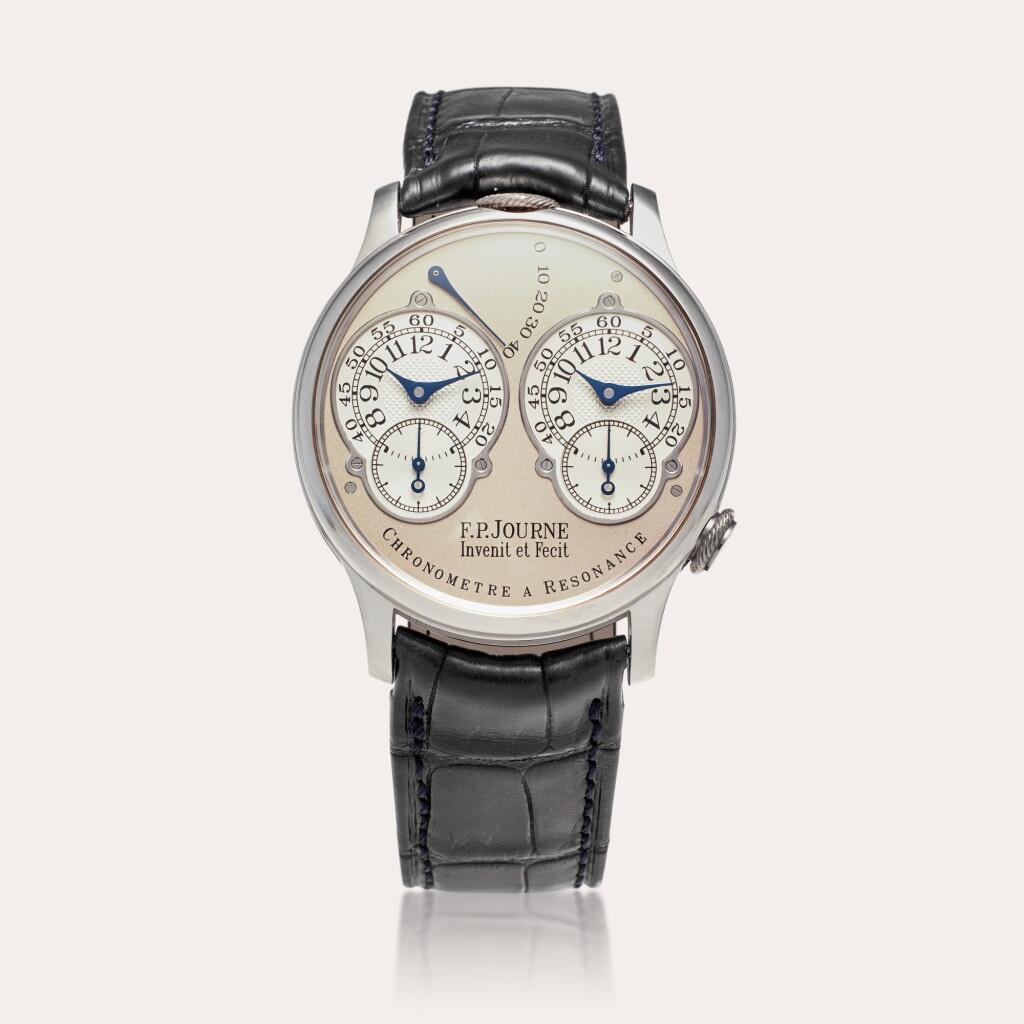
Chronomètre à Résonance | A platinum dual time zone wristwatch with power reserve indication and brass movement, Circa 2001
Auction Closed
December 8, 10:03 PM GMT
Estimate
150,000 - 250,000 USD
Lot Details
Description
Dial: silvered
Caliber: cal. 1499 mechanical rhodium-plated brass, 36 jewels
Case: platinum, sapphire crystal display back secured by six screws
Case number: no. 159/01R
Closure: platinum F.P. Journe buckle
Size: 38 mm diameter
Signed: case and dial
Box: no
Papers: no
The Chronomètre à Résonance, launched by François-Paul Journe in 2000, stands as one of the most intellectually ambitious and mechanically poetic creations in modern horology. It was conceived around a phenomenon first observed by Christiaan Huygens in the 17th century, who noted that two pendulum clocks placed side by side would, over time, synchronize in perfect harmony, a natural occurrence known as resonance. Later studied and refined by Abraham-Louis Breguet, this mysterious principle of sympathetic vibration fascinated watchmakers for centuries, but few dared to harness it in a wristwatch. Journe not only succeeded, but did so with an elegance and precision that transformed a scientific curiosity into a tangible, wearable expression of horological genius.
The Resonance followed closely on the heels of Journe’s first serial wristwatch, the Tourbillon Souverain, introduced in 1999, and shared many of its aesthetic hallmarks, a 38mm platinum case, finely proportioned and discreet, and a dial architecture that balanced technical complexity with aesthetic restraint. The dial of this early example, rendered in silver with two beautifully guilloché sub-dials, allows each time display to be independently set, offering dual-time functionality. At 12 o’clock, a 40-hour power reserve indicator anchors the symmetry of the design, while the inscription “F.P. Journe – Invenit et Fecit” at 6 o’clock. Latin for “Invented and Made” reminds the wearer that every detail of the watch is born of Journe’s own conception and execution.
Beneath the dial lies the beating heart of Journe’s vision: the manual-winding calibre 1499, crafted in rhodium-plated brass. This early brass movement series, produced only until 2004, has become especially coveted by collectors for its purity and rarity, marking the formative years of the brand before the transition to 18k gold movements. The movement’s two independent gear trains and balance wheels operate in close proximity, and through the resonance effect, their oscillations naturally synchronize, minimizing rate variations and improving stability, a triumph of physics applied to haute horlogerie.
The present example, number 159/01R, dates from 2001, only the second year of production for the Resonance, and exemplifies the discreet refinement of these early pieces. The platinum case remains in superb, unpolished condition, and the silvered dial shows a subtle, natural sheen with the earliest traces of gentle patination, a visual hallmark of originality and age. Worn only sparingly, the watch retains a freshness that reflects the care of its previous owner.
As a whole, this early Chronomètre à Résonance encapsulates everything that defines François-Paul Journe’s watchmaking philosophy: innovation grounded in historical understanding, technical mastery fused with aesthetic grace, and the pursuit of precision elevated to an art form. Among collectors, the brass-movement Resonance models are regarded as the purest expression of Journe’s genius, a bridge between the experimental spirit of independent watchmaking at the turn of the millennium and the enduring legacy that continues to define his manufacture today.