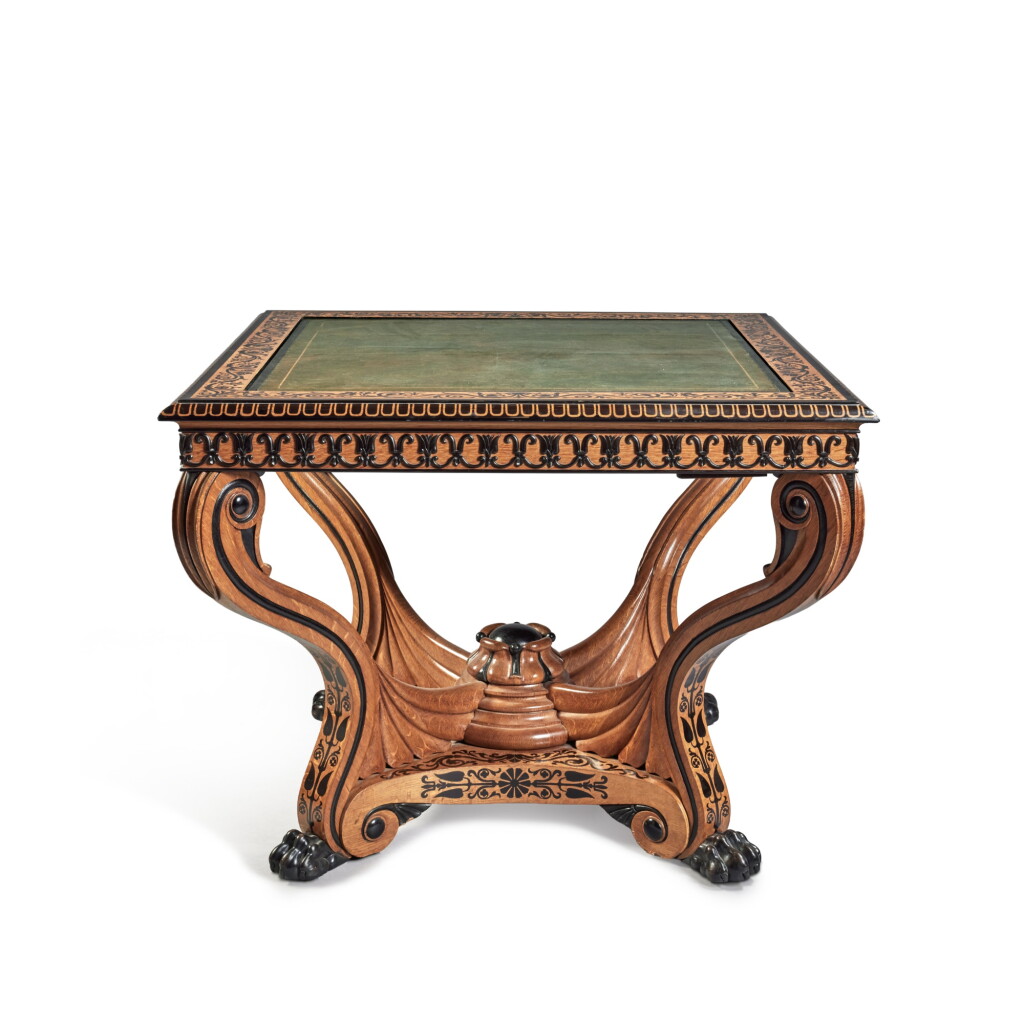
A Regency Oak, Ebony Inlaid and Ebonised Games and Centre Table attributed to George Bullock, Circa 1815
No reserve
Auction Closed
October 15, 06:30 PM GMT
Estimate
40,000 - 60,000 USD
Lot Details
Description
the central square section with a hinged inlaid chess board top opening to an inlaid backgammon compartment and rotating one hundred eighty degrees to a green leather lined playing surface; the frieze with applied ebony carving on all sides with a pivoting key-holder affixed underneath one side rail; on four moulded incurved legs joined by a concave quadrilateral stretcher raised on paw feet with recessed castors
height 29 1/2 in.; width 38 in. square
75 cm; 96.5 cm
Christie's London, 9 June 2005, lot 239;
Christie's New York, 23 October 2018, lot 270.
Games tables incorporating boards for chess and backgammon were highly popular by the early nineteenth century, sometimes combined with containers to hold the tools and fabric for ladies’ embroidery (a ‘work table’). However, they were typically smaller in size: most of the time, the tops were not much larger than the chessboard at the centre, or the board would sit in the middle of a narrow rectangular ‘sofa table’. This reflected the contingent nature of these utilitarian pieces of furniture, which would usually be moved into prominence when the mood for each domestic pastime struck. The present games table, though, takes a radically different approach: the table is centred within a generous, richly ornamented border, and sits on a grand base of showpiece quality. While the chess and backgammon boards of its top can also be replaced by a plain surface, this design and level of ornament remain unusual for the games tables of the period and was possibly intended for a patron who was not only wealthy enough to buy luxurious furniture, but was particularly keen on board games.
There are a couple of other instances of this particular model appearing on the market, with one example appearing at Bonhams London, 16 July 2008, lot 88 and another at Christie’s South Kensington, 9 October 2012, lot 255. These examples differ from the present lot only in the lack of a mounted frieze, and without detailed provenance there remains the possibility that they are actually the same table, further emphasising the rarity of this model. The use of dark ebony inlay in a paler wood is typical of George Bullock (c.1782–1818), who is perhaps best known for furnishing the house in which Napoleon resided during his St Helena exile. Many of Bullock’s designs survive through posthumous copies known as the ‘Wilkinson Tracings’, including one that clearly shows a design for a games table with chessboard-form top (1974M3.31). Elements of the decoration are also echoed in other examples of his work, such as the mounted frieze, which can be see on a pair of cabinets at Blair Atholl (see C. Wainwright, George Bullock: Cabinet-Maker, London 1988, p.68). Beyond the works attributed to Bullock, two other George IV games tables that have richly carved stands and centre table proportions sold Christie’s London, 21 April 1994, lot 256 and Christie’s London, 2 May 2002, lot 92.
You May Also Like