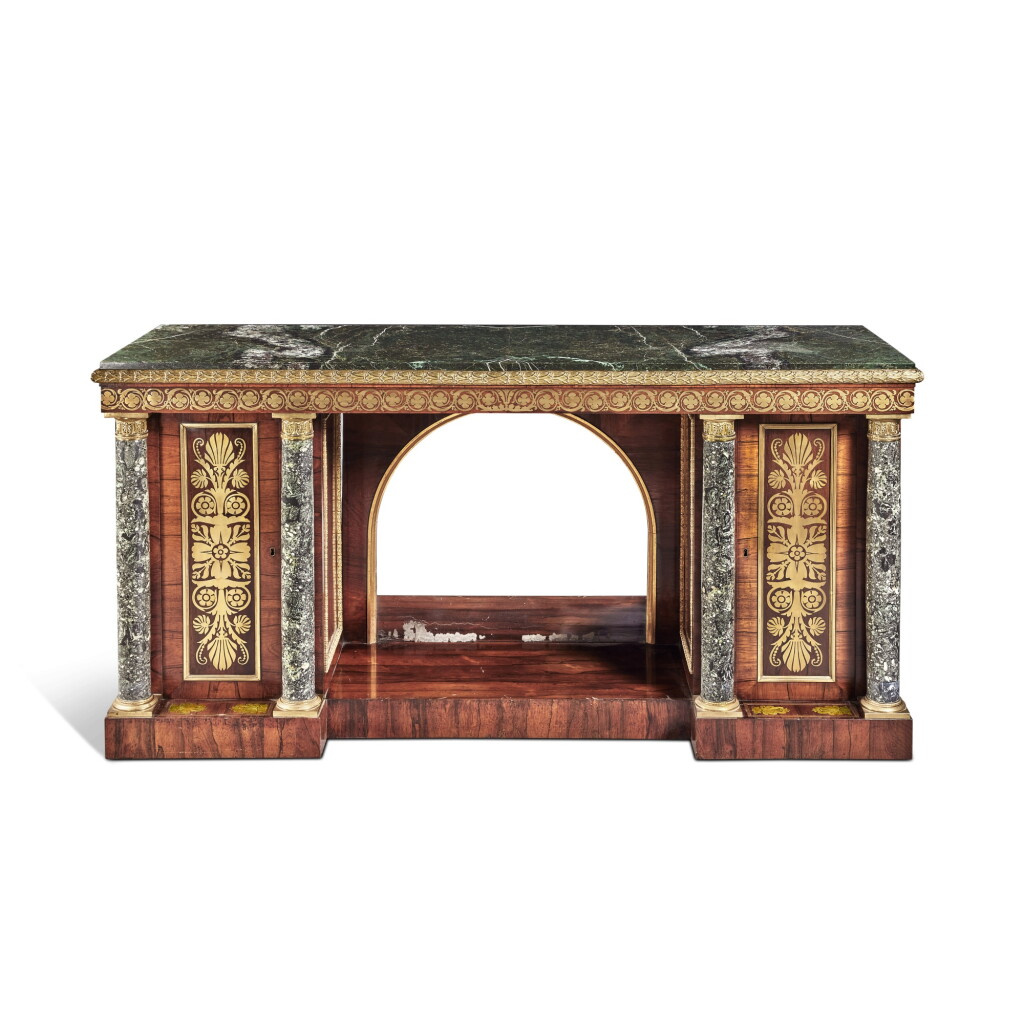
A Regency Gilt-Bronze Mounted and Brass Inlaid Rosewood Side Cabinet attributed to George Bullock, Circa 1815
No reserve
Auction Closed
October 15, 06:30 PM GMT
Estimate
30,000 - 50,000 USD
Lot Details
Description
with a Mona marble top; the central recessed section with mirrored back and flanked by two cupboards each behind a pair of detached scagliola columns
height width 72 in. depth 22 1/2 in.
183 cm; 57 cm
By repute, The Dukes of Marlborough, Blenheim Palace, Oxfordshire;
Wateringbury Place, Maidstone, Kent, The Property of David Style, Esq., Part II, Christie's, 1-2 June 1978, lot 527;
Sotheby’s London, 19 November 1993, lot 141;
Property from the Collections of Lily and Edmond J. Safra, Sotheby's New York, 3-4 November 2005, lot 177;
Sotheby's New York, 18 October 2016, lot 152.
Helena Hayward, World Furniture, London 1965, p.206, fig.768
Clive Wainwright, George Bullock Cabinet Maker, 1988, pp. 69-71, note 13
After a wave of new research led by Martin Levy in the 1990s drew fresh attention to the work of George Bullock (c.1777–1818), his name has become an important point of reference for historians of Regency taste and fine furniture. Fortunately, a large corpus of designs and drawings by Bullock survive, allowing new research to contribute newly attributed pieces to his identified oeuvre. This is the case for the present side cabinet, which cataloguers have long linked to the luxurious and polychrome taste typical of Bullock, but which we are now in a position to more concretely attribute to him on account of the close match with not one but two surviving drawings. One of these drawings (1974M3.96) clearly shows a side table on an inverted breakfront plinth, with two columns to each side, a double frieze of rinceaux and laurels, and even an arch that is annotated GLASS to denote a mirrored backing – all of these match the present lot. The patterns of the metalwork inlay also correspond, with another drawing (1974M3.124) showing a careful close-up study of the exact motif found on the vertical panels of the present cabinet. The cabinet in Bullock’s design has a chiffonier-style superstructure that is absent from the present lot, but this may well have been a decision on Bullock’s part – a very similar Bullock cabinet from collection of Helena Hayward also does not have one.1 Since the superstructure in the design clearly matches the pier mirror that is shown in the drawing, its inclusion could have been intended to indicate the decorative harmony between furniture elements within a wider room scheme. Another comparable Bullock cabinet is at the Fitzwilliam Museum (M.16-1980).
During his career, Bullock provided furnishings for several royal and aristocratic clients, including Queen Charlotte, the Duke of Buccleuch, the Duke of Atholl and Lord Cholmondeley. His most famous client, however, was neither royal nor aristocratic, and had ceased even to be imperial after abdicating in 1815: Bullock was the furniture maker given the politically complicated task of furnishing Longwood House, Napoleon’s residence on St Helena. Over the course of Bullock’s career, he had several artistic and commercial ventures with varying rates of success, and after his death the painter Benjamin Robert Haydon wrote in his diary that Bullock was “one of those extraordinary beings who receive great good fortune & are never benefitted by it, & suffer great evils, and are never ruined, always afloat but never in harbour, always energetic”.2 Indeed, it is actually in his capacity as a sculptor that his likeness has been passed down to us, in the form of a painting by Joseph Allen now held at the Walker Art Gallery in Liverpool (WAG 8532).
1 C. Musgrave, ‘England 1800-1830’, in World Furniture, H. Hayward (ed), London 1965, p.206, fig. 768.
2 W. Pope (ed.), The Diary of Benjamin Robert Haydon, Cambridge MA 1960, vol II, p. 209.
You May Also Like