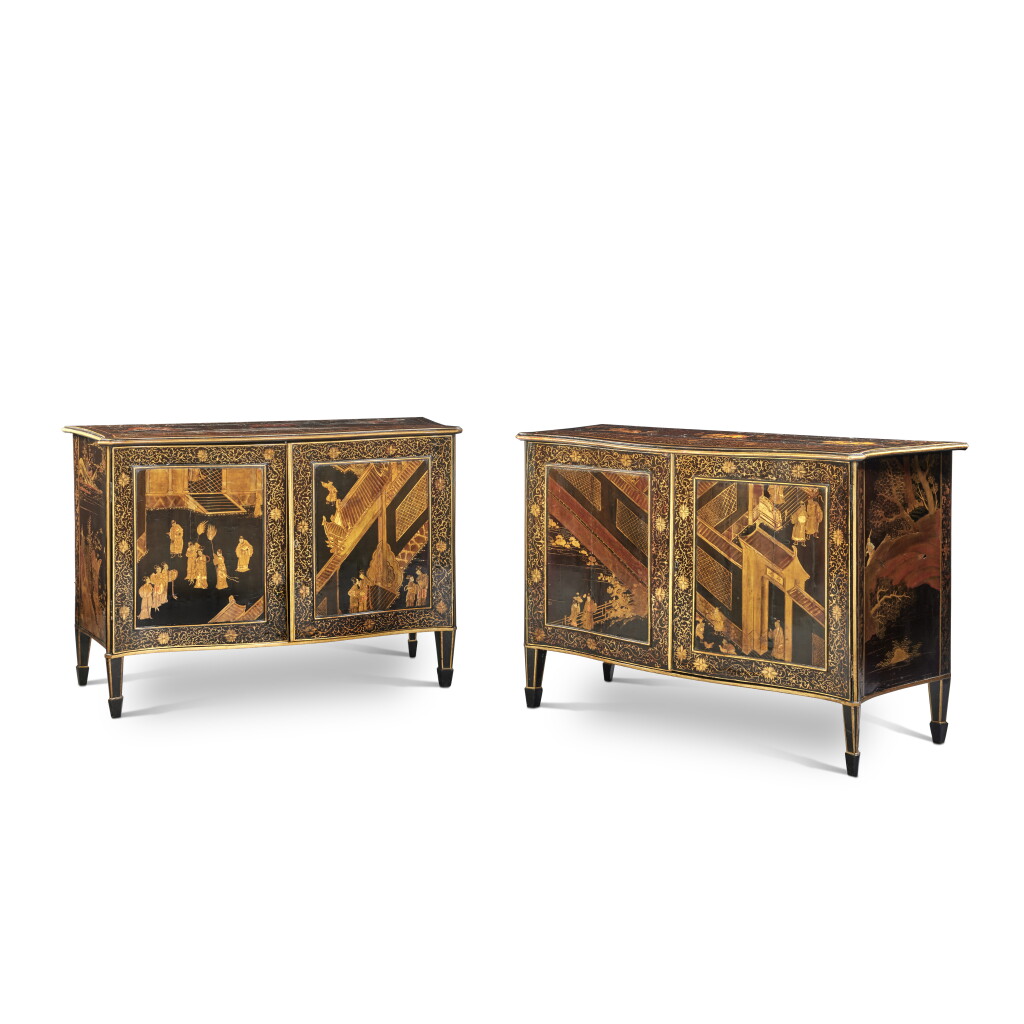
A Pair of George III Chinese Lacquer and Black and Gold Japanned Commodes, Circa 1780
No reserve
Auction Closed
October 15, 06:30 PM GMT
Estimate
50,000 - 80,000 USD
Lot Details
Description
of serpentine form; decorated overall in Chinese lacquer and japanned panels depicting palace and hunting scenes, men on horseback, aquatic landscapes and fantastic beasts on the tops within scrolling prunus and foliate borders; the cupboard doors opening to a tier of three drawers with ring pulls in one commode and two linen slides in the other, the drawers and slides all lined in pale blue paper; on square tapering legs with spade feet; the locks and hinges replaced; hinges on one stamped HORNE PATENT; one with two manuscript paper labels underneath inscribed 43391 and 43391 x 2
height 37 in.; width 55 1/4 in.; depth 24 1/2 in.
94 cm; 140.5 cm; 62 cm
Ann and Gordon Getty Collection, Wheatland, California, supplied by Parish-Hadley, New York, 1974;
Christie's New York, 19 October 2023, lot 75.
Lacquer, which is essentially the art of applying many layers of a varnish that includes the sap of the lacquer tree (toxicodendron vernicifluum), existed in many decorative variations across China and Japan, and was highly admired and coveted in eighteenth-century Europe. Throughout the eighteenth century, European artisans became more sophisticated in the art of mimicking the effects of East Asian lacquer in paint and varnish, known as ‘japanning’, but panels of the original material were also incorporated into pieces of furniture manufactured in Europe. While some pieces of lacquer furniture would be brought intact from China or Japan, such as chests or cabinets, these were bulky to transport in ships and therefore highly expensive, whereas lacquer panels could be repurposed from other piece of furniture (usually folding screens) and could be incorporated into art furniture that aligned with current European tastes. As with the mounted porcelains of the same era, the most successful examples of this technique marry together different decorative traditions to create spectacular and creative results.
This practice of using lacquer panels in furniture was first seen in France, and came to England through émigré craftsmen such as Pierre Langlois (1718-1767). One of the most important examples of English furniture incorporating lacquer panels in this way is a suite of furniture that Chippendale created for Harewood House – for this suite, the 12 November 1773 bill to Edwin Lascelles informs us that this prestigious commode was made “with your own Japann”1 and that the lacquer was not supplied by Chippendale, a demonstration of the aesthetic and financial importance that the material carried. Other important examples attributed to Langlois with provenance linked to major country houses include one from Clumber Park (sold Christie’s London, 29 March 1984, lot 84), Strawberry Hill (now in the Legion of Honor Museum, San Francisco 1985.58a-b), and pairs from Ashburnham Place,2 Uppark (NT 137649.2) and Powis Castle (NT 1181049). Another Chippendale commode very close in design to the Harewood example sold at Sotheby’s London, 14 May 1993, lot 150 for £194,000, setting a world record for an English lacquer commode.
1 C. Gilbert, The Life and Work of Thomas Chippendale, London, 1978, vol I p.197 and vol II p.122, fig.215.
2 Recently with Ronald Phillips, see Fine Antique English Furniture, 2019, pp. 20-25. Available at: <https://issuu.com/artsolution/docs/rf_antique_webbooklarge-optimised/23> [accessed 11 August 2025]
You May Also Like