
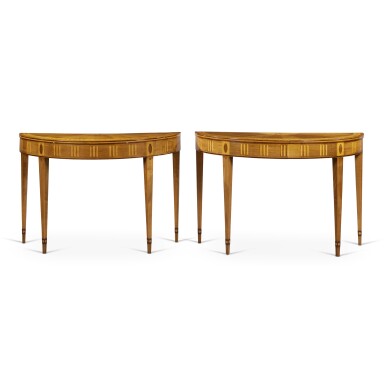
A Near Pair of Irish George III Harewood, Satinwood, Sycamore, Tulipwood, Amaranth and Marquetry Demilune Side Tables attributed to William Moore of Dublin, Circa 1785
No reserve
Auction Closed
October 15, 06:30 PM GMT
Estimate
30,000 - 50,000 USD
Lot Details
Description
the tops inlaid with a fan motif and rosette border; the frieze inlaid with simulated triglyphs and oval burr yew reserves above husk-inlaid square tapering legs; one table slightly larger
the larger: height 32 in; width 49 in.; depth 20 1/8 in.
81.5 cm; 124.5 cm; 51 cm
the smaller: height 31 3/4 in.; width 47 1/4 in.; 19 1/2 in.
80.5 cm; 120 cm; 49.5 cm
Northeast Auctions, New Hampshire, 2-3 November 2002, lot 889
These demi-lune tables are a typical example of English and Irish Neoclassical pier tables, which are designed to be placed underneath a mirror on the section of wall between two long windows. The clean and geometric semicircular or ‘demi-lune’ outline allowed a pair to be placed back-to-back and create a round table or for the reflection in the wall mirror to create the illusion of this. On the friezes of the tables, the clusters of three inlaid vertical notches are a direct quotation from the triglyphs of classical architecture: on the friezes of buildings in the Doric order, these triglyphs will tend to alternate with spaces called metopes that are often decorated as on the celebrated Parthenon with splendid carved reliefs. The fan motif centring the tops is also a signature of the so-called Adam style, and they are a common sight on the dazzling plasterwork ceilings so characteristic of Robert Adam’s work.
William Moore of Dublin (1768-1814) was one of the finest practitioners of Neoclassical marquetry, perhaps unsurprising given that he trained under the celebrated London masters of the style John Mayhew and William Ince. A richly inlaid commode made for the 3rd Duke of Portland bears a label for William Moore, allowing furniture historians to venture attributions to Moore for similar pieces such as those in the Victoria & Albert Museum (W.56:1 to 3-1925) and the Cooper Hewitt Musem, New York (1967-87-1-a,b). The marquetry decoration on the present pair appears to be identical to that on a table attributed to Moore in the National Museum of Ireland (illustrated in Rosemary Luddy, 'Every Article in the Inlaid Way: the Furniture of William Moore', Irish Arts Review 2002, vol.18, p.48 fig.7). A commode attributed to Moore recently sold at Sotheby’s New York, 17 October 2023, lot 121 also featured the same combination of triglyphs, ovals surmounting the legs and fan-centred top as on the present tables.
You May Also Like


