Exquisite Corpus: Surrealist Treasures from a Private Collection
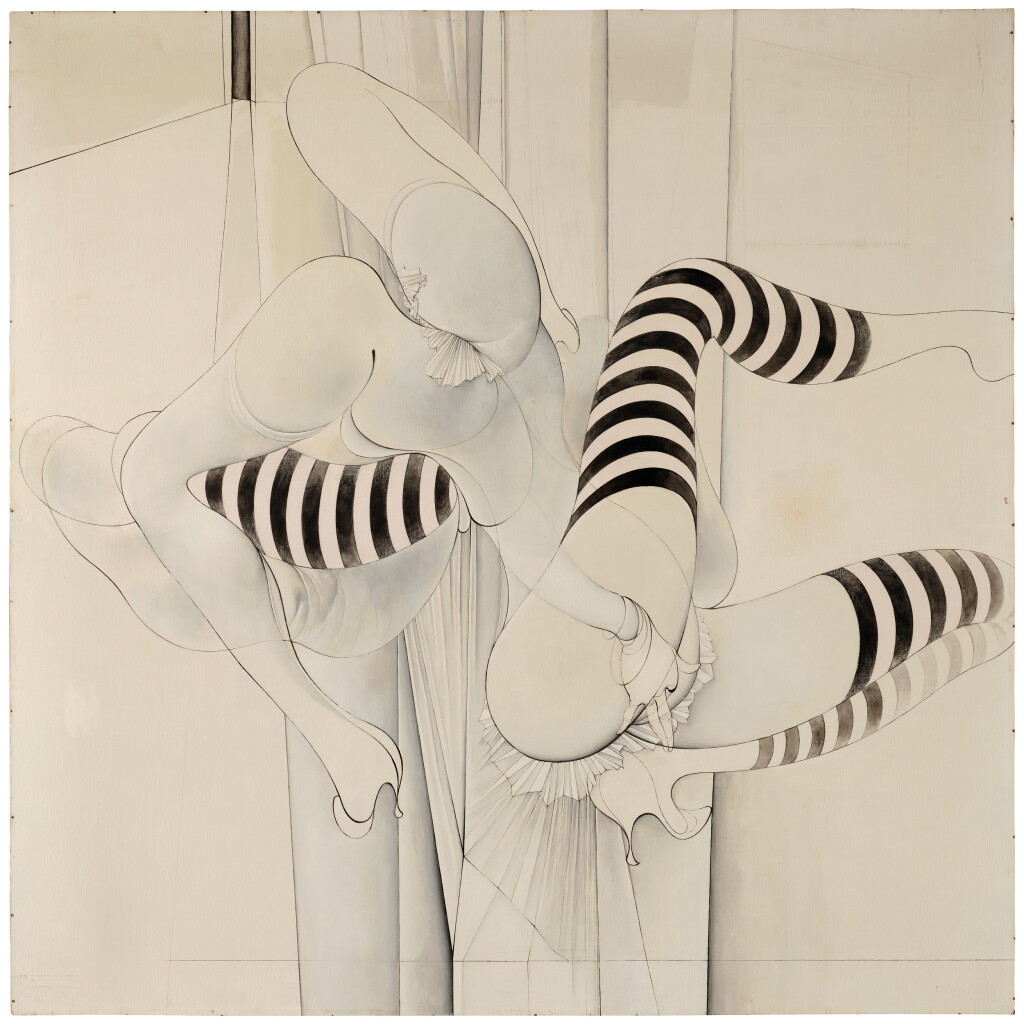
Les Bas rayés
Auction Closed
November 21, 12:43 AM GMT
Estimate
300,000 - 400,000 USD
Lot Details
Description
Hans Bellmer
(1902 - 1975)
Les Bas rayés
oil on panel
39 ⅜ by 39 ⅜ in. 100 by 100 cm.
Executed in 1959.
Madame Rodica Aldoux has confirmed the authenticity of this work.
Daniel Cordier, Paris (acquired by 1971)
Galerie Brockstedt, Hamburg
Acquired from the above in 1975 by the present owner
Paris, Centre national d'art contemporain, Hans Bellmer, 1971-72, no. 111 (not listed in the catalogue)
London, Hayward Gallery, Dada and Surrealism Reviewed, 1978, no. 17.3, p. 437, illustrated
New York, Solomon R. Guggenheim Museum, Surrealism: Two Private Eyes, 1999, vol. I, no. 15, p. 63, illustrated in color
Jacques Baron, Anthologie plastique du surréalisme, Paris, 1980, p. 30, illustrated in color (dated 1959)
Obliques, special edition, 1976, p. 265, illustrated in color
Peter Webb and Robert Short, Hans Bellmer, London, 1985, pl. xxxi, illustrated in color; p. 287
Peter Webb and Robert Short, Death, Desire and the Doll: The Life and Art of Hans Bellmer, Paris, 2006, no. 25, n.p., illustrated in color; no. 244, p. 161, illustrated; pp. 162 and 196 (dated circa 1959)
“The starting-point of desire, with respect to the intensity of its images, is not in a perceptible whole but in the detail,” Bellmer wrote. “The essential point to retain from the monstrous dictionary of analogies/antagonisms which constitute the dictionary of the image is that a given detail such as a leg is perceptible, accessible to memory and available, in short is real” (Hans Bellmer, L'Anatomie de l'image, Paris, 1957, p. 38). Depicting several pairs of legs adorned with striped stockings and stiletto shoes, Les Bas rayés distills Bellmer’s ideas of female sexuality into fragmented and intensely charged bodily forms.
A work of exquisite draftsmanship and potent eroticism, Les Bas rayés is exceptionally rare within Hans Bellmer’s oeuvre for its grand scale and painted medium. The German artist would return to the same subjects throughout his career, reinventing his dolls and stockinged figures across disciplines. Primarily drawn to photography, drawing and engraving, Bellmer completed comparatively few oil paintings during his career, with Les Bas rayés among the finest of its kind.
The present work reflects the links between Bellmer’s art and the writings of the philosopher Georges Bataille, whose work in turn was influenced by the Marquis de Sade, and occasionally banned for its explicit nature. Later recognized as a key proponent of “transgressive fiction,” Bataille exerted significant influence on critical and psychoanalytical theories, yet had a complex relationship with Surrealism, describing himself as its “old enemy from within,” and often clashing with André Breton. Eventually excommunicated from Breton’s circle, Bataille and a group of Surrealist artists and thinkers gathered around the magazine Documents, which they published in 1929-30.
Bataille sought to denounce Breton’s ideology centered around dreams and the subconscious, concentrating his own aesthetic philosophy on “base materialism,” which focuses on direct physical experiences. The cornerstones of his ideology were the notions of violence, sacrifice, seduction and mutilation, and his theories were shaped by dualisms: beauty and cruelty, ecstasy and horror. Whilst Breton-centric Surrealists sought to shed light on the unconscious mind and pursue l’amour fou as a positive force, in Bataille’s worldview, negative forces and the dualism between life and death took center stage. Bellmer later wrote: “I agree with Georges Bataille that eroticism relates to a knowledge of evil and the inevitability of death[;] it is not simply an expression of joyful passion” (Hans Bellmer quoted in Peter Webb, The Erotic Arts, London, 1975, p. 369).
Much of Bellmer’s art, including Les Bas rayés, can be seen as a visual depiction of Bataille’s philosophy. The two men collaborated on the 1940 edition of Histoire de l’œil, a highly transgressive novella written by Bataille in 1928 and illustrated by Bellmer.
“In all of Bellmer's work, the repetition and scrambling of body parts is intended to show how the obsessive nature of desire transforms perception of the beloved's body, endlessly replicating it for its own pleasure” (Michael Duncan, “Hans Bellmer,” Frieze, London, June 5, 1993). Bellmer’s first, and arguably most unsettling, “scrambling of body parts” appears in his famous doll sculptures created in the 1930s, which also served as the subject for a series of photographs featuring a variety of suggestively-posed dolls in both indoor and outdoor settings. He first introduced the motif of striped stockings and interwoven legs in his Céphalopode series of the late 1930s, a reference to marine creatures distinguished by their bilateral symmetry
A year before he completed Les Bas rayés, Bellmer created a series of photographs in which his earlier dolls were substituted with an actual female body. The subject was Unica Zürn, a fellow German artist who became Bellmer’s partner and model. In their collaborative project of 1958, Bellmer photographed Unica’s body tightly tied up in string, taking the notion of fetishized body parts to a new level. These photographs would serve as a point of departure for many compositions to follow, including the present painting. As Peter Webb and Robert Short observed: “Clearly he was fascinated by the transformations that Unica’s body underwent. Many drawings resulted from the series [...]; a section of [a photograph] became part of ‘Les Bas Rayés’ (The Striped Stockings) of c. 1959, one of the most successful of Bellmer’s painted images, in which two headless cephalopods play their sexual games [...]. The bold patterns of their striped stockings form an effective contrast to the glimpses of delicate pleated underclothes which accentuate their genitals” (Peter Webb and Robert Short, Death, Desire and the Doll: The Life and Art of Hans Bellmer, 2006, p. 162).
Les Bas rayés extends Bellmer’s exploration of the fetishized body, presenting a corpus composed of multiple pairs of legs, combined in such a way that the viewer is left wondering whether they belong to a single figure or to several metamorphosed ones. “The fact that the Marquis de Sade and Georges Bataille both had a great influence on Bellmer’s entire corpus is a testament to the contradictory forces of desire and lust as well as shame and aversion” (Jeremy Bell, “Uncanny Erotics—On Hans Bellmer’s Souvenirs of the Doll,” Feral Feminisms, issue 2, summer 2014, p. 72).
Bellmer’s deconstructed sexualized figures have much in common with the work of other artists in Bataille’s circle, including Marcel Duchamp and Alberto Giacometti, who similarly conveyed the close relationship between passion and violence, often testing the boundaries between desire and destruction. This trajectory continues in contemporary art, where it finds new and often shocking expressions in the work of artists such as Robert Gober, Sarah Lucas and Jake and Dinos Chapman.
You May Also Like