Exquisite Corpus: Surrealist Treasures from a Private Collection
Le Symbole dissimulé
Auction Closed
November 21, 12:43 AM GMT
Estimate
1,200,000 - 1,800,000 USD
Lot Details
Description
René Magritte
(1898 - 1967)
Le Symbole dissimulé
signed Magritte (lower left); titled (on the reverse)
oil on canvas
21 ⅜ by 28 ¾ in. 54.3 by 73 cm.
Executed in 1928.
Georges Vriamont, Brussels (acquired by 1931 and until 1961)
Galerie André Petit, Paris
Acquired by 1968 by the present owner
Brussels, Palais des Beaux-Arts, Guiette, Magritte, Picard, 1931, no. 33
Brussels, Palais des Beaux-Arts, Le Nu dans l’art vivant, 1934, no. 49, p. 24
New York, Byron Gallery, René Magritte, 1968, no. 3, p. 11, illustrated
New York, Solomon R. Guggenheim Museum, Surrealism: Two Private Eyes, 1999, vol. I, no. 127, p. 191, illustrated in color
Brussels, Palais des Beaux-Arts and Paris, Centre Pompidou, Rétrospective Magritte, 1978-79, no. 80, n.p., illustrated
Southampton, The Parrish Art Museum, René Magritte: Poetic Images, 1979, no. 5, n.p., illustrated
Montreal Museum of Fine Arts, Magritte, 1996
Vienna, Kunstforum and Basel, Fondation Beyeler, René Magritte: The Key to Dreams, 2005, no. 32, p. 89, illustrated in color
Robert Desnos, “Les mystères du métropolitain,” Variétés, vol. II, no.12, 15 April 1930, p. 837, illustrated
Sarane Alexandrian, Dictionnaire de la peinture surréaliste, Paris, 1973, p. 37, illustrated in color
Jacques Baron, Anthologie plastique du surréalisme, Paris, 1980, p. 166, illustrated in color (dated 1929)
Exh. Cat., New York, The Museum of Modern Art, Henri Cartier-Bresson, The Early Work, 1987-89, p. 36, illustrated
David Sylvester, Magritte: The Silence of the World, New York, 1992, p. 146, illustrated in color
David Sylvester and Sarah Whitfield, René Magritte, Catalogue Raisonné, vol. I, London, 1992, no. 282, p. 85, illustrated in a photograph of the artist’s apartment; p. 316, illustrated; p. 317
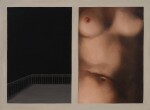
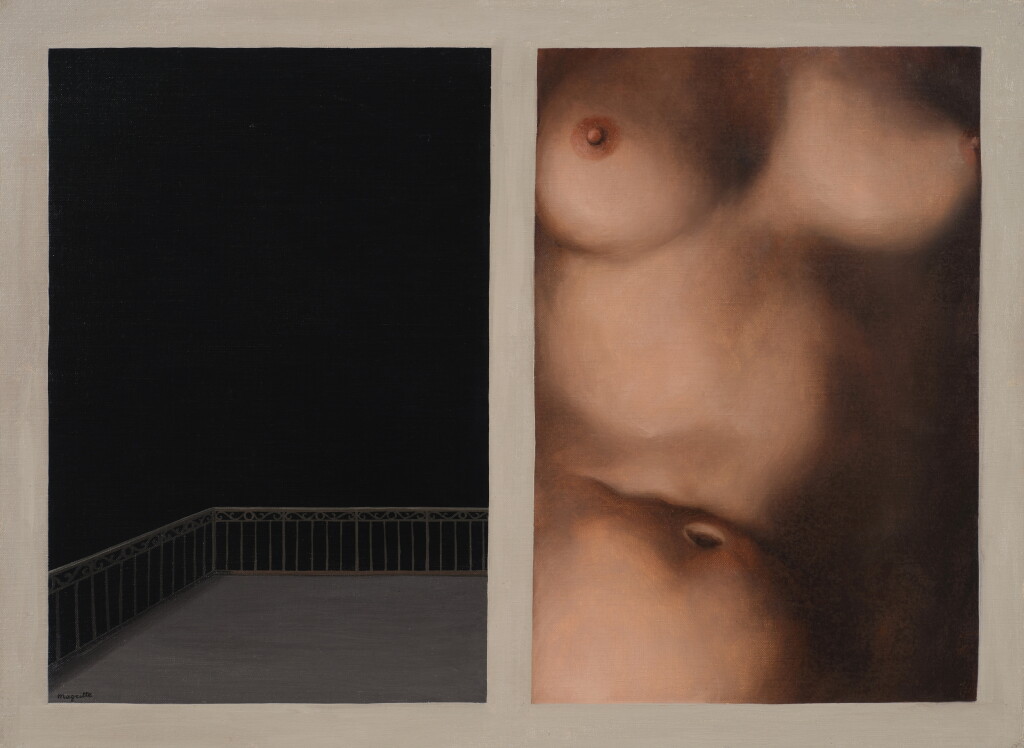
A paragon of René Magritte’s early Surrealist oeuvre, Le Symbole dissimulé powerfully declares a key pictorial and thematic device that would come to define his canon. Here, the tactic of doubling marks one of Magritte’s earliest means of expression as he found his voice within the Surrealist idiom. Central to his aim of drawing mystery from the everyday, this pairing offers no resolution beyond the images themselves—leaving viewers to confront their own response to the uncanny associations that emerge in their combination.
Lacking explicit context, the composition invites viewers to approach its imagery with a measured objectivity. Magritte’s quasi-diptych format allows the two images to be read either simultaneously or in sequence: as a dual portrait—two sides of the same image—or as a pairing marked by irreconcilable discontinuity. The balcony, rendered in conventional diminishing perspective, recedes into the painted surface, its depth intensified by the vast, unbounded night beyond. The woman’s body, by contrast, appears in shallow relief, her form filling the frame. The tight cropping and hyperreal shading make her figure—particularly her torso—seem to project outward from the surface.
Around the same time, Magritte executed a second canvas, Le Palais d'une courtisane, in which he presents the same close-cropped torso but this time set within a conventional frame, hung on a wall within a shallow, wood-paneled interior. Once placed within a setting which the viewer can read and relate to with respect to their own body, there become manifold readings of the image. Magritte suggests the possibility that the frame does not surround a painting hanging on the wall, but rather a window through it, behind which the woman’s body appears to be trapped by and compressed against the glass. The physical impossibility of scale and distance does not diminish the visceral impact of the idea. There also arises the possibility that the frame contains a mirror, and the body depicted is not in fact a painted representation but a reflection.
This complication within Le Symbole dissimulé is heightened by the ambiguity of the framing device itself. At first glance, the white border bears a striking similarity to the stretcher bar of a canvas, positing the two scenes as though painted on the reverse of a canvas. The distinctly flat, unmodulated handling, however, creates the suggestion that the frame is placed on top of the composition and in turn bifurcates the image into two.
The idea would resurface in the 1930s, where, as in L'Évidence éternelle, the frame was employed as a vehicle for a different type of deconstruction. In these later works, Magritte created a single image as the composite of separate canvases, each of which were individually framed in gilded wood and affixed with small gaps between them such that should those gaps be filled in, everything would be in its proper place. The transition which this new format introduced was what David Sylvester terms the “picture-object,” a key tenet of which is the distinction within painting between an image and the thing which it represents. The key distinction between Le Symbole dissimule and L'Évidence éternelle is Magritte’s insistence in the latter that the act of fragmentation is done to an image of a female body, not to the female body itself. As Sylvester writes, “The eternally obvious, with its cropped and framed fragments of a body isolated from any natural setting and laid out on a plane given a severely geometric shape, is a further and still more extreme affirmation of art’s artificiality” (David Sylvester, Magritte: The Silence of the World, New York 1992, p. 196).
The fragmentation of the female body was a recurring Surrealist device, its close cropping rendering the familiar strange and seemingly objective. In Le Symbole dissimulé, this effect is heightened by the contrast between the woman’s magnified torso and the expansive nightscape beside it. Beyond the overt psychological impact of their pairing, and the lack of explicit narrative between them, Magritte’s approach to the imagery in Le Symbole dissimule can likewise be read as a striking, poetic evocation of the artist’s own personal mythology.
One cannot help but draw allusions to the story of the death of his mother, Regina. Though Magritte, who was just twelve at the time that the traumatic event took place, scarcely ever spoke about her suicide in his adult life, the haunting imagery reverberates with varying degree throughout his paintings. Seventeen days after she went missing, her body was recovered from the Sambre river which ran through Hainaut, the province in Belgium where Magritte grew up. When she was discovered, the currents had drawn up her nightgown, covering her face and leaving her body exposed. “The veiling of the face by the nightdress is an inspired mixture of the complacently romantic and the shockingly erotic,” writes David Sylvester in his observation of the psychological impact of the event on Magritte’s painting. “The poignant idea of the woman whose delicate sensibility prevents her from facing up to her chosen death; the frisson, at once Oedipal and necrophilic, of a pubescent boy’s glimpse of his dead mother’s torso laid bare” (ibid., p. 12).
Despite the deeply personal mythology of the pairing, Magritte may have intended only the mystery born of their proximity. One might draw parallels between the female form as void and the night sky as fertile and unknown, yet thematically the composition evokes a broader dialectic of absence and presence, interiority and exteriority, concealment and disclosure. Above all, its ambiguity reveals Magritte’s ultimate aim: to expose the image’s power to blur the line between seeing and perceiving.
You May Also Like