
Property from an Important New York Collection
Tiffany Studios
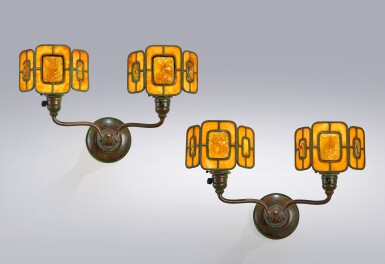
Pair of Two-Light "Turtle-Back Tile" Sconces
Auction Closed
December 11, 04:33 PM GMT
Estimate
12,000 - 18,000 USD
Lot Details
Description
Property from an Important New York Collection
Tiffany Studios
Pair of Two-Light "Turtle-Back Tile" Sconces
circa 1905
leaded Favrile glass, patinated bronze
each shade with small early tag impressed TIFFANY STUDIOS/NEW YORK
14 x 20 ¾ x 7 ¾ in. (35.6 x 52.7 x 19.7 cm), each
Geoffrey Diner Gallery, Washington, D.C.
Acquired from the above by the present owner, 2007
Alastair Duncan, Tiffany: Lamps and Metalware, Woodbridge, Suffolk, 2019, p. 386, no. 1568 (for a related example)
Louis Tiffany and his various companies were in the forefront of creating artistic lighting fixtures for American homes. He and his designers were particularly adept as the nation quickly converted from kerosene to natural gas and finally to electricity to light its lamps. The company was also quick to advertise the superiority of their product: “Fixtures fitted with Tiffany shades have a value that is enhanced by the fact that they are beautiful by day, as well as by night, an important consideration when a selection is made.”
That is certainly the case with the pair of wall sconces offered here. Likely originally configured for gas, they were easily redesigned by the company for electricity. The mottled opalescent yellow glass is equally attractive in both reflected and refracted light, just as Tiffany Studios publicized. What adds immeasurably to the fixtures’ appearance are the central rectangular sections set into each of the panels. This feature in the model was normally fashioned with opalescent white turtle-back tiles having a light gold exterior iridescence. While interesting and attractive, these tiles have the quality of slightly dimming the light radiating from the fixture. In this instance, however, thick, hand-chiseled pieces of transparent yellow glass were utilized, creating a brilliancy and radiance that is rarely seen in similar sconces.
– PAUL DOROS