Property from a Prominent New York Collection
Tiffany Studios
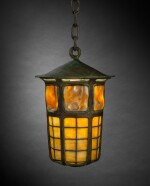
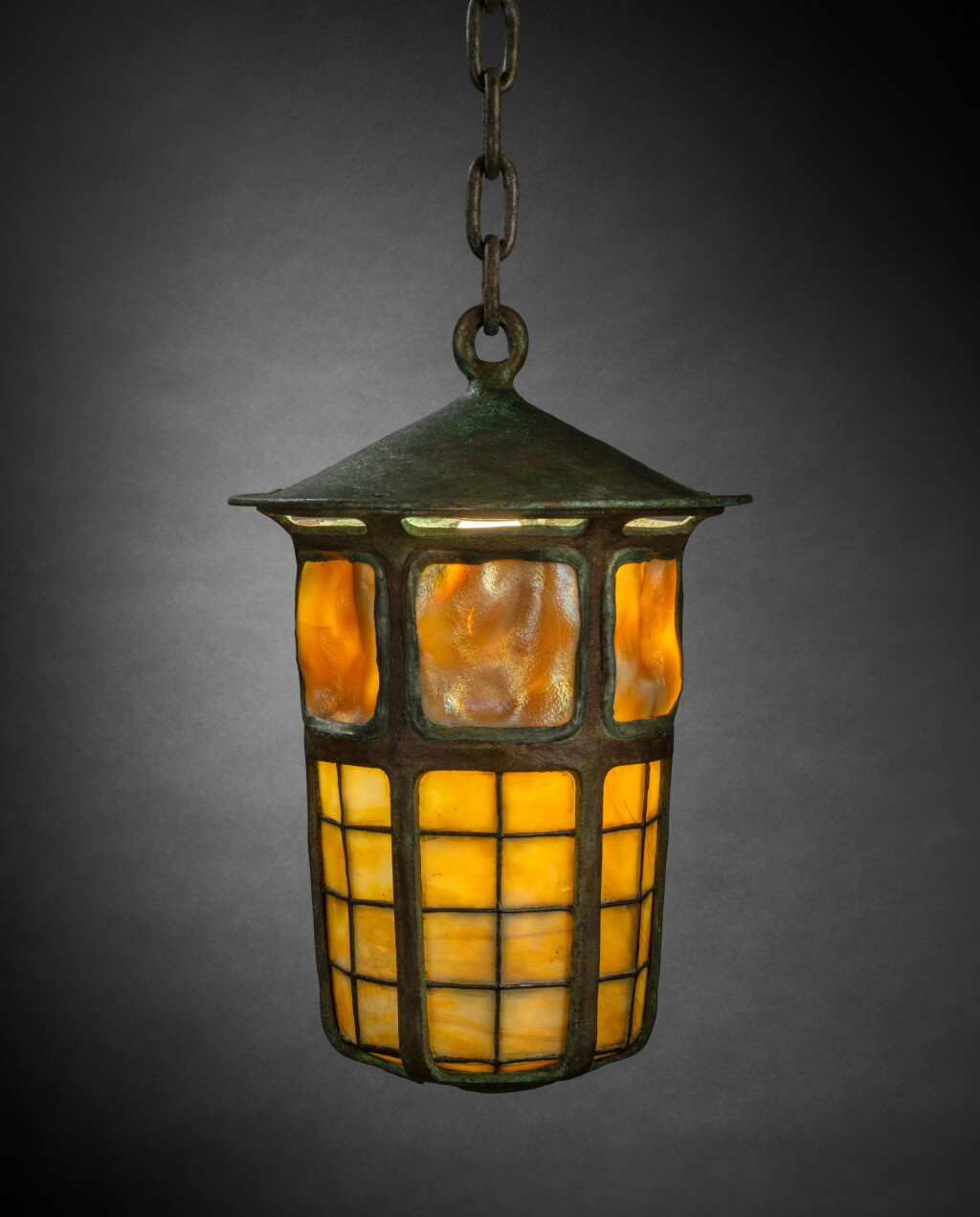
“Geometric and Turtle-Back Tile” Lantern
Auction Closed
December 11, 04:33 PM GMT
Estimate
30,000 - 50,000 USD
Lot Details
Description
Property from a Prominent New York Collection
Tiffany Studios
“Geometric and Turtle-Back Tile” Lantern
circa 1910
leaded glass, Favrile glass, patinated bronze
42 in. (106.7 cm) drop
12 in. (30.5 cm) maximum diameter
Private Collection, New Jersey
Thence by descent to the present owner
Alastair Duncan, Tiffany Lamps and Metalware, Woodbridge, Suffolk, 2019, p. 324, no. 1287
Although blown and flat glass comprised the vast majority of the Tiffany Furnaces’ output, the glasshouse also manufactured some molded and pressed glass for a variety of purposes. Three presses of various sizes were utilized and gaffer Jimmy Stewart was responsible for most of the production. The largest press produced “turtle-back tiles,” thick rectangular pieces with rounded corners and iridized undulating top surfaces that were an integral part of many lamp shades.
Molded glass tiles resembling the backs of turtles were among the earliest objects manufactured by the Stourbridge Glass Company, Louis Tiffany’s initial glasshouse in Corona, New York. Their first recorded appearance was as one of the major components of the enormous electrolier, currently in the permanent collection of the Charles Hosmer Morse Museum of American Art (Winter Park, FL), that was featured in the Tiffany Glass and Decorating Company’s Chapel created for the 1893 Columbian Exposition.
Those initial tiles of transparent green glass were quickly supplanted by versions in darker green with a multi-hued iridescence, iridized translucent red, and opalescent white with a gold iridescence. All three colors were made in a variety of sizes and shapes and appeared in a wide range of the company’s products, including leaded glass windows, lighting fixtures, candlesticks, lamp bases, inkstands, lanterns, fern dishes, and paperweights. An early explorer of Tiffany’s original New York City workrooms on Fourth Avenue remarked: “Here choice pieces of blown glass lie around, awaiting attention from Mr. Tiffany or his intelligent aide, among odds and ends of all kinds; the dark-green ‘turtle-backs’ of molded glass that make such delightful hall lamps….”
The chandelier and wall sconce offered here (lots 203 and 204) are superior examples of how turtle-back tiles were seamlessly integrated into the company’s electrical fixtures. In the former, the lower half is leaded with square opalescent pieces of white-streaked yellow glass separated by wide patinated bronze columns. These are surmounted by a band of gold-iridized turtle-back tiles that softly radiate the transmitted light while beautifully shimmering in reflected light. There is also an additional matching turtle-back tile in the circular hinged lower opening. The wall sconce is similar in that it also features an upper band of opalescent white turtle-back tiles with a gold iridescence. There is, however, a special addition: a pair of pendant leaded glass balls comprised of large fragments of turtle-back tiles.
The chandelier and wall sconce have a magnificent presence both in reflected and transmitted light. It is due to examples such as these that led a 1904 critic to exclaim that the “lanterns with heavy opaque panes, the so-called ‘turtleback’ pattern, impress one with the power of production, the beauty of conception, and the skill of the master workmen that have combined to work out such fascinating and magical effects of light and color….”
– PAUL DOROS
You May Also Like