
David Roberts, R.A.
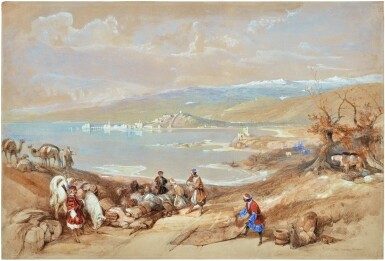
Sidon, looking towards Lebanon
Auction Closed
April 29, 03:51 PM GMT
Estimate
60,000 - 80,000 GBP
Lot Details
Description
David Roberts, R.A.
(Edinburgh 1796 - 1864 London)
Sidon, looking towards Lebanon
Watercolour over pencil, heightened with bodycolour and gum arabic;
inscribed lower right: SIDON. looking towards L [Lebanon]
324 by 480 mm.
Probably Lord Francis Egerton, later 1st Earl of Ellesmere (1800-1857), purchased from the artist,
The Ellesmere Sale, London, Christie's, 2 April 1870, lot 74 (as Sidon: Lebanon in the Distance), bt Colnaghi;
with P. & D. Colnaghi, London;
with Aldridge Brothers, Worthing, by circa 1950;
sale, London, Sotheby's, 12 April 1995, lot 162, bt Agnew's on behalf of the parents of present owners.
Lithographed:
by Louis Haghe for The Holy Land, London 1843, vol. II, pl. 75 & London 1855, vol. II, pl. 75
Oxford, The Ashmolean Museum of Art and Archaeology, on long-term loan, 2015 - 2021
Roberts and his party arrived at Sidon on the 27th of April 1839 after travelling the twenty-five miles or so from Tyre. It was after dark when they approached the gates and - as the town authorities continued to be concerned about the existence of the plague at Jerusalem - they were not given permission to enter that evening. Instead, in the middle of a thunderstorm, they were forced to pitch their tents slightly to the south and Roberts had to wait until the following day to explore.1
Sidon was one of the most celebrated cities of the ancient world, renowned for its ecomonic power and its opulence. Its rulers included Alexander the Great and later the Kings of Egypt and Syria. In the seventeenth century it was ruled by the Emir of the Druses, Fakhr-ed-Din, who built up trade with Venice. The mulberry trees of Sidon provided silk for its main source of commerce. After spending nine years in Florence at the court of the Medici, the Emir returned to Sidon and adorned the city with extravagantly constructed public buildings.
By Roberts’s day little was left of this sophisticated city but he was nevertheless impressed and very pleased to have been able to make drawings there, he wrote in his journal: 'The people seem well dressed, and the town thriving… on the whole I was much pleased with it. The view of Sidon which we saw from a little farmhouse with gardens of olive and mulberry trees, is one of the finest I have seen. The chain of Lebanon, now covered with snow, rises magnificently in the background’.2
The present watercolour was executed after Roberts’s return to England and was lithographed for The Holy Land series. It is one of three watercolours in the sale that are connected to this important and beautiful place (see lots 331-333).
1. J. Ballantine, The Life of David Roberts, London 1866, p. 136
2. MS Eastern Journal, National Library of Scotland, Edinburgh
You May Also Like


