
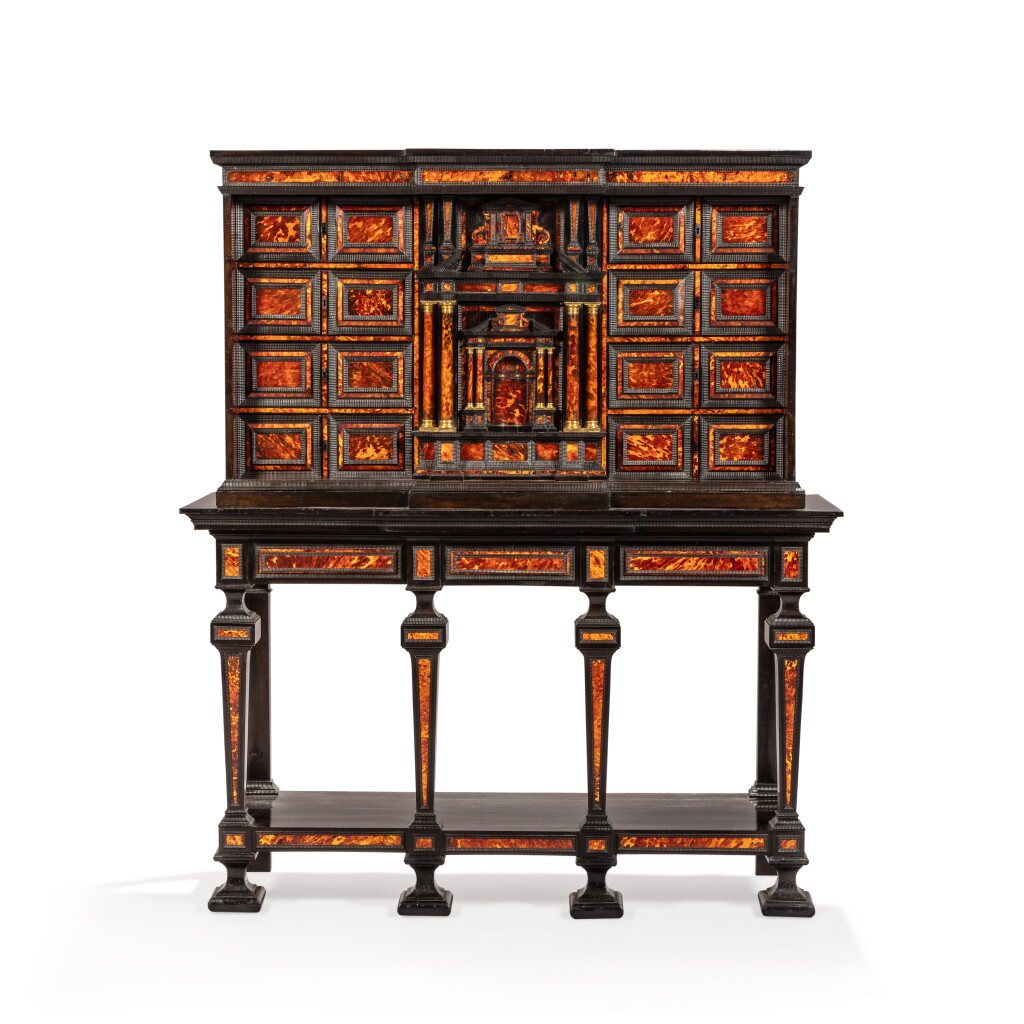
An South Italian gilt-metal mounted tortoiseshell, ebony and ebonized cabinet, probably Naples, late 17th century, with a later stand
Lot Closed
September 23, 01:13 PM GMT
Estimate
7,000 - 10,000 EUR
We may charge or debit your saved payment method subject to the terms set out in our Conditions of Business for Buyers.
Read more.Lot Details
Description
with a breakfront façade opening with eight drawers, the central architectural section framed by small columns, with a broken pediment upper drawer, a lower drawer and a door revealing nine additional drawers ; the later stand with a similar decoration, resting on tapering legs joined by a stretcher
Haut. 192 cm, larg. 154 cm, prof. 54 cm; Height 75 1/2 in, width 64 1/2 in, depth 21 1/4 in
Please note that this lot contains restricted materials. Sotheby's is not able to assist buyers with the shipment of any lots containing restricted materials into the U.S.A. Buyer's inability to export or import these lots cannot justify a delay in payment or a sale's cancellation.
Private collection from a palazzo in Palermo, Sicily;
Christie’s, London, 17 November 2020, lot 576
Related Litterature
M. Riccardi-Cubitt, Un art européen : Le Cabinet de la Renaissance à l’époque moderne, Paris, 1993, p. 61
Coming from a Palermo palace, this cabinet illustrates the Southern Italian appropriation of a model that originated in Central Europe and was widely disseminated during the 17th century. Made of ebony and decorated with red-backed tortoiseshell, it stands out for the balance between the rigor of its composition and the controlled brilliance of its materials.
The façade, organized with an architectural vocabulary typical of the Baroque movement in Europe, arranges panels and pilasters around a central niche shaped like an aedicula. The stand, with its slender colonnettes, echoes this layout with restraint, giving the whole a sense of visual unity.
Both in function and appearance, the cabinet belongs to the tradition of the theatrum mundi, a microcosm intended to store and showcase precious objects. It thus reflects an aristocratic ideal of knowledge and representation.
A structurally similar example, made in Naples around 1630–1640, is mentioned by Monique Riccardi-Cubitt (Un art européen : Le Cabinet de la Renaissance à l’époque moderne, Paris, 1993, p. 61). However, that example differs through the addition of small gilt-bronze figurines on the façade and a much more restrained stand than ours.