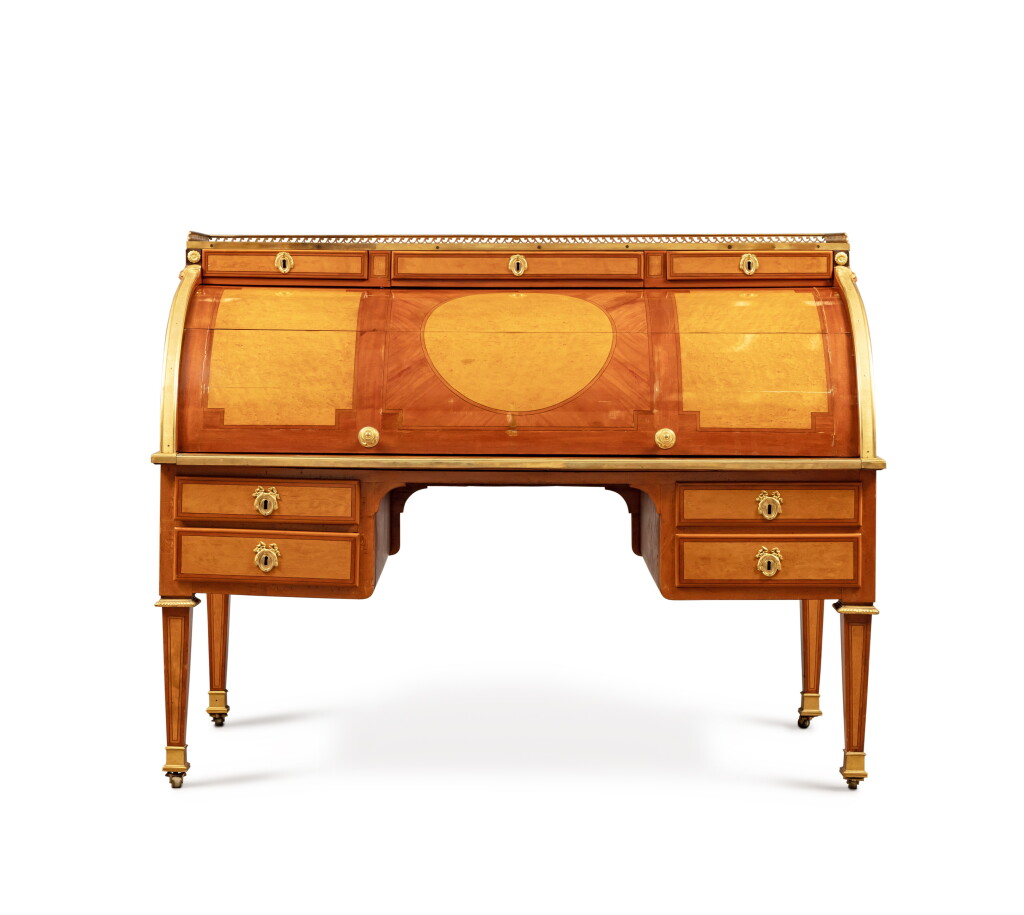
A Louis XVI gilt-bronze mounted maple veneered, bird's eye maple, tinted holly bureau à cylindre, 1779, by Jean-François Hache
Lot Closed
September 23, 01:42 PM GMT
Estimate
20,000 - 30,000 EUR
We may charge or debit your saved payment method subject to the terms set out in our Conditions of Business for Buyers.
Read more.Lot Details
Description
decorated with geometric marquetry, the gallery opening with three drawers, the cylinder enclosing eight drawers and twelve compartments, with a leathered top, a lateral sliding panel with leathered tops, the lower part opening with four drawers, on tapering legs, with castors, bearing a trade label of "Hache à Grenoble" pasted inside a drawer and dated 6 septembre 1779; (significant restorations to the veneer)
Haut. 129 cm, larg. 162,5 cm, prof. 92 cm ; Height 50 3/4 in, width 64 in, depth 36 1/4 in
Bought at the Galerie Didier Aaron in 1985, Paris by the actual owner.
P. et F. Rouge, Le Génie des Hache, Faton, Dijon, 2005, p. 508-509 (illustrated)
Related literature :
M. Clerc, Hache Ebénistes A Grenoble, musée Dauphinois, 1997.
Grenoble. La dynastie des Hache, dans L'estampille. L'objet d'Art, October 1997, pp. 40-57.
R. Fonvieille, La dynastie des Hache, Grenoble, 1974.
The Hache family, renowned cabinetmakers, elevated the art of marquetry to an unprecedented level of sophistication and thrived for several decades during the 18th century.
Their success began with Thomas Hache (1664–1747), who created floral marquetry using a wide variety of woods sourced from the Alpine forests surrounding Grenoble. His grandson, Jean-François Hache, displayed a clear ability to move away from the abundant, flowing Rococo style of the Louis XV period toward the geometric marquetry fashionable under Louis XVI, as exemplified by the present piece. Jean-François Hache’s work in the 1770s marks the final peak of the Hache family's legacy: their last commode was produced in 1783, and Jean-François was imprisoned by the Revolutionary government in December 1793.
A distinctive hallmark: the labels
The trade label found inside one of the drawers of this desk allows us to identify not only the hand of the Hache family, but also the exact year of its production: label XI indicates a date of September 6, 1779. Unlike Parisian cabinetmakers, the Hache family rarely stamped their furniture; in extremely rare cases, they placed the stamp under the marble top, on the top of the case, as seen on the unique Louis XV secrétaire held at the Musée des Arts Décoratifs in Lyon. In truth, pieces produced by the Hache workshop scarcely needed a stamp—their craftsmanship speaks for itself.
The first labels that Jean-François Hache affixed to the back of drawers or the reverse of doors appeared in 1760. Serving as true advertising flyers, they listed the workshop’s activities, furniture, accessories, tools, and hardware. Research conducted by René Fonvieille (La Dynastie des Hache, Grenoble, 1974, pp. 80–98) on a large number of these labels identified fourteen different versions.
Our desk within the Hache bureaux à cylindre production
This desk displays the key characteristics of roll-top desks made by Jean-François Hache: the notably narrow legs, stiles, and fall-front, as well as the interior arrangement, in which no drawer shares the same height or length. Also typical is the single-piece roll-top mechanism, preferred over the slatted type, unlike the famous roll-top desk made for the king by Oeben and Riesener.
The marquetry on the roll-top follows a pattern common in Hache’s work: a central medallion—either circular or oval—outlined with stringing, echoed in the drawer fronts. The decoration here is tastefully restrained, using subtly contrasting light woods, giving the piece a remarkably modern aesthetic. There is more bronze ornamentation on this desk than is typical for Hache roll-top desks: it adorns the frieze, capitals, foot sabots, and the gallery, which is enriched with a post frieze. The richness of the gilt-bronze mounts suggests that this may have been a special commission.
You May Also Like