Property from an Asian private collection | 亞洲私人收藏
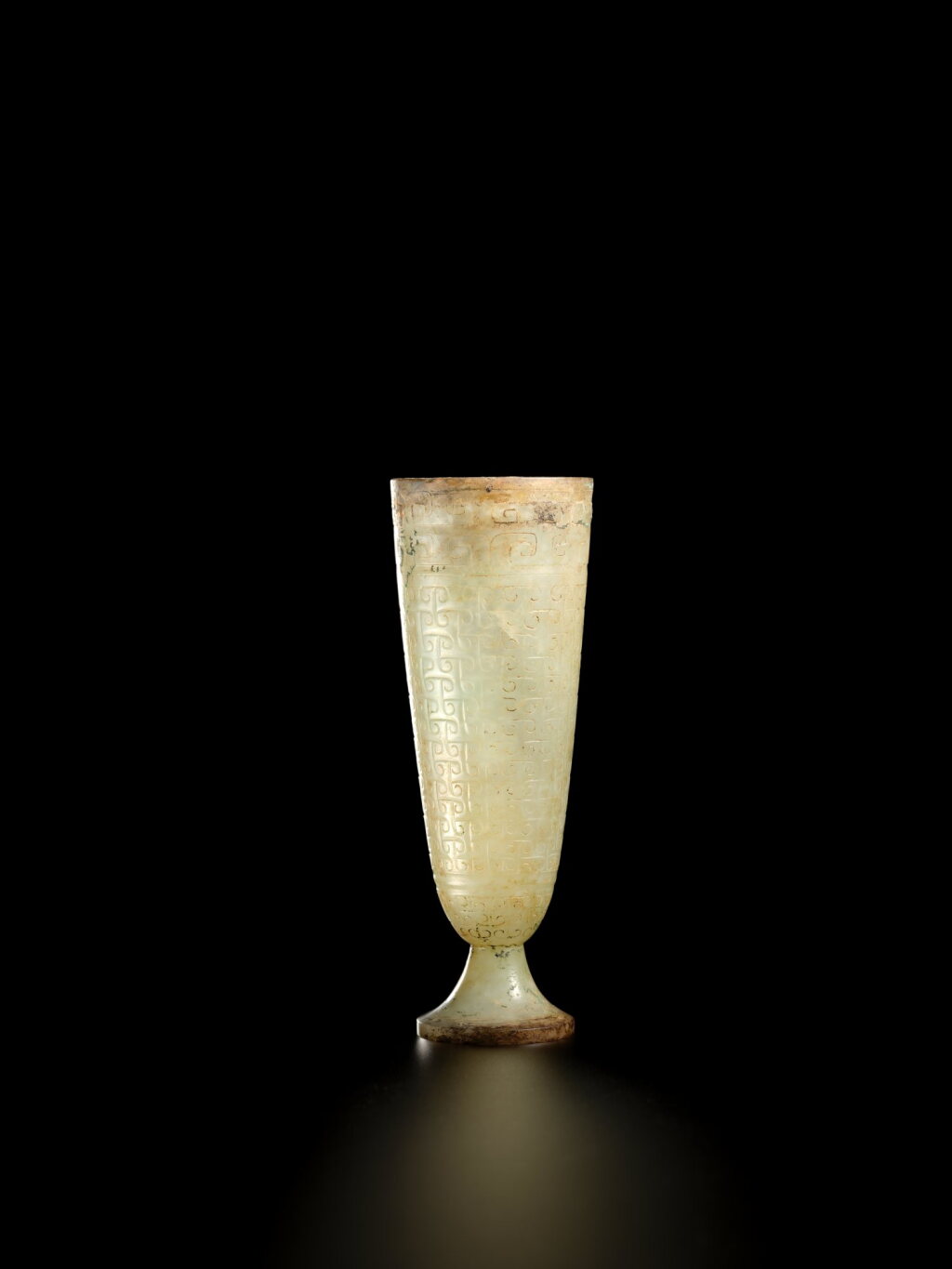
An extremely rare jade stem cup, Western Han Dynasty | 西漢 白玉勾連雲紋高足盃
Auction Closed
May 7, 10:26 AM GMT
Estimate
1,500,000 - 3,500,000 HKD
Lot Details
Description
wood stand
h. 11 cm
Feng Wen Tang Collection, Hong Kong
The Raymond and Frances Bushell collection, acquired from the above in the early 1990s.
Jade stem cups of this form are exceedingly rare and were objects of the highest prestige, produced for the Chinese imperial court, local royalty and a privileged elite associated with these circles during the Western Han dynasty. Comparable examples have been excavated from some of the most significant burial sites of the period, indicating their importance in funerary and ritual contexts. Rather than being merely luxury drinking vessels, such jade cups are believed to have played a role in Daoist immortality practices, possibly used for collecting dew, which, when mixed with powdered jade, was thought to create an elixir of eternal life.
The present cup is distinguished by its finely carved surface, featuring an intricate whorl pattern. This motif, composed of interlocking spirals arranged in horizontal and vertical pairs, imparts a sense of movement and vitality to the design. A very similar whorl-pattern appears on a jade stem cup excavated from the tomb of Zhao Mo, King of Nanyue (r. 137–122 BC), at Xianggangshan, Guangdong. That cup was placed at the centre of an elaborate ritual assemblage, secured on a pedestal within a bronze tripod basin, surrounded by a trefoil jade collar and supported by three silver dragons with gold-inlaid heads, see James C.S. Lin, The Search for Immortality: Tomb Treasures of Han China, The Fitzwilliam Museum, Cambridge, 2012, cat. no. 164, pp. 58, 287–289.
The geometric pattern seen on this cup, with sophisticated design of whorls turned in different directions is characteristic of Han dynasty decorative art and is found on related examples of earlier in date, including a jade beaker from the E’pang Palace site in Xi’an, commissioned by Emperor Qin Shihuang (r. 221–210 BC), see The First Emperor. China’s Terracotta Army, The British Museum, London, 2007, cat. no. 92; see another cup excavated from a tomb at Luobowan, Guixian, Guangxi, belonging to a high official of the Nanyue Kingdom and dating from the long reign of the first King of Nanyue, Zhao Tuo (r.203-137), see Guangxi Guixian Luobowan Han mu, Beijing, 1988, col. pl. 8 and pl. 28.
Jade was highly valued in the Han dynasty for its translucency, durability, and purported protective qualities. The belief that jade possessed mystical properties made it a favoured material for objects associated with the pursuit of immortality, as evidenced by the extensive use of jade in elite burials, including entire jade burial suits. The present cup, with its finely executed form and symbolic decoration, exemplifies the sophistication of Han jade craftsmanship and the dynasty’s enduring fascination with the quest for eternal life.
For a closely related jade stem cup, see the example from the Sze Yuen Tang collection, sold at Bonhams Hong Kong, 5 April 2016, lot 38, for a world-record price, alongside a related cup missing its stem, lot 42. See also a related jade ‘tiwn bird’ stem cup, Western Han dynasty, illustrated by J.J. Lally & Co. Ancient Chinese Jade, New York, 2018, cat. No. 130, and later sold in these rooms, 9 October 2020, lot 16.
來源
奉文堂收藏,香港
Raymond and Frances Bushell 收藏,1990年代初購自上述來源
此盃身呈圓筒狀,中空,外表由上及下分別琢刻雲雷紋、勾連雲紋和卷雲紋。廣東象崗山南越王趙眜(公元前137-122年在位)陵墓出土一件高足玉盃,配件華麗繁複,下以青銅製三足淺盤相托,內置銀製套盤,玉盃立於正中央托高底座,盃身套三瓣玉壁,銀盤內沿作三金首銀身龍,相扣玉壁,整體平穩安定;參考林政昇編,《The Search for Immortality. Tomb Treasures of Han China》,菲茨威廉博物館,劍橋,2012年,編號164,頁58、287-289。
白玉質,受沁局部呈深褐色,質地溫潤,色澤晶瑩。西漢時期,此類高足玉盃珍貴非凡,乃專為漢皇室、諸侯、朝廷權貴所製。相類作例曾出土於重要遺址、墓葬,且發掘地點皆於墓室主位。其非用於一般飲酌,而應與祭祀相關,裝盛添加了細磨玉粉、甘露之靈藥,祈求飲者長生不老,這與漢室貴族追求成仙神通之術之社會潮流相輔相成。
勾連雲紋和卷雲紋看似素簡,實繁複縝密,猶如旋渦,方向各異,兩兩成雙,或水平、或垂直,變化之間,生意盎然,映得主紋更顯耀眼。其他相類之器,多僅綴穀紋,或高足作圓弧形。陝西西安阿房宮遺址曾出土一件玉盃,錄於《The First Emperor. China's Terracotta Army》,大英博物館,倫敦,2007年,編號92;廣西貴縣羅伯灣出土一例,與本品器形相似,亦綴穀紋,原屬南越國首任君主趙佗時期(公元前203-137年在位)重臣之墓,見《廣西貴縣羅泊灣漢墓》,北京,1988年,彩圖8,圖版28。
漢代人對玉非常崇拜,類似於本拍品的玉雕深腹高足杯在傳世品中非常稀少,這種玉器不僅代表權力、地位和財富,更被認為是健康長壽、長生不老的象徵。由於漢代人深信玉石能避邪驅毒,亦能使屍體不朽,因此當時更出現了一種皇室成員特有的金縷玉匣作為殮服,可見皇帝與貴族們追求長生不老、成仙、神通之術已成為漢代時的一種社會潮流。
傳世品之例,見思源堂舊藏一件玉盃,售於香港邦瀚斯,2016年4月5日,拍品編號38及編號42。另見一西漢玉雕朱雀紋高足盃,錄於藍理捷,《Ancient Chinese Jade》,紐約,2018年,編號130,後售於香港蘇富比2020年10月9日,拍品編號16。
You May Also Like