
Property from a European Private Collection
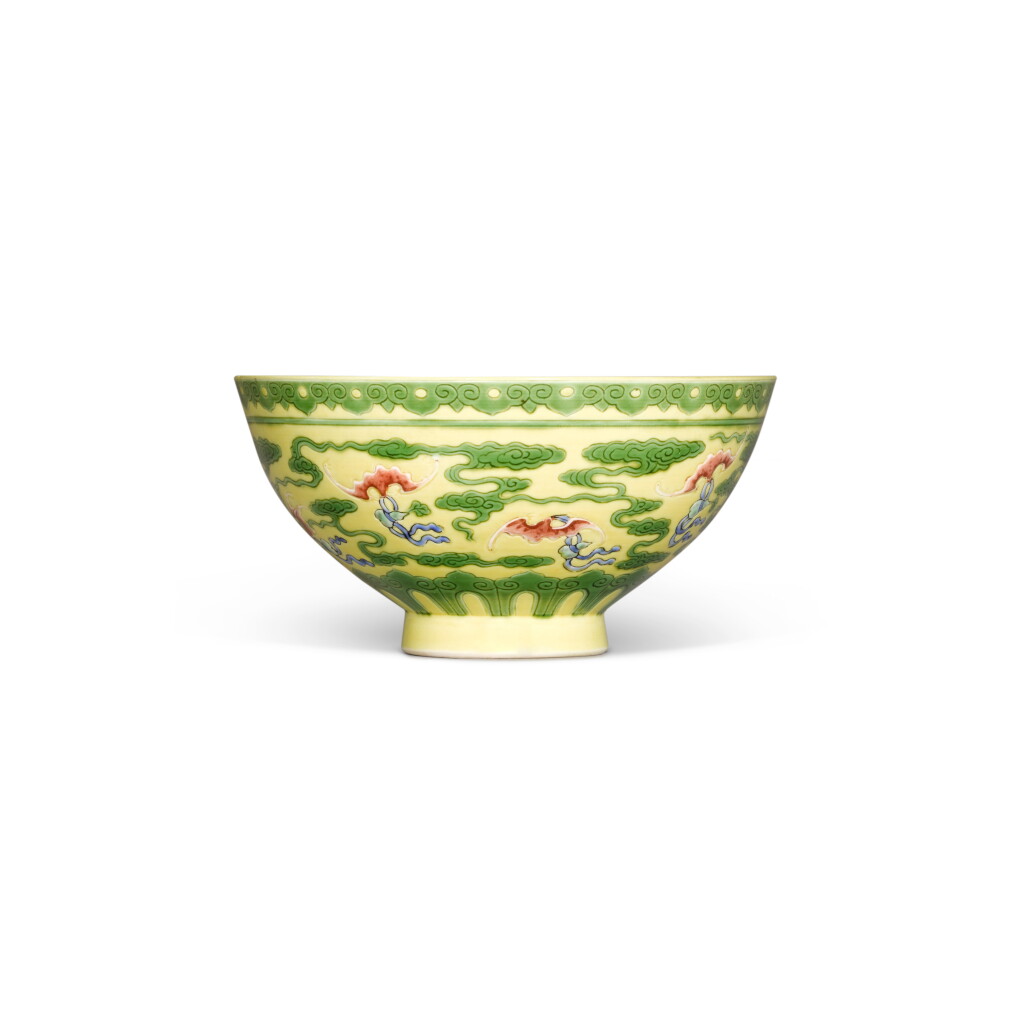
A rare yellow-ground green-enameled famille-rose 'bats and cloud' bowl, Mark and period of Yongzheng
Auction Closed
November 5, 05:06 PM GMT
Estimate
30,000 - 50,000 GBP
Lot Details
Description
the base with a six-character mark in underglaze blue within a double circle
Diameter 12.2 cm, 4¾ in.
French Private Collection.
Christie's London, 3rd November 2020, lot 34.
Christie's Hong Kong, 3rd December 2021, lot 2916.
Finely thrown with a splayed foot and steeply rounded form, this bowl exudes a sense of imperial elegance and is among the highest quality of porcelain produced by the Imperial Workshop under the reign of the Yongzheng Emperor (r. 1722-1735). However, this piece is more than just technically fine, it also represents a rare feat of innovation.
From as early as the Tang dynasty, artisans had experimented with the combination of yellow, green and white glazing. Known as sancai or the 'three colours', this glazing scheme became a staple of the pottery studio and was adopted and adapted to match ever-improving firing technologies. Even by the time porcelain production began at the imperial kilns at Jingdezhen, the palette of sancai was never abandoned. Usually without the inclusion of white slip, vibrant patterns of green enamels on a yellow ground – particularly those featuring five-clawed dragons among the clouds – were a rare but treasured feature of Ming and Qing imperial collections.
The present lot, however, takes things one step further. Adding to the sancai palette with overglaze enamels from the famille rose palette, the potter lends the design of twelve bats, ribbons and gourds a remarkable sense of vibrancy and naturalism. The red enamel pooling over the white slip below renders the bats in a variegated pink hue, while splotches on the pale-green gourds lend them a lifelike depth. This combination of glazes is extremely rare and was only produced during Yongzheng's brief reign. Only one other known design from the Yongzheng period shares this colour scheme, namely a pattern of cranes carrying the emblems of the Eight Immortals; compare a bowl from the H.M. Knight Collection, sold in our Hong Kong rooms, 15th November 1983, lot 263 and illustrated in Chinese Porcelain: The S.C Ko Tianminlou Collection, Hong Kong Museum of Art, Hong Kong, 1987, cat. no. 101, which quotes Geng Baochang calling this variety 'a new type of wucai ('five colours')'.
This bowl is also imbued with auspicious symbolism. A homophone of the word fu, meaning 'good fortune,' bats are a common motif in Chinese art said to grant the owner success. Similarly, a rebus for good fortune and rank (fulu), double gourds (hulu) are also a commonly used symbol and associated with the life-giving magic of the Immortals who are often depicted carrying them.
A very similar bowl in the collection of the Palace Museum, Beijing has been widely published including in Qing Porcelain of Kangxi, Yongzheng and Qianlong Periods from the Palace Museum Collection, Hong Kong, 1989, pl. 67 and The Complete Collection of the Treasures of the Palace Museum: Porcelains with Cloisonne Enamel Decoration and Famille Rose Decoration, Hong Kong, 1999, pl. 83. Compare also a bowl from the Constantinidi Collection, sold in these rooms, 8th July 1947, lot 24 and illustrated in Soame Jenyns, Later Chinese Porcelain: The Ch'ing Dynasty (1644-1912), London, 1951, pl. LXIX, no. 3; another from the collection of the British Rail Pension Fund, sold in our Hong Kong rooms, 16th May 1989, lot 78, and again, 11th July 2020, lot 3620; and a pair from the collection of John Oswald Liddell (1858-1918), sold in our New York rooms, 18th September 2024, lots 10 and 11.
You May Also Like


