Property from a Private European Collection
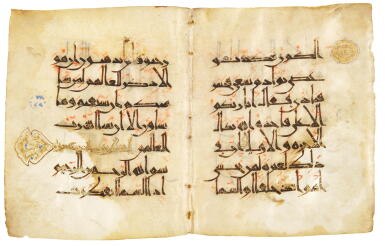
A Qur'an bifolium in Eastern Kufic script, North Africa or Eastern Mediterranean region, late 10th century
Auction Closed
April 30, 03:48 PM GMT
Estimate
5,000 - 8,000 GBP
Lot Details
Description
text: Qur'an, surah al-nazi'at (LXXIX), verses 14 to 28; surah al-takwir (LXXXI), verses 25 to surah al-infitar (LXXXII), verse 1
Arabic manuscript on vellum, 7 lines to the page, written in Eastern Kufic script in brown ink, vocalisation in red, fifth verses separated by stylised letter 'ha', tenth verse marked in the margin by an illuminated medallion containing the word 'ashr in gold, surah heading written in gold with a palmette extending into the margin
12 by 19.4cm. bifolium
This charming bifolium is probably an early example of the use of so-called Eastern Kufic script in the Mediterranean region around the late tenth century. We know that Eastern Kufic script was used in this region for Qur’ans in the late tenth century from a parchment manuscript copied at Palermo in Sicily in 982-83 AD (Nuruosmaniye Library, Istanbul, Ms.23; Khalili Collection, inv. nos.QUR261, 368, see Déroche 1992, no.81, pp.146-151). The calligraphic style of the present example is a fairly standard Eastern Kufic type, but the fact that the material used is vellum is indicative of a western rather than eastern origin. Vellum continued to be used for the writing of Qur’ans in North Africa and the Maghrib later than in the east, witness the aforementioned Palermo codex and the famous Mushaf al-Hadina ('Nurse's Qur’an') copied on vellum at Qairawan in 1019-20 AD. In contrast, a Qur’an in a related Eastern Kufic script copied at Isfahan in 993 AD is on paper (Museum of Turkish and Islamic Arts, Istanbul, Mss.453-6; Khalili Collection, inv. no.KFQ90, see Déroche 1992, no.83, pp.154-5), as is the famous naskh Qur’an of Ibn al-Bawwab copied in 1001 at Baghdad (Chester Beatty Library, Dublin, Ms.1431, see Rice 1955). In Morocco and Islamic Iberia parchment continued to be used for Qur’an manuscripts until at least the fourteenth century.
An unusual aspect of the present script is that it lacks almost all letter-pointing. The vocalisation has been fully applied, so it cannot be that the manuscript was unfinished, as letter-pointing generally preceded the application of vocalisation. It is also worth noting the unusually small size of this bifolium. The complete codex may well have been designed as a portable Qur’an for travelling. The closest comparisons in terms of size, calligraphy and illumination can be found in a juz’ in the Khalili Collection (Déroche 1992, no.80, pp.144-5. See also Christie’s, 4 July 1985, lot 71; Quaritch 1991, no.6, and Sotheby’s, 12 October 2000, lot 10.
You May Also Like