
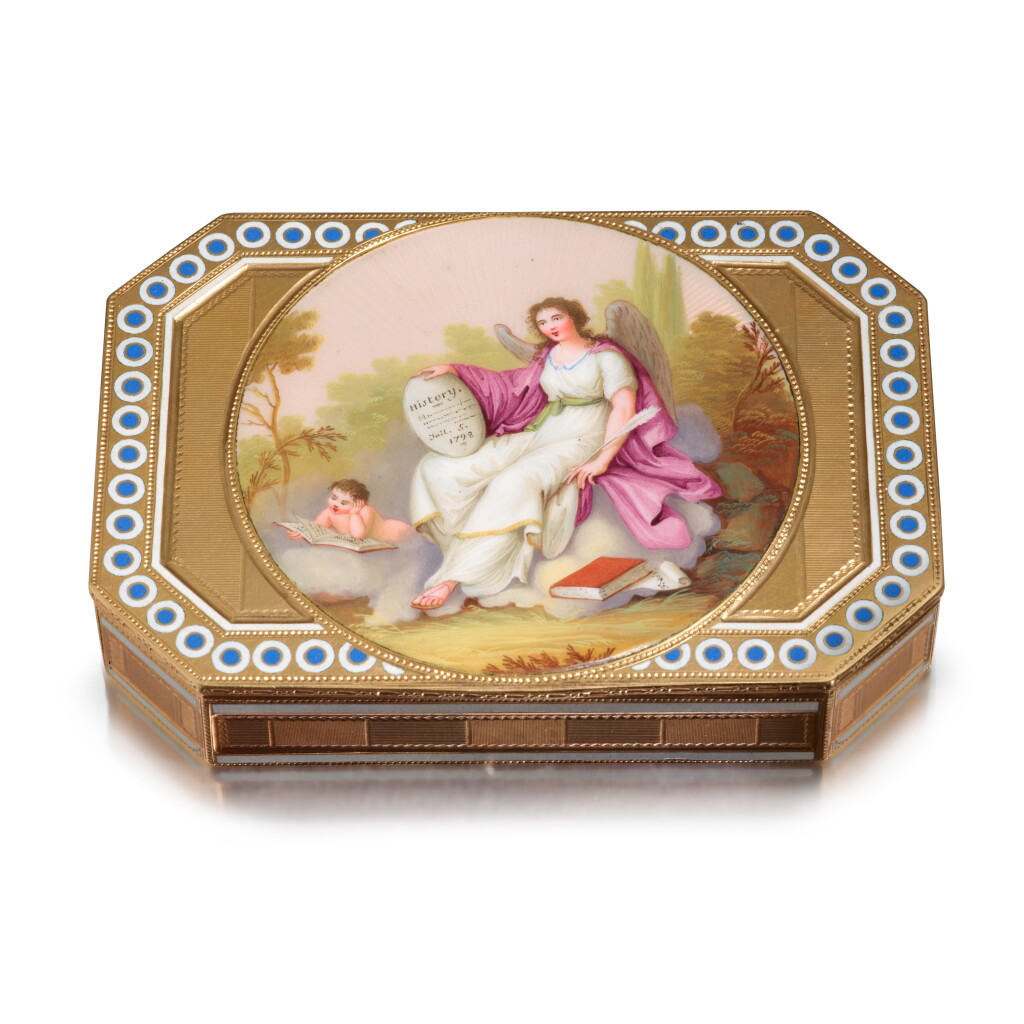
A Gold and Enamel Snuff Box, Frères Jordan, Berlin, 1798
No reserve
Auction Closed
October 16, 06:35 PM GMT
Estimate
8,000 - 12,000 USD
Lot Details
Description
rectangular with cut corners, the lid painted en plein with a large circular medallion representing Clio, the muse of History, holding an oval shield reading: 'History', dated: Juil 5, 1798, next to a putto reading, against an opalescent pink sky over sunburst engine-turning, on a reeded gold ground within borders of white and cornflower blue enamel circles, the sides and base similarly decorated, maker's mark FJ within stylised N marks, the base with a sundial mark within sprigs, the right rim numbered: 4638
Length 3 ⅜ in.
8.6 cm
The Collection of Prince and Princess Henry de La Tour d'Auvergne Lauraguais;
sold, Sotheby's London, The Collection of Prince and Princess Henry de La Tour d'Auvergne Lauraguais, 3 May 2012, lot 98
Over the past few decades, a significant number of gold boxes struck with the initials FJ, often between small sprigs or sundials, have appeared on the market.
Stylistically datable to the last two decades of the eighteenth and the beginning of the nineteenth century, they were usually described as 'Swiss' or Geneva, for their marks were loosely based on Paris hallmarking principles and therefore believed to be 'prestige marks'. In-depth research in the Geneva State Archives, however, which holds extensive records on the city’s citizens and goldsmiths, revealed no suitable match for the initials.
Therefore, another place with no formal hallmarking system or guild, such as Germany, seemed to be a plausible alternative. Indeed the workshop behind the initials FJ was based in a city on which Haydn Williams has recently shed more light as a center of gold box production - Berlin.
Connecting written observations and records from Les Mémoires pour servir à l’histoire des réfugiés françois dans les Etats du roi by Jean Pierre Erman and Pierre Chrétien Frédéric Reclam (1786) with the existing substantial number of gold boxes marked 'FJ', Williams has been able to prove that the Frères Jordan workshop in Berlin was in fact responsible for the production of at least 7,000 snuff boxes in a period of circa 25 years (Haydn Williams, 'The FJ conundrum', in 18th-Century Snuff Boxes: The David and Mikhail Iakobachvili Collection, vol. I, London, 2024, pp. 408-411).
It is rather remarkable that after the glorious period of gold box making in Berlin under Frederick the Great in the middle of the eighteenth century the city has somewhat fallen into oblivion as a bijouterie center thereafter, given the pre-existence of the required infrastructure, clientele and ways of distribution, and most importantly the presence of craftmanship following substantial Huguenot immigration. Finally the ‘mystery’ of the FJ boxes and those marked with just sprigs, sundials or marks resembling stylised Paris date letters N or P could be solved (see also Julia Clarke, 'Swiss Snuff Boxes 1785-1835, in: Haydn Williams, Enamels of the World, The Khalili Collections, London, 2009).
You May Also Like


