
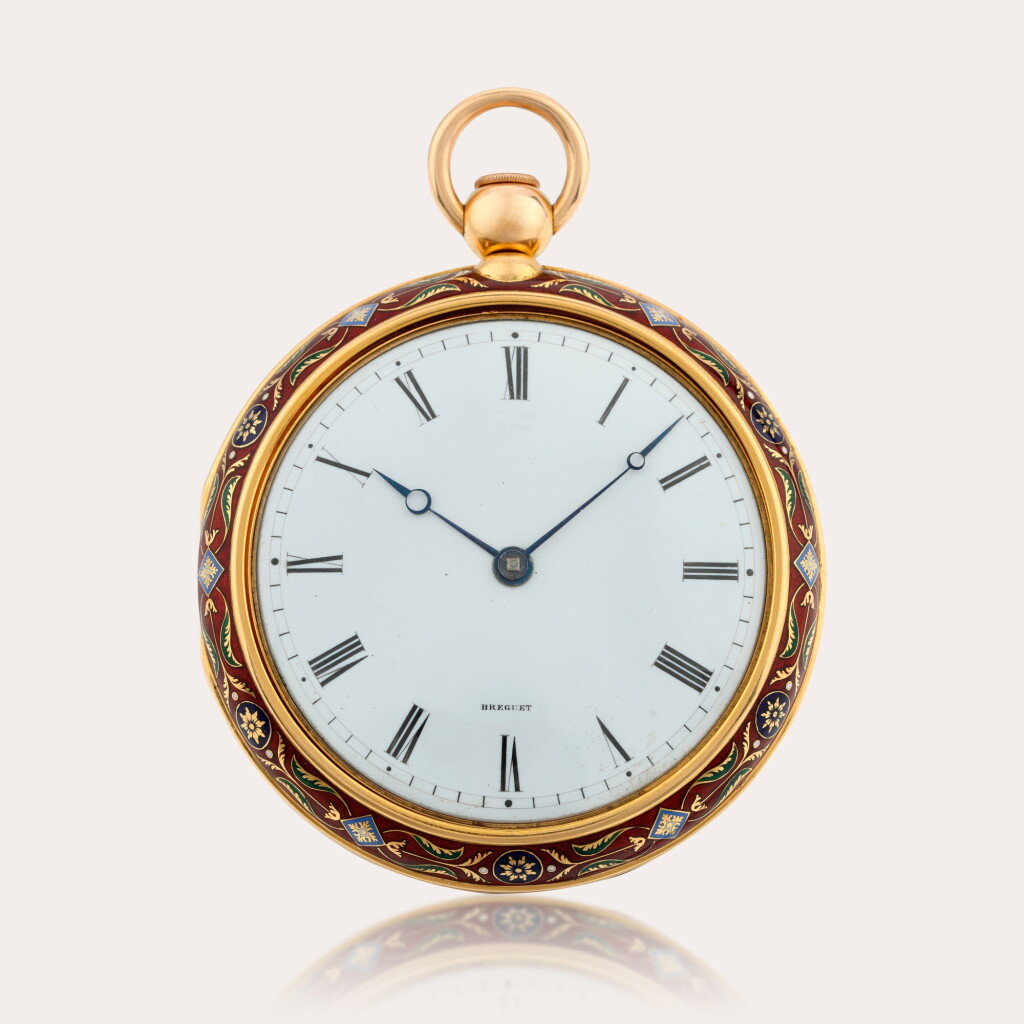
An important and magnificent 20ct gold, enamel and paillon decorated cabriolet cased quarter repeating watch with duplex escapement and chronometer balance made in the Turkish market style, the cuvette engraved with equation of time
Breguet No. 1795/4384 | Sold on 31 December 1810 to Moreau/Maison Russie for Fr. 3,070
Auction Closed
November 9, 08:49 PM GMT
Estimate
150,000 - 300,000 CHF
Lot Details
Description
19’’’ gilded movement, double wheel ruby duplex escapement with ruby impulse pallets and ruby rest roll, two polished steel escape wheels, large chronometer-type two-arm bi-metallic compensation balance, two large sliding wedge-shape weights and two platinum mean time screws, parachute suspension, flat blued steel hairspring and index regulator, two polished steel hammers with chamfered edges and deep satin finished sides repeating on two coiled gongs
white enamel dial, Roman numerals, outer minute ring, signed Breguet above VI o’clock, secret signature beneath XII, engraved Breguet No. 4384, blued steel Breguet hands, the back counter enamelled and signed by the dial maker Droz P
20ct gold inner case with red translucent enamel over sunburst engine-turning, gold paillon border and central rosette, translucent red enamel bezels with paillon fronds heightened with translucent green enamel ribbons, royal blue champlevé enamel band heightened with paillons and opaque white enamel roundels, quarter-turn piston mounted to plain ring pendant, 20ct gold outer case with translucent red enamel over sunburst engine-turning, bordered by gold scrolling vines and leaves, central starburst motif, bezels of red translucent enamel heightened by leaves and rosettes in translucent royal blue and green enamel, opaque turquoise and white enamel, gold cuvette engraved with equation table, aperture for winding, signed Breguet No. 4384 both cases numbered B 1795 and with Tavernier case maker’s mark P.BT beneath a triangle for Pierre-Benjamin Tavernier in lozenge cartouche, inner case additionally numbered 2958, each case with Paris assay and discharge marks comprising baby’s head 2 in irregular cartouche (2nd standard gold 840/1000), Cockerel facing left 2 in oval frame (840/1000, 1798-1809), man’s head facing forward 85 excise mark (1798-1809)
Measurements
inner case diameter 50mm
outer case diameter 55mm
overall depth 15.5mm
weight 170.2g
Accompaniments
with a Breguet 250th anniversary certificate
1810-1822 supplied to the Maison de Russie.
1822 returned to Breguet, Paris and exchanged by General Count Levasheff.
1825 following overhaul re-numbered 4384 and sold to Monsieur Villaret de Joyeuse, subsequently re-sold again to Breguet.
1830 supplied to Wenham, Breguet's agent in Russia.
c. 1870-1879 George Arnold Hearn (Hearn collection now at Metropolitan Museum of Art in New York)
1879 sold by George Hearn to Russia, possibly to Henry Moser.
1879-c.1920 Russian collection.
1920-1954 Gunnar Jacobsson (1882-1967), Nobel Brothers employee.
1954-c1960 family of Christian Gjestvang, Sweden, an automobile enthusiast responsible for the introduction of Ford and Hudson cars to Sweden.
c. 1960-1982 Bo Lindh (1908-1982), Art Collector.
1982-2014 descendants of the above.
2015 Christie’s Geneva, 9 November 2015, lot 299.
The Breguet Archives provide fascinating insight into the production of this magnificent and important watch. Work began in 1804, and delivery of the ébauche was made on 27 January 1805. The inner case, struck with assay marks for 20-carat gold, was crafted by Pierre-Benjamin Tavernier and delivered on 28 December 1808. On 19 April 1809 he completed the outer case, also in 20-carat gold. The case spring was completed on 5 September and the crystal supplied by Roger on 19 October. On 31 January 1810 Sautter completed the engravings, likely for the flinqué enamel, and on 28 February Tavernier finished the engine-turning of the case backs. Lallemand completed the final task of enamelling on 30 March 1810. The total cost of the cases amounted to 980 francs. The double-wheel ruby duplex escapement — exceedingly rare, and rarer still in a Turkish-market watch — with the repeating work, was executed to exceptional standards, as reflected in its cost of over 500 francs, in contrast to the average 66 francs for a Breguet ruby cylinder escapement. Also notable is the use of a chronometer-style balance and the Equation of Time chart engraved to the cuvette; the latter is a feature found on some other important Breguet watches including no. 2788, the double movement resonance watch sold to the Prince Regent in 1818. The engraving of the equation chart on this watch was complete by Tardé on 6 June 1809.
One of the most spectacular watches made by Breguet in the Turkish market style, Breguet No. 1795/4384 holds a fascinating history. It has previously been suggested that this watch may have been purchased on behalf of Tsar Alexander I for him to use as a diplomatic gift. Though no firm record survives to corroborate this, there is some circumstantial evidence that may support such a claim. The Breguet Archives note that this watch was sold to Moreau (Breguet’s agent) at the Maison Russie on 31 December 1810. Subsequent records within the Archives record that the watch was returned to Breguet in 1822 by General Count Lewascheff, who exchanged it for Breguet no. 3260, a half-quarter repeating watch with a gold engine-turned case and a silver engine-turned dial in the Western style (for illustrations of the latter see Daniels, The Art of Breguet, p. 245, figs. 277a–c). General Count Lewascheff was a trusted aide of the Tsar and, among his other missions, is recorded as being in London on behalf of the Emperor of Russia at Carlton House on 8 April 1820 to congratulate King George IV on his recent accession to the throne.1
After the watch’s return to Breguet, it was overhauled, its dial replaced (likely changing from a Turkish numeral dial to the present Roman numeral dial), and renumbered as no. 4384. It was then re-sold on 7 February 1825 to Monsieur Villaret de Joyeuse, son of the French Admiral Louis Thomas Villaret de Joyeuse.
At the time of its original sale on 31 December 1810 through the Maison de Russie (founded in 1808 under Abraham-Louis Breguet’s direction by his agent Lazare Moreau), the firm’s Russian outpost had already secured significant sales, including to the Tsar himself. The Turkish-market styling of this watch and the context of its sale through the Maison de Russie make it plausible that it was purchased for use as a diplomatic gift. The date of the transaction is significant. In 1810, Russia and the Ottoman Empire were still locked in the Russo–Turkish War of 1806–1812, with Russian forces gaining the upper hand along the Danube. Yet even in moments of military advantage, Russia had strong incentives to cultivate diplomatic openings. The war was costly and prolonged, and Alexander was already looking ahead to the growing threat of conflict with Napoleon. Securing peace with the Ottomans on favourable terms became a strategic priority. In this context, the purchase of a Turkish-market watch from Breguet may be understood within the wider culture of diplomacy, where prestige objects could be used to ease negotiations, reward interlocutors, and sustain channels of communication that remained open even in wartime.
Gift-giving was a well-established part of Ottoman diplomatic culture. Luxury objects such as jewelled snuffboxes, clocks, and watches were regularly presented to viziers, envoys, and courtiers. Such gifts went beyond casual courtesies: they were formal tokens of respect and prestige that also served practical purposes — to cultivate goodwill, consolidate influence, and strengthen channels of negotiation. Watches carried particular weight, embodying European science and refinement while appealing to the Ottoman taste for enamelled decoration and dials with Turkish numerals — details Breguet mastered with advice from Esseid Ali (Galib) Effendi, the Ottoman ambassador to France from 1797, who became both a friend and invaluable intermediary.
That Tsar Alexander I might have selected a Breguet for such a purpose would be entirely plausible. During the first decade of the nineteenth century, Breguet had become an important supplier to Russian and Ottoman elites alike. In Russia, sales were so strong that by 1809 more than half of Breguet’s annual production was destined for Russian clients. In Turkey, Ali Effendi’s introductions had secured Breguet a following at the highest levels of court society. Effendi’s commissions included ten repeating watches and, in 1804, he specifically requested from Breguet a repeating watch of the finest quality for the Ottoman emperor himself, Selim III; the Emperor was clearly pleased with the resulting watch, for the following year he requested a second, identical watch.2
The sumptuously decorated case of Breguet no. 1795/4384 reflects the distinctive style Breguet developed specifically for the Ottoman market, a style that stood in striking contrast to his more restrained productions for European and Russian clients. As noted by Emmanuel Breguet in his book Breguet, Watchmakers Since 1775, “the only real freedom which Breguet permitted himself in the decoration of his watches concerned those which fell into two highly specific categories: tact watches decorated with enamelling … and enamelled Turkish watches.”3 Created as a pair-cased watch, the inner and outer cases were made by Pierre-Benjamin Tavernier, one of Breguet’s most distinguished case makers, in collaboration with the enamellist Lallemand. The style is of cabriolet form. As a cabriolet case, in addition to displaying the watch in an open-faced format, the inner case could be reversed within its outer to display the richly decorated back. Such is the superior level of finishing that, when reversed within its outer, the back of the inner case fits so precisely within the bezel of the outer that the two elements appear seamless. The Ottomans wore their watches on the outside of their clothes, which meant that their decorative elements were of even greater importance.
Trade with the Ottoman Empire became increasingly important to Breguet during the first decade of the 19th century as the Napoleonic wars interrupted trade with three of Breguet’s most important outlets — first Britain (in the wake of Napoleon’s Continental System), followed by Spain from 1808 and Russia in 1810. Breguet’s main conduit to important Ottoman clients was via the Ottoman Ambassador to France, Esseid Ali Effendi, known as Galib Effendi. Ali Effendi arrived in Paris in 1797 and was introduced to high society by the French diplomat Charles Maurice de Talleyrand-Périgord. Having received an introduction to Breguet, Effendi’s first Breguet purchases were a remarkable minute-repeating watch and a long-case clock.4 Ali Effendi and Breguet became friends, and after Effendi’s return to Turkey in 1802, they continued to correspond regularly. Effendi went on to hold important positions at the Ottoman court, rising to the position of Minister of the Navy.
Effendi was clearly of great help to Breguet, not only by introducing the watchmaker to important clients, but by advising on the style of watch and type of decoration preferred by clients in Turkey, especially their preference for white enamel dials with Turkish numerals and cases ornately decorated with enamels, particularly in red. This experience and expertise in producing watches for the Ottoman market meant that Breguet was ideally placed to create an exceptional watch of diplomatic character — perhaps originally intended for presentation on behalf of the Russian court.
One of the most distinguished Breguet watches to have appeared on the market in recent years, no. 1795/4384 is particularly remarkable for its exceptional state of preservation, all the more so given the intricacy of its magnificent enamel decoration. The cases display a rich, lustrous surface, their superb workmanship befitting a commission intended for a patron of the highest importance.
1 Bulletins of State Intelligence, Bulletins from the London Gazette, 1820, collated and printed by R. G. Clarke, Westminster, p. 171.
2 Breguet, Emmanuel, Breguet Watchmakers since 1775, Revised and Expanded Edition, Swan Éditeur, 2016, pp. 248-249.
3 Ibid p. 373.
4 Ibid p. 246.