
Property from a branch of the Breguet family
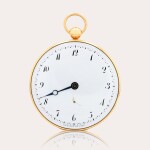
A large 18ct gold open-faced Souscription watch
Breguet No. 3185 | Sold to Monsieur le Duc de Frias on 10 April 1818 for Frs. 978
Auction Closed
November 9, 08:49 PM GMT
Estimate
8,000 - 16,000 CHF
Lot Details
Description
gilded Souscription calibre, large central going barrel, ruby cylinder escapement, plain three-arm balance with parachute suspension, flat spiral steel balance spring, bi-metallic compensation curb, blued steel index regulator, signed Breguet No. 3185
white enamel dial, Breguet numerals, secret signature ‘Breguet No. 3185’ beneath 12, outer minute ring, single blued steel Breguet hand, dial securing screw above 6 o’clock, further signed Breguet et Fils beneath 6 o’clock
18ct gold Joly case, the back with unusual concentric engine-turned crémaillère rings, milled case sides with raised polished central band, case back interior numbered 3185 B and 2184 *, case maker’s stamp J L J beneath a bird in lozenge-shaped cartouche for Joly, Paris assay and discharge marks comprising cockerel 3 with right leg raised and head turned right in irregular hexagon cartouche (3rd standard gold 750/1000, 1809-1819), bear’s head 3 facing left in circular cartouche (750/1000), lion’s head excise mark facing right in circular frame (1809-1819)
Measurements
diameter 62mm
case depth 14mm
weight 143g
Accompaniments
with a later associated velvet lined fitted box with compartment for large ratchet key with hexagonal head and a Breguet 250th anniversary certificate
Duc de Frias, 1818
Rev. Bentinck Hawkins
Christie’s London, 6 February 1895, lot 37 sold to Roberts for £12.150.
Louis Desoutter, London 1909 – the Breguet Archives note the firm supplied certificate no. 2539 for the present watch to Desoutter on 26 November 1909.
Charles Kalish, New York.
Sotheby & Co. London, An Important Collection of Watches and Clocks, The Property of Charles Kalish Esq. of New York, 13 July 1964, lot 84 sold for £750 ($2,100) to Mrs Oakes.
Purchased from the above.
Britten, F. J., Old Clocks and Watches and their Makers, London: E. & F. N. Spon, Seventh Edition, 1956, p. 169.
Britten, F. J., Old Clocks and Watches and their Makers, London: Bloomsbury, Ninth Edition, 1982, p. 183, plate 124.
The case back has a most unusual and distinctive engine-turned pattern of concentric circles, echoing the crémaillère borders often found around the chapter rings of Breguet’s dials. This case design is extremely rare, with perhaps as few as nine identified among Breguet’s recorded works.1 Most were produced with gold dials, making the present example with its white enamel dial especially rare.
For further examples of this case decoration, see: Breguet no. 2053 illustrated in Breguet in the Hermitage p. 20, Breguet Art and Innovation, p. 54-55 and Breguet Watchmakers since 1775 p. 218
Bernardino Fernández de Velasco, 14th Duke of Frías (1783–1851)
A senior figure in 19th-century Spanish nobility, Bernardino Fernández de Velasco y Benavides, 14th Duke of Frías, was born in Madrid in 1783 and inherited the dukedom in 1811, which he held until his death in 1851. As head of the House of Velasco, he carried one of Spain’s oldest hereditary titles, which also conferred the traditional distinction of Constable of Castile, a title historically associated with military leadership and courtly precedence.
The Duke’s political career reflected the shifting currents of post-Napoleonic Spain: he held high office as a diplomat, senator, and even briefly as Prime Minister of Spain in 1838, serving under Queen Isabella II.
The Duc de Frias also purchased Breguet No. 3234, a ruby cylinder souscription watch, on 23 June 1819 for Fr. 920 (see: Sotheby & Co., 22 April 1965, lot 161) and No. 3066, a first class half-quarter repeating watch with moon phases (see: An Apogee of European Watchmaking, Breguet/Louvre, 2009, p.98).
Breguet’s Souscription Watches
Following his return to Paris from exile in Switzerland in 1795, Abraham-Louis Breguet faced the considerable task of rebuilding his business. He recovered his home and workshop at Quai de l’Horloge in Paris, confiscated during the Revolution, in 1796. In this critical period of re-establishment, Breguet introduced what would become one of his most commercially important innovations: the Montre à Souscription, or Subscription watch.
Launched formally in 1797, the Souscription watch was conceived as a robust, high-quality timepiece of simplified construction, sold at a moderate price. Breguet described it in a brochure issued that same year as a watch ‘sufficiently perfect to rank immediately behind astronomical and marine timekeepers, but available to the public at a moderate price.’2 Designed for reliability and ease of repair, the watch featured a large, single-handed enamel dial and a movement architecture centred on a powerful mainspring designed to run for 36 hours. The large dial with clear calibrations ensured that time could be easily read to the nearest five minutes. Breguet also stated in the brochure that each dial would bear ‘a special mark… made by a machine whose effects are extremely difficult to imitate’,3 a clear reference to his secret signature. The large central barrel was engineered to draw power only from the central portion of the mainspring—avoiding the extremes of tension when fully wound or nearly unwound—thereby delivering a more even and consistent force over its running period. Breguet further noted that the connection between the balance and the gear train would be entirely in steel, acting on ruby bearings, and that the escapement would be protected against shocks, even in the event of a fall.4
The economic model Breguet proposed for its manufacture was equally innovative. Recognising the difficulty of raising capital through borrowing, ‘which no honest industry, in the current circumstances, could sustain’, Breguet chose to fund the project through advance subscriptions. ‘A certain number of watches must be made at once to give their execution the uniformity and perfection I seek... the subscriber who pays a portion in advance will find compensation in the moderation of the purchase price.’5 Clients paid one quarter of the 600-livre price up front, with delivery guaranteed in sequence of subscription.6
As Emmanuel Breguet notes, the money collected in advance enabled Breguet to procure components for what was effectively a form of early series production.7 The concept had been forming since at least 1792, when Breguet sold a 'simple watch with one hand' to Talleyrand, but the Souscription model was the first systematic and commercially scaled iteration.8
George Daniels emphasised the mechanical consistency that emerged from this series: though early experimental pieces varied in escapement type, later examples showed clear uniformity in their central-barrel movement design, regulated by Breguet’s ruby-cylinder escapement.9 Cases were typically engine-turned silver with gold bezels, gold cased examples were also made; dials were almost always in enamel, fitted with Breguet’s friction-set single hand, and discretely signed under the 12 with his secret signature.
Following the publication of Breguet’s 1797 brochure, the Souscription watch was an immediate success. Of the 105 watches sold in 1798, forty were Souscription models.10 The advance payments made to purchase them significantly helped the firm re-establish its presence following Abraham-Louis’s return to Paris, and Souscription watches remained a popular and important part of Breguet’s production well into the 19th century.
1 Keith Orford, A Watch with Breguet’s Échappement Naturel, Antiquarian Horology, vol. 32, No. 1, March 2010, p. 55.
2 Breguet, printed brochure for the Souscription watch, 1797. Original: "J'ai pensé que le Public accueilleroit favorablement des montres assez parfaites pour tenir le premier rang, après les machines servant à l'Astronomie et à la Marine, lorsqu'il pourroit les avoir à un prix modéré."
3 Ibid. Original: “je mettrai sur le cadran une marque particulière, exécutée par une machine dont les effets sont très-difficiles à imiter.”
4 Ibid. Original: "Elles se distinguent par leur simplicité et par une disposition qui garantit l’échappement des accidens les plus graves, même en cas de chûtes."
5 Ibid. Original: "Le moyen de se les procurer, par un emprunt, oblige de supporter un intérêt énorme, que dans l'état actuel des choses, aucune industrie honnête ne peut couvrir."
6 Ibid. Original: "Il faut pouvoir faire un certain nombre de montres à-la-fois, pour donner à leur exécution toute l'uniformité et la perfection que je desire... le souscripteur qui payeroit une partie d'avance, trouveroit son indemnité dans la modération du prix d'acquisition."
7 Emmanuel Breguet, Breguet: Watchmakers Since 1775, Revised and Expanded Edition, Swan Éditeur, 2016, p. 128.
8 Ibid.
9 George Daniels, The Art of Breguet, Sotheby Parke Bernet, 1975, p. 62.
10 Emmanuel Breguet, Breguet: Watchmakers Since 1775, Revised and Expanded Edition, Swan Éditeur, 2016, p. 139.