Giulio Benso
The Finding of Moses
Auction Closed
January 31, 08:10 PM GMT
Estimate
20,000 - 30,000 USD
Lot Details
Description
Giulio Benso
Pieve del Tecco 1601 - 1668
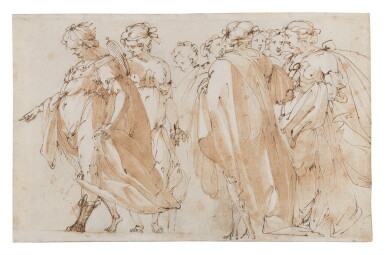
The Finding of Moses
pen and brown ink and wash over traces of black chalk
10 ½ by 16 ½ in.; 267 by 420 mm
Bernard Houthakker (1884-1963), Amsterdam;
His sale, Amsterdam, Sotheby's, 17-18 November 1975, lot 6 (as Luca Cambiaso);
Private collection, The Netherlands;
With W.M. Brady & Co., New York;
From whom acquired, February 2003.
Amsterdam, Bernard Houthakker, Dessins exposés chez Bernard Houthakker, 1953, no. 17 (as Luca Cambiaso).
As an adolescent, Benso left his native town of Pieve di Teco for Genoa, where he made such a strong impression on Giovanni Carlo Doria, the city's most important and wealthy patron, that he immediately entered the workshop of Giovanni Battista Paggi (1554-1627), the leading artist of the early seventeenth-century Genoese school. Consequently, the young Benso came to be influenced by numerous artists, not only Paggi and his master, Luca Cambiaso (1527-1585), but also Simon Vouet (1590-1649) and Giulio Cesare Procaccini (1574-1625), who were active in Genoa at the end of the second decade of the 17th century. While still with Paggi (according to his seventeenth-century biographer, Raffaele Soprani), Benso produced "bizarre sketches of great number and variety, as he had a fertile mind along with a lively and vigorous imagination”.1 As the present work attests, Benso was a highly spirited draughtsman and he earned particular renown in Genoa as the city’s foremost painter of quadrature - illusionist architectural perspectives with spectacular foreshortenings, such as those in the Basilica della Santissima Annunziata del Vastato, Genoa, executed by the artist circa 1639.2 Benso was clearly much influenced by the graphic style of his Genoese artistic forebear, Luca Cambiaso, and the Younger sheet, exquisitely drawn with a dynamic combination of penwork and glorious brown washes, is a particularly fine and indicative example of this influence. Indeed so compelling was the influence of Cambiaso on this drawing that when in the collection of the renowned Dutch collector, Bernard Houthakker (see Provenance), it was documented as such. The attribution to Benso was subsequently proposed by Florian Härb and endorsed by Mary Newcome Schleier prior to the drawing's reappearance on the New York art market in 2003 (see Provenance).
The subject depicted in the present work remains enigmatic. A group of gracefully attired women move elegantly across the sheet from right to left. It is tempting to believe that the scene could show Pharaoh's daughter and her entourage (Exodus 2:1-10), as the left hand figure, wearing a crown, gestures down to an invisible discovery beyond the left edge of the drawing. However, as Brady notes, no such painting or fresco of this subject survives, or is recorded in Soprani's vita of the artist. While the subject matter remains something of a tantalizing mystery, the attribution is far more robust, with the eight female figures contained within the Younger drawing, particularly those that the viewer can see full length, highly comparable on stylistic grounds to those found in two further drawings by the artist to have appeared on the international art market over the course of the last quarter of a century.3
1. R. Soprani, Le vite de pittori, scoltori et architetti genovesi; e de' forestieri che in Genova operarono, Genoa 1674, p. 280
2. For a comprehensive summary of Benso's life and career see M. Newcome Schleier, "Giulio Benso," Paragone, 1979, pp. 27-40
3. See sale, London, Christie’s, 4 July 2000, lot 4 and sale, Paris, Christie’s, 10 April 2008, lot 14


