Jean-François Millet
Lot and His Daughters
Auction Closed
January 31, 08:10 PM GMT
Estimate
40,000 - 60,000 USD
Lot Details
Description
Jean-François Millet
Gréville-Hague 1814 - 1875 Barbizon
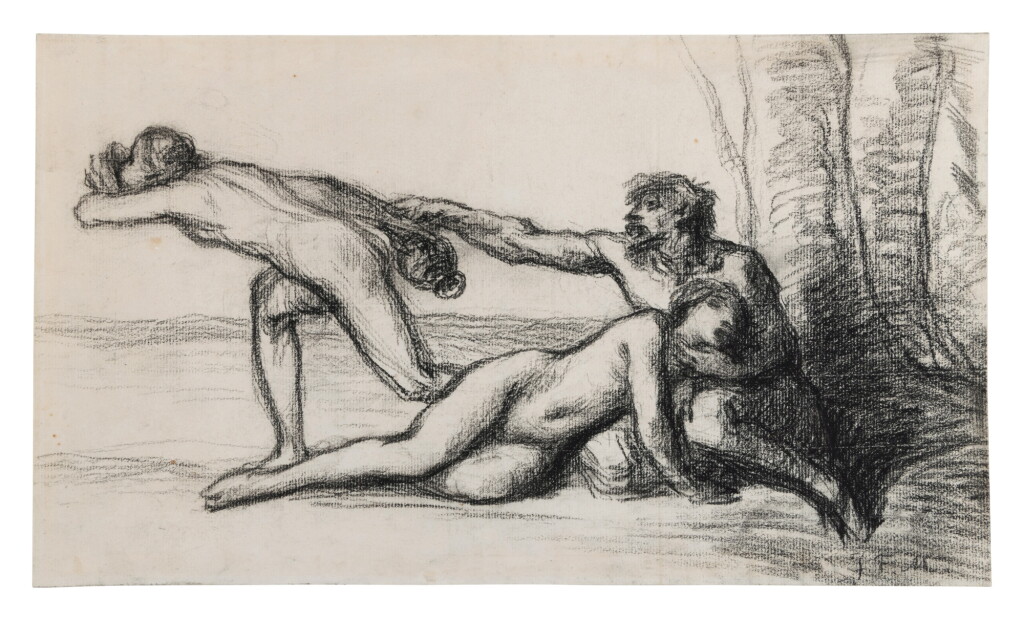
Lot and His Daughters
Black chalk;
signed with the artist's initials in black chalk, lower right: J.F.M.
7 ½ by 12 ¾ in.; 190 by 321 mm
With W.M. Brady & Co., New York;
From whom acquired, 1999.
This beautifully preserved sheet, executed in Millet’s preferred medium of densely applied black chalk, has been dated to the late 1840s and is a fine and highly expressive example of the artist’s work as a draughtsman. Although Millet is perhaps most celebrated for his portrayals of peasants in the fields, in which the strenuous labors and plight of his subjects is brought to the forefront of his compositions, he is also known to have focused intently on works with more historical subject matter. This was, in part, to appease the more formal demands of Salon painting, but also allowed him great expressive freedom and the opportunity to demonstrate his sophisticated compositional skills, as well as his convincing and lifelike figure studies. In the case of the present work Millet has cleverly blended an Old Testament subject, that of Lot and His Daughters, and heightened the drama of the scene through his contorted yet realistic figure types as well as their contemporary attitudes.
As noted by Alexandra R. Murphy in her catalogue entry for the present work when it was last on the art market in 1999 (see Provenance) "the eloquent figure of the beautiful young nude stretched across the foreground of Lot and His Daughters remained in Millet's vision, eventually serving the artist as inspiration for a sleeping female harvester (resting on a grain sheaf) in La Méridienne around 1858." This is a particularly fascinating observation as it demonstrates the manner it which Millet’s ideas and artistic vision straddled both the Religious and the everyday and positions this drawing not only as a powerful work of art but also as a drawing that was influential within the artist’s own development.
You May Also Like