Pietro Buonaccorsi, called Perino del Vaga
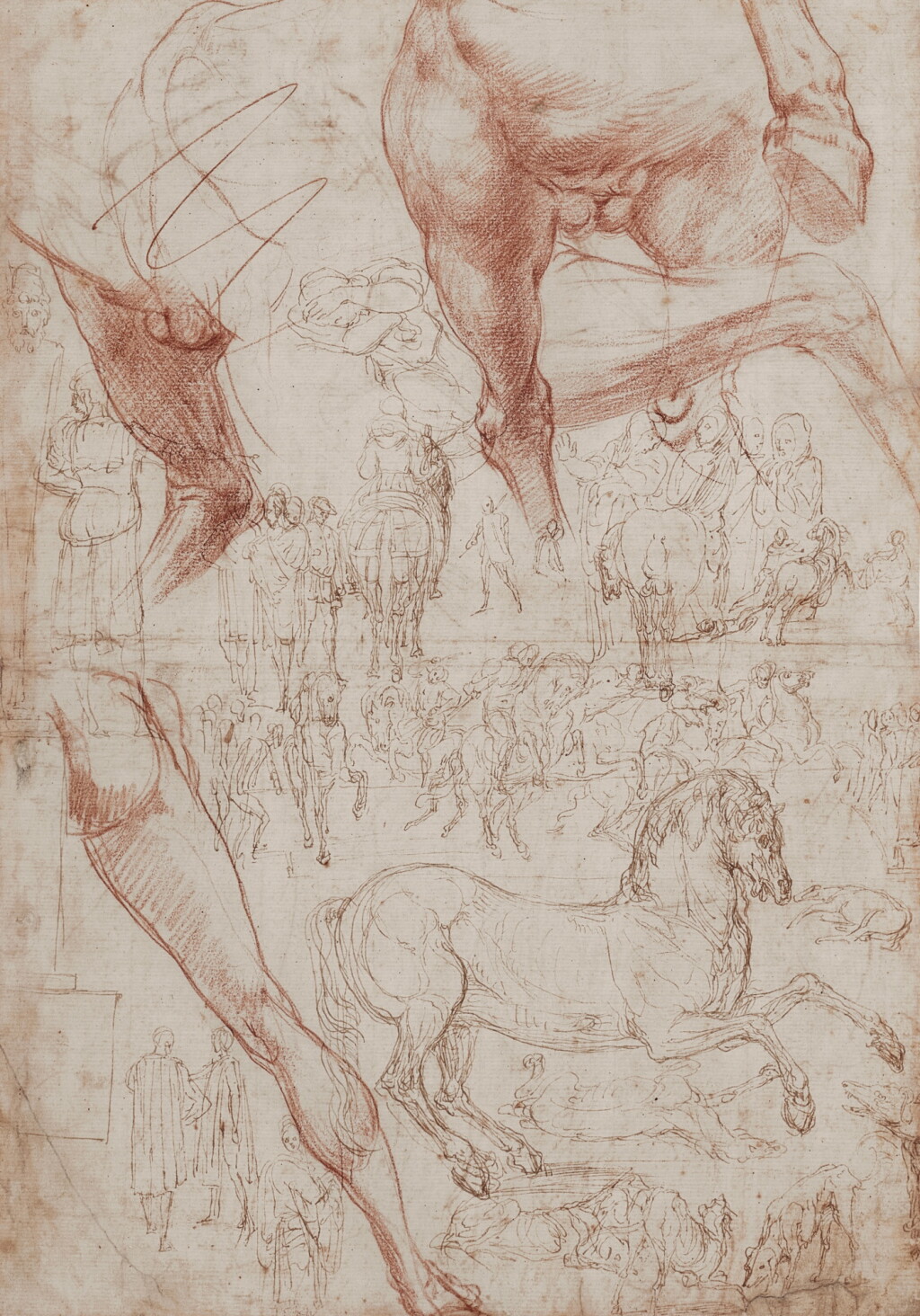
Double-Sided Sheet of Studies: Recto: Studies of men on horseback and in combat, Hector's corpse dragged by Achilles's chariot, dogs and horses, with subsidiary studies of horses legs and the right leg and buttock of a man Verso: Studies of horses
Auction Closed
January 31, 08:10 PM GMT
Estimate
300,000 - 500,000 USD
Lot Details
Description
Pietro Buonaccorsi, called Perino del Vaga
Florence 1501 - 1547 Rome
Double-Sided Sheet of Studies:
Recto: Studies of men on horseback and in combat, Hector's corpse dragged by Achilles's chariot, dogs and horses, with subsidiary studies of horses legs and the right leg and buttock of a man
Verso: Studies of horses
pen and brown ink and red chalk (recto); pen and brown ink (verso);
inscribed in brown ink, verso: acero [?] and nero
15 ½ by 10 ¾ in.; 395 by 273 mm
Doge Nicolò Sagredo, Venice, by circa 1654;
His brother, Stefano Sagredo, Venice;
Zaccaria Sagredo, Venice (1653-1729);
His nephew Gerardo Sagredo (d.1738),
His widow, Cecilia Grimani Sagredo (1686-1755), until sold, circa 1743;
With Artemis/Boerner;
With Salamander Inc., London;
From whom acquired, 2003.
Austin, Texas, Blanton Museum of Art, Illusion and Imagination: Pictorial Decoration for Architectural Spaces, 1500-1800, exhib. with no catalogue, 24 March-17th June 2018.
Perino del Vaga and Giulio Romano (1499-1546) were the most influential of Raphael's pupils, who together propagated in their exuberant styles the master’s universal influence across the entire Italian peninsula.
Even more than his painted œuvre, Perino's drawings are fascinating in their stylistic diversity and especially exciting in the virtuoso use of various techniques. Unknown before its appearance on the art market and acquisition by the late owner in 2003, this important, double-sided addition to the corpus of Perino’s known drawings was the subject of an unpublished paper by Linda Wolk-Simon, on which we have gratefully drawn in the preparation of the present entry.
The drawing is emblematic of Perino's graphic style in its diversity and inventiveness. Both on the recto and on the verso we can admire the artist using the sheet to the full, on the recto with contrasting and seemingly unconnected studies and techniques. As Wolk-Simon described, 'Clusters of diminutive figures randomly deployed in a series of unrelated graphic ''vignettes'' fill the recto.' These visual notes, quickly jotted down in pen and ink, appear to have been drawn in a frenzy of creativity. Over these pen sketches, much larger in scale and sensitively executed in red chalk, are drawn equine and human anatomical details. Contrasting so strikingly with the pen studies, these elegant, delicately finished studies in red chalk create a pause – a moment of reflection – enhancing the reading of the recto in its entirety, and paradoxically helping the viewer to focus on the different groupings executed in pen and ink. The studies in red chalk, a medium so congenial to Perino, are more in keeping with the scale of the sketches of horses and equine details filling the verso, though these are solely executed in pen and brown ink.
Returning to the recto, and to Linda Wolk-Simon’s observations on the central section of clustered figures, she writes: 'Those forming a frieze-like swathe across the center of the sheet are engaged in a battle (such scenes being among Perino's favorite subjects)'. As she also points out, there are clear echoes here of a Leonardesque combat of naked cavaliers.1 Above these figures is a horseman, seen from behind, with other figures in contemporary attire and a sleeping woman above. This last sketch is on a slightly larger scale than the others, as is the one, to the far left, of a gesturing female figure beside a herm. To the opposite side, far right, just below another group of veiled women (one on horseback), is a corpse of a man, dragged by a horse. Might this be a reference to Hector's corpse dragged by Achilles's chariot, as described in Homer’s Iliad?2 Further down on the right is another, larger horse in a rather static and unnatural pose; could this be a representation of the Trojan Horse, and therefore a reference to another poem from Classical literature, Virgil’s Aeneid (book 2)? Lastly, below these studies we see a random selection of figures and animals: some dogs, what looks like a seated cow, and – drawn upside down – a chained dragon.
It is not obvious what the connection is between all these studies, but presumably Perino must have been exploring a series of specific subjects, in relation to one of his many decorative schemes. It is hard to imagine that the various studies seen here were really just unrelated, fanciful exercises. It seems plausible that the equine anatomical studies at least were mostly drawn from life, while the right leg of a man seen from the rear, to the lower left, is clearly reminiscent of some of Raphael's male figures, and may be loosely based on one of them. On the verso, the studies of horses and their anatomical details fill the sheet; again, although these may largely have been drawn from life, the partial study of a horse at the lower edge, as Linda Wolk-Simon noted, closely recalls the poses of the horses of the celebrated classical Dioscuri group, in the Piazza del Quirinale.3
Overall, as Wolk-Simon rightly noted, there are close stylistic similarities between this sheet and a double-sided pen and ink drawing by Perino in the Art Institute of Chicago.4 The latter, less elaborately drawn, was attributed to Perino by Philip Pouncey in 1958, and subsequently dated by Bernice Davidson to Perino's Genoese period, 1528-38.5 On the verso of the Chicago sheet, together with a series of contemporary looking heads and figures, there are two sketches of ceiling plans. These have been related by Janet Garrell to a number of bays and spandrels which correspond to the ceiling of the large central room of the Sala dei Giganti in the Palazzo del Principe, Genoa.6
Though it is still not possible at present to associate any of the drawings on this double-sided sheet with any specific commission, the apparent references to the Trojan hero Aeneas, who was, according to some popular legends of the day, the ancestor of Romulus and Remus and therefore instrumental in the founding of Rome, are consistent with the iconography of the celebrative projects and the various decorations linked to the embellishment of Palazzo Doria, to celebrate and glorify Andrea Doria's role in Genoa.
This magnificent sheet, large in scale and varied in technique, is an exceptional example of Perino's originality and artistic talent, representing an apex of achievement within the corpus of one of the most dazzling draughtsmen of the first half of the sixteenth century.
Another drawing in the Younger Collection, by Bernardo Strozzi (lot xxx) shares the same distinguished provenance from the patrician Venetian family, the Sagredo.
1. Wolk-Simon writes: 'Battling horseman of the type that appear on the recto of this sheet are a recurrent motif in Perino's graphic oeuvre. His enduring fascination with this subject was perhaps inspired by his early exposure, during his formative years in Florence, to Leonardo's compelling treatment of the theme in the background of the unfinished Adoration of the Magi for San Donato a Scopeto and the celebrated cartoon for his unrealized mural of the Battle of Anghiari in the Palazzo Vecchio.''
2. This detail was pointed out to the owners by Simone J. Wicha, director of the Blanton Museum, in a loan request of 17 November 2017. This is a dramatic moment in the Trojan war, when the vengeful Achilles kills King Priam's son Hector to avenge the death of his friend Patroclus (Homer, The Iliad, book 21)
3. The Dioscuri (the Horse-Tamers of Monte Cavallo) are among the few colossal statues visible throughout the Middle Ages. As noted by Bober and Rubinstein ' ...the pair of nude giants, eighteen feet high, dominating their rearing horses, provided artists with powerful examples of controlled energy and grandiose scale.' See Phyllis Pray Bober and Ruth Rubinstein, Renaissance Artists and Antique Sculpture, London and Oxford 1986 p. 159, no. 125, reproduced figs. 125 to 125d
4. Chicago, Art Institute of Chicago, inv. no. 1922.477; see Suzanne Folds McCullagh and Laura M. Giles, Italian Drawings before 1600 in the Art Institute of Chicago, Chicago 1997, pp. 186-8, no. 244, reproduced, color plate XVII (recto) and figs. 244r, 244v
5. Bernice Davidson, Mostra di Disegni di Perino del Vaga e della sua Cerchia, Florence 1966, p. 35, no. 30, reproduced figs. 28-29 and p. 36, no. 31, reproduced figs. 31-32
6. Folds McCullagh and Giles, op. cit, p. 187
You May Also Like