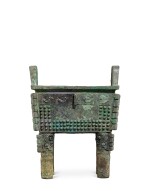

The Fu Wu fangding, Late Shang dynasty | 商末 父戊方鼎
Auction Closed
October 29, 07:27 AM GMT
Estimate
2,000,000 - 5,000,000 HKD
Lot Details
Description
The Fu Wu fangding,
Late Shang dynasty
商末 父戊方鼎
the ritual bronze food vessel of rectangular section with heavy flanges at the corners and supported on four cylindrical legs, each side intricately cast in high relief with a frieze of birds facing each other over a flange against a leiwen ground, below the frieze with a rectangular area decorated with a lozenge pattern, bordered on three sides by neatly arranged rows of protruding bosses, the legs cast with animal masks, each divided in half by flanges, the rim set with two upright loop handles and cast inside below the rim with two characters reading Fu Wu ('Father Wu'), zitan wood stand and Japanese double wood box, one of which with Zoroku Hata's inscription dated 1917
h. 22.2 cm
連 紫檀座及日本木盒,其一木盒帶秦蔵六丁巳年(1917年)題字
Only one other fangding of this striking design is known to bear the same ‘fu wu’ inscription. Preserved in the Shanghai Museum, this very similar piece was once in the famous bronze collection of Pan Zuyin (1830-90), illustrated in Chen Peifen, Ancient Chinese Bronzes in the Shanghai Museum, London, 1995, pl. 23, and its inscription widely recorded in early compendia. Recent excavations of Shang tombs show that ding vessels of this quality and importance were frequently produced in pairs; compare a pair of smaller rounded ding from the lavishly furnished tomb of Fu Hao at Anyang in Yinxu Fu Hao mu / Tomb of Lady Hao at Yinxu in Anyang, Beijing, 1980, pls 11:3 and 4. Given this, the shared inscription, and the similarity of decoration between the two pieces, it seems highly likely that the Pan Zuyin fangding in the Shanghai Museum was once a companion to the present lot.
Revered as symbols of great power and status since antiquity, ding vessels are considered to be the most ritually significant of bronze ceremonial vessels and commonly associated with kingship and high rank. While the vast majority of Shang and Zhou dynasty ding were produced with rounded bodies, those of rectangular form with four legs (fangding) are comparatively rare. According to legend, the first nine ding were cast by Yu the Great, founder of the Xia dynasty, and although archaeological evidence has yet to reveal bronze fangding from before the Shang dynasty, pottery versions from the Erlitou and Erligang periods do survive. By the Shang and Zhou dynasties, bronze fangding became central features of ancestral worship and other sacrificial ceremonies, and their ownership appears to have been restricted to only the most distinguished members of the nobility.
A very small number of other known fangding share this rare form and design. Compare two very similar pieces excavated from the Shang capital in Anyang, illustrated in Zhongguo qingtongqi quanji [Complete series on Chinese bronzes], vol. 2, Beijing, 1997, pls 44 and 49: the former excavated from tomb M160 in Guojiazhuang in 1990; the latter uncovered from the area in 1950, now preserved in the Xinxiang Museum, Henan; a third, from the Duke Collection, was illustrated in Chen Mengjia’s seminal work on Chinese bronzes in American collections, Meidiguozhuyi jielue de woguo Yin Zhou tongqi jilu [Compilation of Yin and Zhou archaic bronzes in America], Beijing, 1962, no. A70, and later sold at Christie’s New York, 21st September 2004, lot 150; and a fourth, with a ‘ya chou’ inscription, is preserved in the Palace Museum, Taipei, illustrated in Shang Ritual Bronzes in the Palace Museum Collection, Taipei, 1998, cat. no. 98 and cover.
方鼎造型紋飾別出心裁,出戟、乳釘、獸面、冠鳥,大方不凡。同具「父戊」銘之方鼎僅有一例,現存上海博物館,原屬潘祖蔭(1830-90年)名藏,銘文早見著錄甚豐,收入陳佩芬,《上海博物館中國古代靑銅器》,倫敦,1995年,圖版23。近年商代墓葬考古研究發現如此飾紋華美之重要銅鼎,大多成對鑄造;例如安陽婦好墓出土一對尺寸較小之弧腹銅鼎,見《殷墟婦好墓》,北京,1980年,圖版11:3-4。本品與上博方鼎的銘文與飾紋均相匹配,大有可能與潘祖蔭舊藏方鼎原屬一對。
自古以來,鼎乃權力地位的象徵,在吉金禮器中至為重要,宗親權貴才配享用。商周銅鼎多採弧腹,方鼎則較罕。傳說鼎乃大禹所創,云他建立夏朝後鑄成九鼎以喻九州。雖無商代以前銅質方鼎的考古實證,但二里頭和二里崗均有出土陶質方鼎,可資參考。及至商周,在祭祖等儀典上,吉金方鼎已居中至正,僅限貴族要員尊享,重要性無庸置疑。
與此方鼎形飾相類之例極稀。比較安陽商邑出土二例,圖見《中國青銅器全集》,卷2,北京,1997年,圖版44、49,前例1990年郭家莊M160墓出土,後例乃1950年在該區採集所得,現貯河南新鄉市博物館。杜克舊藏也有一例,圖見陳夢家,《美帝國主義劫掠的我國殷周銅器集錄》,北京,1962年,編號A70,後售於紐約佳士得2004年9月21日,編號150。台北故宮尚有一「亞醜」方鼎,圖載《故宮商代青銅禮器圖錄》,台北,1998年,編號98及封面。
You May Also Like