An archaic bronze ritual wine vessel, zun, Shang dynasty | 商 青銅獸面犧首尊
Auction Closed
October 29, 07:27 AM GMT
Estimate
1,000,000 - 2,500,000 HKD
Lot Details
Description
An archaic bronze ritual wine vessel, zun,
Shang dynasty
商 青銅獸面犧首尊
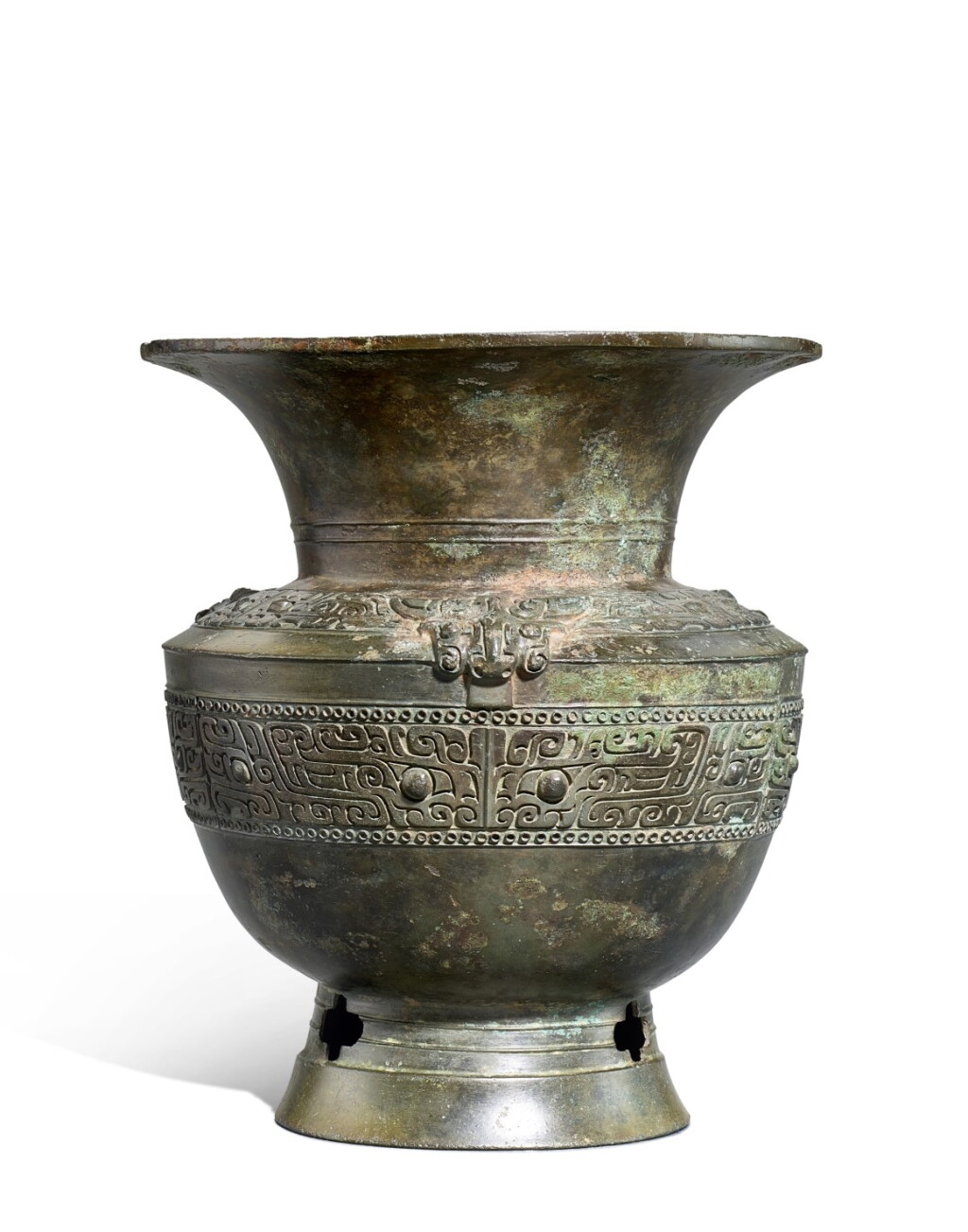
raised on a spreading foot and surmounted by a sloping shoulder and trumpet neck, the stout vessel cast to the middle section with a single register enclosing three prominent animal masks between narrow bands of small circles, the shoulder similarly decorated and interspersed with three small animal heads in high relief, each head aligned with the corresponding mask in the main register, both the neck and foot encircled by bowstrings, with the foot interrupted by three quatrefoil apertures, one side of the interior body cast with a lengthy inscription, wood stand, Japanese double wood box, the inner box with Zoroku Hata's inscription dated 1921
h. 25.2 cm
銘文:
□亥,王才(在)東閒(間)□,王商(賞)乍(作)冊般貝,用乍(作)父己寶彝,□子□□。
其一木盒帶秦蔵六辛酉年(1921年)題字
Discussed at length by Robert Bagley, Shang Ritual Bronzes from the Arthur M. Sackler Collections, Washington D.C., 1987, pp 264-311, vessels of this shouldered zun form seem to have evolved from earlier lei vases and preceded those of a taller gu-inspired shape. At their height in the early Anyang period, zun had become one of the most popular and ritually significant vessels produced and were found in a variety of sizes and proportions. Crafted using piece-mould casting, Anyang bronzes preserve in their bold designs a sense of vitality, presence and grandeur largely unrivalled in later ages and often feature ornate zoomorphic taotie motifs akin to those on the present lot. For a thorough analysis on the development of bronze workmanship during this time, see Su Rongyu, ‘Bronze-Casting Technology in the Late Shang Dynasty’, Mirroring China’s Past. Emperors, Scholars, and their Bronzes, The Art Institute of Chicago, 2018, pp 32-37.
A number of related zun vessels of this form have been excavated from Anyang period sites around Henan and recorded in Zhongguo qingtongqi quanji [Complete collection of Chinese bronze vessels], vol. 1, Beijing, 1996: compare a very similar zun excavated from People’s Park, Zhengzhou in 1961, pl. 107; and another of very similar design and proportions but lacking taotie masks on the shoulder, excavated from Tazhuang, Yanshi in 1974, pl. 105. Compare also a very early shouldered zun of closely related design and slightly taller proportions attributed to the Erligang phase, preserved in the Royal Ontario Museum (acc. no. 954.136.2), illustrated in Bagley, op. cit., p. 87.
貝格利在其專著《Shang Ritual Bronzes from the Arthur M. Sackler Collections》,華盛頓特區,1987年,頁264-311,長文論述此類折肩的青銅尊,可溯自早期的罍,並演變影響後期觚的造形。安陽早期,尊已是最重要的禮器之一,各種比例、尺寸作例皆有。此時期的青銅器使用陶範製作,紋飾與造形強而有力,尊貴穩重,後期難以媲美,多見饕餮紋,如本品。青銅器製作研究,參考蘇榮譽,〈Bronze-Casting Technology in the Late Shang Dynasty〉,《Mirroring China's Past. Emperors, Scholars, and their Bronzes》,芝加哥藝術博物館,2018年,頁32-37。
河南安陽時期遺址出土為數不少相類的青銅尊,錄於《中國青銅器全集》,卷1,北京,1996年:比較1961年鄭州人民公園出土一件相似作例,圖版107;1974年偃師出土另一例,比例與造形相近,器肩無饕餮紋,圖版105。比較另一件更早期的青銅尊,折肩且紋飾相似,造形較高挑,斷為二里崗時期,貯於加拿大皇家安大略博物館(藏品編號:954.136.2),刊於貝格利,前述出處,頁87。
You May Also Like