
Property from a European private collection | Provenant d'une collection particulière européenne
Probably workshop of Guido Durantino (Fontana) | Probablement Atelier de Guido Durantino (Fontana)
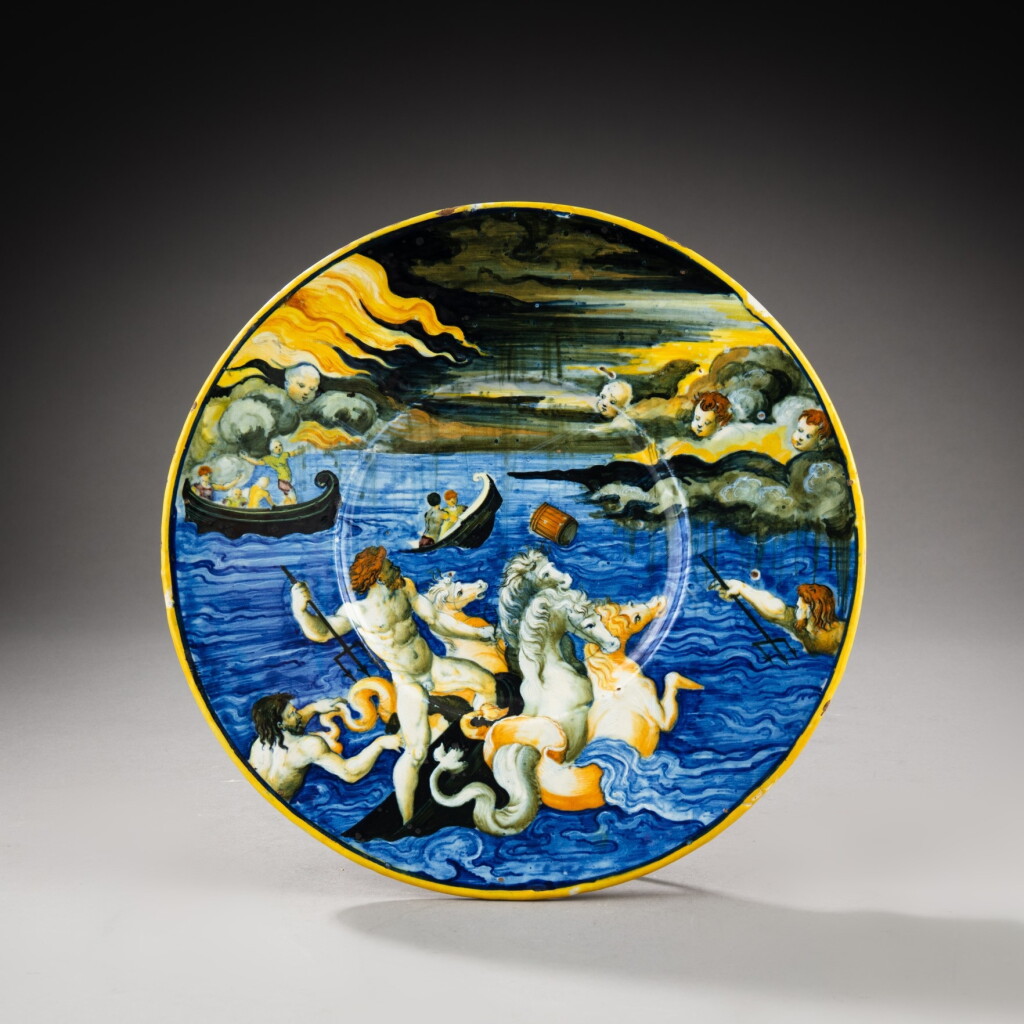
Istoriato plate with “Quos ego” or Neptune calming the storm | Plat 'a istoriato' avec « Quos ego », ou Neptune apaisant la tempête
Auction Closed
November 22, 02:50 PM GMT
Estimate
18,000 - 26,000 EUR
Lot Details
Description
Property from a European private collection
Probably workshop of Guido Durantino (Fontana)
Castel Durante circa 1495 -1576 Urbino
Italian, Urbino, circa 1535 - 1550
Istoriato plate with “Quos ego” or Neptune calming the storm
tin-glazed earthenware (maiolica)
the reverse painted with nottuno in blue
The central figure of Neptune, furious and wielding his trident, is astride a conch shell drawn by hippocampi. To the left of Neptune's shell, a shipwrecked sailor clings to the tails of two hippocampi. On the upper register, Aeneas' fleet has been scattered, the ships are overcome by the storm and two ships, one with the hero standing and raising his hands to the sky. To the right of Aeneas in the center, the ship carrying the Lycians and Orontes sinks. Four heads of putti representing the winds, Boreas, Notos, Euros and Zephyr, hover in the dark clouds.
diameter: 27.2cm., 10¾in.
____________________________________________
Provenant d'une collection particulière européenne
Probablement Atelier de Guido Durantino (Fontana)
vers 1495 - 1576
Urbino, vers 1535 - 1550
Plat 'a istoriato' avec « Quos ego », ou Neptune apaisant la tempête
plat en faïence émaillée (majolique)
nottuno inscrit à la peinture bleue au revers
la figure centrale de Neptune, furieux et brandissant son trident, est à cheval sur une conque tirée par des hippocampes. À gauche de la conque, un naufragé s'accroche aux queues de deux hippocampes. Au registre supérieur, la flotte d'Énée dispersée, les navires vaincus par la tempête et deux navires, dont l'un avec le héros debout et les mains levées vers le ciel. À droite d'Énée, au centre, le navire transportant les Lyciens et l'Oronte coule. Quatre têtes de putti représentant les vents, Borée, Notos, Euros et Zéphyr, planent dans les nuages sombres
Diam. 27,2 cm ; 10 ¾ in.
Signora Sederino, since before 1776, "casa Sederino, Milano e Pombia [Piedmont]", maternal grandmother of Giuseppe Robbo;
By descent to Giuseppe Robbo;
American private collection.
____________________________________________
Collection Signora Sederino, avant 1776, « casa Sederino, Milano e Pombia [Piémont] » ;
Par descendance, collection Giuseppe Robbo, administrateur de la Société des chemins de fer de Sicile à la fin XIXe siècle ;
Collection particulière américaine.
H. Thode et H. von Tschudi (dir.), Repertorium für Kunstwissenschaft, Berlin et Stuttgart, W. Spemann Vienne, 1894, vol. XVII, p. 458-459 ;
G. M. Columba, Il Quos Ego di Raffaello in una maiolica del cinquecento, con una fotolitografia ed una cromolitografia, Palerme, coi tipi del « Giornale di Sicilia », 1895 ;
G. Protonotari, Nuova Antologia, revista di scienze, lettere ed arti, Rome, Direzione della Nuova Antologia, 1895, Anno XXX, vol. CXXXIX, p. 814- 815 ;
The Athenaum, 2 mars 1895, nº 3514, p. 288.
The composition is based upon one of the nine episodes from the story of Aeneas, an episode of Virgil’s epic poem the Aeneid. The story tells how Neptune, who was angry with the winds who Juno released to commence a storm and harass the Trojan hero Aeneas, berates them for causing the tempest without his approval. Neptune addresses the winds “Quos ego…” (Whom I…). In 1516, Marcantonio Raimondi created the engraving after Raphael’s designs which included several vignettes illustrating stories from the Aeneid, including central image of Neptune and which Durantino adopted for this composition here (fig. 1). This engraving was a rich source of designs frequently used by maiolica painters in Urbino. The painter of this dish used intense colors creating and creates a sense of movement and depth which contribute to the decorative richness of the scene.
GUIDO DURANTINO, FOUNDER OF THE FONTANA DYNASTY
Guido Durantino was one of the most important creators of istoriato maiolica of the 15th century. By 1541, he took the name Fontana, which was passed on to his descendants. From that date forward, he held a prestigious position in his craft and his workshop was awarded many major commissions from the likes of the Duke Francesco Maria Della Rovere, the Emperor Charles V, Cardinal Farnese, brother of the Duchess of Urbino Vittoria Farnese, the Duke Guidobaldo II of Urbino, and Philip II of Spain.
J.V.G. Mallet, in his seminal article on the workshop of Guido Durantino1, distinguishes the hand of six painters who worked in that studio. After a thorough analysis of the workshop’s corpus, it seems possible that the present plate of Neptune calming the storm is linked to Mallet’s second group, executed between 1535 and 1539, in which we can detect the influence of Nicola da Urbino. During this period, the workshop was producing the two great princely ceremonial services, that of the Constable Anne de Montmorency, painted with mythological and historical scenes, and that of Cardinal Antoine Duprat painted with biblical subjects, both from 1535. These services allow us to date the present plate as early as 1535. Although the inscription on the reverse of this piece is in a different hand than those on the two services, it does not mean that they are the work of different artists. Mallet has demonstrated that the painter and inscriber were not always the same person.
1 J. V. G. Mallet, “In Botega di Maestro Guido Durantino,” in The Burlington Magazine, vol. CXXIX, no. 1010, May 1987, pp. 284-298
We are grateful to Professor Timothy Wilson and Mrs. Greta Kaucher for their invaluable contributions to the research on this entry.
____________________________________________
La composition de ce plat s'inspire d'un des neuf épisodes l'Énéide, poème épique de Virgile relatant l'histoire d'Énée. L'épisode raconte comment Neptune, en colère contre les vents que Junon a libérés afin de déclencher une tempête sans son accord afin de tourmenter le héros troyen. Neptune s'adresse aux vents en ces termes : « Quos ego... » (Qui je...). En 1516, Marcantonio Raimondi réalise la gravure d'après les dessins de Raphaël, qui comprend plusieurs vignettes illustrant des récits de l'Énéide, dont l'image centrale de Neptune, que Durantino a adoptée pour cette composition (fig. 1). Cette gravure fut une précieuse source d'inspiration fréquemment utilisés par les peintres en majolique d'Urbino. Le peintre de ce plat utilisa des couleurs intenses, créant ainsi une impression de mouvement et de profondeur qui contribue à la richesse décorative de la scène.
GUIDO DURANTINO, FONDATEUR DE LA DYNASTIE DES FONTANA
Guido Durantino est l'un des plus importants créateurs d'istoriato en majolique du XVe siècle. En 1541, il prit le nom de Fontana, qui fut transmis à ses descendants. À partir de cette date, il occupe une position prestigieuse et son atelier reçoit de nombreuses commandes importantes de la part du duc Francesco Maria Della Rovere, de l'empereur Charles Quint, du cardinal Farnese, frère de la duchesse d'Urbino Vittoria Farnese, du duc Guidobaldo II d'Urbino et de Philippe II d'Espagne.
J.V.G. Mallet, dans son article fondateur sur l'atelier de Guido Durantino1, distingue la main de six peintres ayant travaillé dans cet atelier. Après une analyse approfondie du corpus de l'atelier, il semble possible de rattacher ce plat illustrant Neptune calmant la tempête au deuxième groupe de Mallet, exécuté entre 1535 et 1539, dans lequel on peut déceler l'influence de Nicola da Urbino. À cette époque, l'atelier produit les deux grands services d'apparat princiers, celui du connétable Anne de Montmorency, peint de scènes mythologiques et historiques, et celui du cardinal Antoine Duprat, peint de sujets bibliques, tous deux datés de 1535. Ces services nous permettent de dater la présente assiette de 1535. Bien que l'inscription au verso de cette pièce soit d'une main différente de celle des deux services, cela ne signifie pas qu'ils sont l'œuvre d'artistes différents. Mallet a démontré que le peintre et l'auteur de l'inscription n'étaient pas toujours la même personne.
1 J. V. G. Mallet, “In Botega di Maestro Guido Durantino,” in The Burlington Magazine, vol. CXXIX, n° 1010, mai 1987, p. 284-298
Nous remercions le professeur Timothy Wilson et Mme Greta Kaucher pour leur précieuse contribution aux recherches concernant cette œuvre.