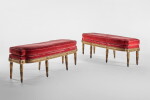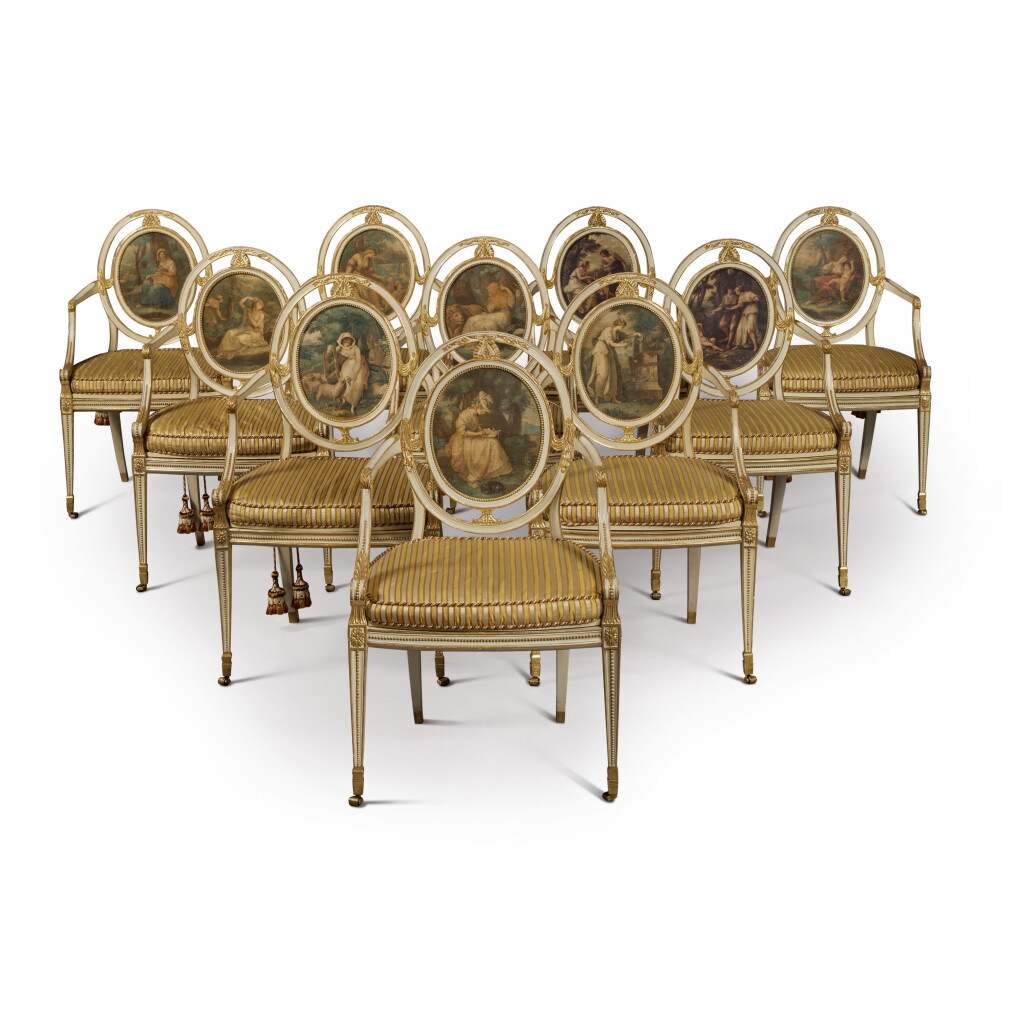
A Set of Eight George III Parcel-Gilt and White-Painted Open Armchairs together with a Matching Triple Back Settee, Attributed to George Brookshaw, Circa 1790
Auction Closed
February 3, 09:38 PM GMT
Estimate
50,000 - 80,000 USD
Lot Details
Description
Each oval back incorporating hand colored engravings after Angelica Kaufman
height armchairs 39 in.; width 23 in.; depth 22 in.
99 cm.; 58.5 cm.; 56 in.
height sofa 39.5 in.; width 5 ft. 11 1/2 in.; depth 29 in.
101.5 cm.; 181.5 cm.; 73.5 cm.
Supplied to James Beal Bonnell, possibly for Upton House,
Essex (circa 1782-88), but more likely Pelling Place, Old
Windsor, Berkshire, circa 1788-90
Thence by descent until circa 1950
H. Blairman & Sons Ltd., June 1960, exhibited at the Antique
Dealer's Fair, Grosvenor House, London
Dr. and Mrs. Jules C. Stein, Christie's New York, 19 April
1986, lots 134-136
Christie’s London, 14 June 2001, lot 55
London, C.I.N.O.A., Victoria & Albert Museum, 1962, cat. no. 124
On loan to Bolling Hall Museum, Bradford, 1964
E. T. Joy, 'The Upton House Suite of Adam Painted Furniture', Connoisseur, June 1960, pp. 28-31.
C. Musgrave, Adam and Hepplewhite Furniture, 1966, p. 196, no. 72; p. 198, no. 88 and fig. 88 (the settee).
R. Edwards, The Shorter Dictionary of English Furniture, London, 1964, p. 159, fig. 165.
This extremely rare suite of eight carved and gilded open armchairs and a chairback settee, the backs decorated with applied oval hand-coloured engravings after Angelica Kauffman (d. 1807), originally formed part of a group that also comprised a pair of torchere stands, a pair of pole screens and a Pembroke table. It was acquired by James Beal Bonnell, who on the death of his father James Bonnell, Lord of Purleigh Manor, in 1774 inherited Upton House in Essex, and in 1788 removed to Pelling Place in Old Windsor, a cottage acquired by his father that was enlarged to create a 14-room villa 'with a bold view of Windsor Castle and the picturesque Scenery in its Vicinity' along with twenty acres of pleasure grounds (William Angus, The Seats of the Nobility and Gentry in Great Britain and Wales in a Collection of Select Views, London 1787, pl. 51). According to Rudolph Ackermann's Repository of Arts, the property was 'considerably enlarged and improved by Mr. Bonnell by purchase, and now consists of a handsome suite of apartments' (vol. III, February 1824, no. XIV).
According to family tradition the suite was used by the Royal Family on an informal visits to the villa in 1797, with Queen Charlotte and her daughters breakfasting on the sofa, and King George scratching the engraved medallions with the buttons of his coat. The Pembroke Table from the suite was recently sold Sotheby's New York, Hyde Park Antiques: Past, Present and Future, Part I, 31 January 2023, lot 68.
A handwritten catalogue of the Pelling Place collection written in August 1852 by Bonnell's half sister Mary Anne Harvey Bonnell lists a chimney piece with frieze panels by Angelica Kauffman supplied by the London cabinetmaker George Brookshaw (sold Sotheby's London, 7 July 2000, lot 81), and he is likely to have created the furniture en suite. Relatively little is known about the career of the Peintre Ebéniste Brookshaw (c.1751-1823), who is recorded at 48 Great Marlborough Street from 1783-1788 and worked for the Prince Regent at Carlton House, where in 1783 he supplied 'an elegant commode highly finished with a basket of flowers painted in the front of the body and sprays of jasmine all over the top, and ditto on the front, the body with carved and gilt mouldings and legs’. He appears to have specialised in painted furniture and would later cease his furniture making activity and become exclusively a botanical illustrator (see Lucy Wood, 'George Brookshaw: The Case of the Vanishing Cabinet-Maker,' Apollo, May and June 1991).
The subjects depicted on the backs of the chairs have been identified as:
- The Shepherdess Griseldis, from Geoffrey Chaucer's Canterbury Tales (G. Hatje, Angelica Kauffmann, 1998, fig. 215).
- Syvlia overseen by Daphne, 1787, engraving by P.W. Tomkins (pupil of Bartolozzi) (Hatje, fig. 120).
- The Birth of Shakespeare, 1782, engraving by F. Bartolozzi (C.G. Boerner, Angelika Kauffmann, Düsseldorf, 1979, fig. 163a).
- Fame Decorating Shakespeare's Tomb, 1782, engraving by F. Batolozzi (Boerner, fig. 163b).
- Una, from Edmund Spenser's Faerie Queene, 1590, engraving of 1783 (Boerner, fig. 169).
- Louisa Hammond, from the novel by Samuel Jackson Prat The Miseries of Civil War, 1780, engraving by F. Bartolozzi, 1781 (Hatje, fig. 119).
- possibly Erminia, in the guise of a shepherdess, from Torquato Tasso's Gerusalemme Liberata
- and a pastoral shepherdess after Francis Wheatley
The settee:
- left oval: Eros having his wings clipped, possibly an allegory of love tamed
- left oval: Eros sleeping, possibly an allegory of love awakening
- central oval: Musidora and Damon, from James Thomson's Seasons, 1730, engraving by F. Bartolozzi, 1782 (Boerner, fig. 138).
You May Also Like