A Louis XV Aubusson Pile Carpet, Mid-18th Century
Estimate
40,000 - 60,000 USD
Lot Details
Description
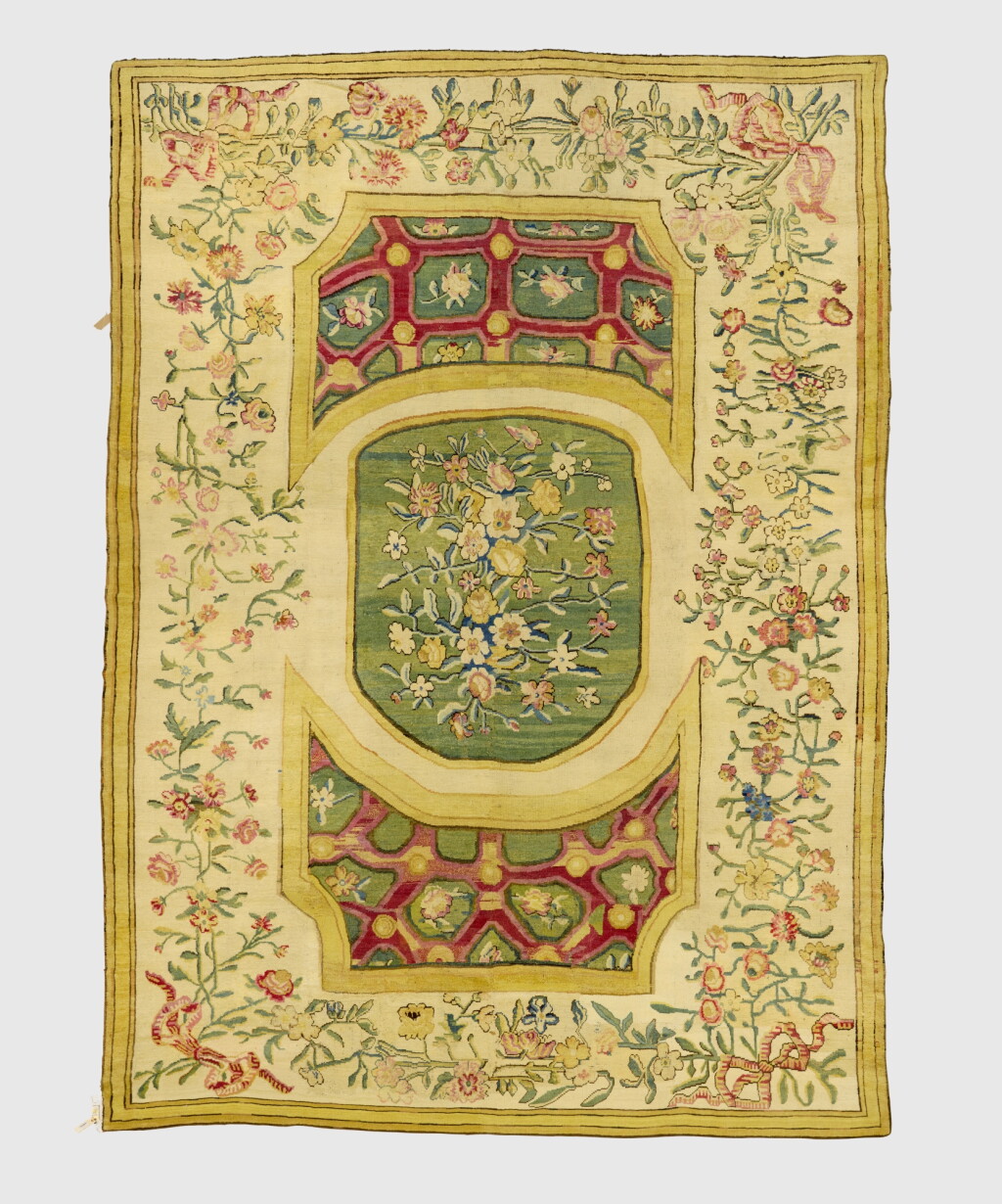
A Louis XV Aubusson Pile Carpet, Mid-18th Century
reduced in width; the central reserves with a green medallion and green coffered cartouches with flowerheads and floral sprays surrounded by ribbon-tied floral sprays on a cream ground within narrow pale-yellow border
approximately 18 ft. 10 in. x 13 ft. 6 in.
574 x 411.5 cm
Collection of Condé Montrose Nast (1873-1942), New York;
Parke-Bernet Galleries, New York, 7-9 January 1943, lot 324;
Collection of Doris Duke (1912-1993);
Christie's New York, 3-4 June 2004, lot 351;
Christie's New York, 14 October 2020, lot 2;
Where acquired by the present collector.
This large and well-preserved lot is a rare example of an early carpet from the central French city of Aubusson. Tapestry-weaving in Aubusson can be traced back to the fourteenth century, probably introduced by immigrants from Flanders, and in 1665 the Aubusson workshops were granted a royal charter by Louis XIV's minister Colbert. In response to increased demand the factory expanded its production in 1743 to include knotted pile carpets in the Turkish manner as had been manufactured in the Savonnerie factory in Paris since the seventeenth century, although unlike the Savonnerie, Aubusson's output was never exclusively limited to a royal clientele. Early Aubusson pile carpets employed abundant colourful floral sprays as the primary decoration, and later in the reign of Louis XV introduced more neoclassical elements such as the coffered background seen on the present lot and on a similar carpet in the Musée Nissim de Camondo, Paris, and Adam-style fan motifs are integrated into the floral design of a further related example formerly in the collection of Mrs Robert Lehman, sold Sotheby's New York, 18 November 2010, lot 245.
The carpet formed part of two highly distinguished twentieth-century American collections; Condé Montrose Nast (1873-1942), founder of the eponymous magazine publishing empire with titles including Vogue, Vanity Fair and House & Garden, who acquired a duplex penthouse at 1040 Park Avenue decorated by the legendary designer Elsie de Wolfe with Louis XV furniture and carpets and Chinese wallpaper and screens and a celebrated venue for entertaining the cafe society of pre-war New York. Following Nast's death it was acquired by the tobacco heiress and philanthropist Doris Duke (1912-1993), who formed and important art collection that filled multiple residences including her Newport mansion Rough Point and Duke Farms, a large estate in New Jersey where she was able to indulge in her passion for botany by transforming the gardens and greenhouses into one of the largest horticultural displays in the United States, an appropriate context for the floral them of the present lot.
You May Also Like