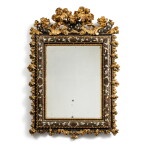
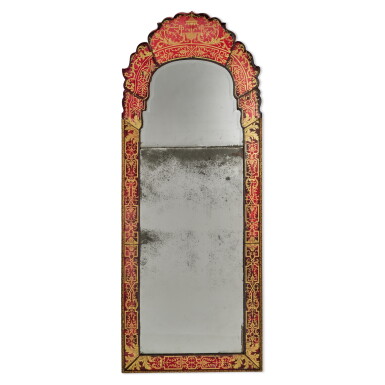
A Queen Anne Scarlet and Verre Églomisé Pier Mirror, in the Manner of Thomas and René Pelletier, Circa 1710
Auction Closed
February 3, 09:38 PM GMT
Estimate
20,000 - 30,000 USD
Lot Details
Description
black and gold painted wood borders and pinewood backing frame later
height 64 1/2 in.; width 25 1/4 in.
164 cm.; 64.2 cm.
Elegance and Wonder: Masterpieces of European Art from the Jordan and Thomas A. Saunders III Collection, Virginia Museum of Fine Arts, Richmond, Virginia, May 2022-October 2023
Named after the Parisian dealer, framer and restorer Jean-Baptiste Glomy (1711-1786), the technique of verre églomisé involves applying gold or silver leaf to the reverse of a glass plate into which designs are then engraved, and then adding coloured foil and pigments, most frequently red or black, but shades of blue and green were also used. The technique existed in ancient Rome and resurfaced in Italy in the 14th century, when details of the process were described in the painter Cennino Cennini's Libro dell'Arte (c.1400). It enjoyed a revival in France and Continental Europe during the reign of Louis XIV and was used to create glass border mirrors decorated with figural and arabesque motifs in the manner of the court ornamental engravers Jean Bérain (1640-1711) and Daniel Marot (1661-1752); the latter's arrival in England in 1694 contributed to its development in England, where it was sometimes referred to as 'mosaic work'.
Other comparable scarlet ground verre églomisé pier glasses include an example at Penshurst Place, Kent (illustrated in R. Edwards, The Dictionary of English Furniture, 1954, Vol. II p.322, fig.28) and a large pair supplied to Sir Nathaniel Curzon, 2nd Bt (d.1718) formerly at Kedleston Hall, Derbyshire and now in the Gerstenfeld Collection, Washington, DC (E. Lennox-Boyd, Masterpieces of English Furniture, The Gerstenfeld Collection, London 1998, no.69 p.227). The latter examples also both have giltwood cresting, unlike the offered lot which retains its cresting of glass panels with conforming decoration to that of the borders, an extremely rare survival. A pair of extremely similar scarlet mirrors without giltwood cresting of larger scale was sold Sotheby's New York, 20 October 2021, lot 110 ($113,400; illustrated Lanto Synge, Mallett's Great English Furniture, London 1991; p.29 fig. 16).
This mirror relates closely to the work of the royal cabinet-makers Thomas and René Pelletier, sons of Jean Pelletier (active 1681 - 1704). This family of carvers and gilders of French Huguenot extraction supplied pier tables, mirrors, candle stands and frames to King William III and Queen Anne as well as for other notable patrons such as Ralph, Earl and later 1st Duke of Montagu, Master of the Wardrobe to William III, for his London home and Boughton House, Northamptonshire.
You May Also Like