Allan Ramsay
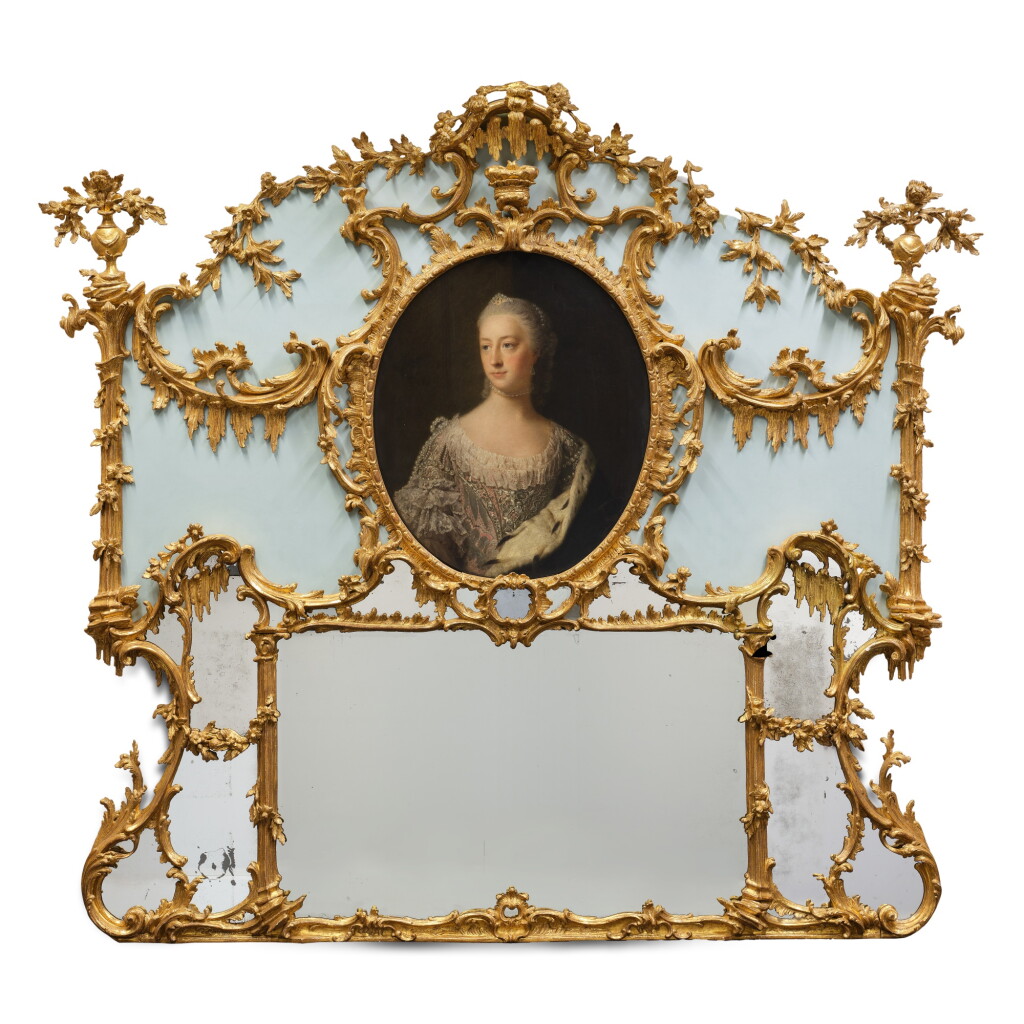
A George III Giltwood Overmantel Mirror attributed to William Mathie, Edinburgh, with a portrait of Willielma Campbell, Viscountess Glenorchy by Allan Ramsay (Edinburgh 1713-1784 Dover)
This lot has been withdrawn
Lot Details
Description
height 6 ft. 5 in.; width 6 ft. 11 in.
195 cm; 211 cm
Commissioned to celebrate the 26 September 1761 marriage of Willielma Maxwell and John Campbell, Viscount Glenorchy
Thence by inheritance and descent to James, 14th Lord Torpichen (1917-1975)
London, Sotheby's, 2 December 1966, lot 167
With Mallett, London
Eric and Rita Robinson, Mereworth Castle, Kent, April 1968
With Mallett, London, February 1982
American Private Collection, April 1982
With Mallett, London 2001
Country Life, 2 March 1971
A. Smart, Allan Ramsay, A Complete Catalogue of his Paintings, New Haven and London 1999, p. 123, cat. no. 199, reproduced fig. 524
This beautiful overmantel is an extraordinary incarnation of British woodcarving from the golden age of the Georgian mirror. Although landscape and still-life scenes painted in oils or Chinese reverse mirror picture panels were periodically introduced into 18th-century mirror compositions, it is exceptionally rare to find a mirror incorporating a portrait where both the sitter and artist are securely identifiable. Along with the in situ overmantel supplied in 1765 by John Linnell for Mrs Child's Dressing Room at Osterley Park with a Francis Cotes portrait of her daughter Sarah Anne (National Trust, NT 771824), the Saunders mirror is one of the few surviving examples of this felicitous combination of the painter's and the carver and gilder's art.
LADY GLENORCHY
This elegant portrait depicts Willielma Campbell (1741-1786), one of the most prolific benefactors and evangelical activists in eighteenth-century Scotland. Allan Ramsay, who captured many of the Scottish Enlightenment's defining portraits, portrayed the stylish sitter on the occasion of her 26 September 1761 nuptials to John Campbell (1738-1771), Viscount Glenorchy, second and only surviving son of John Campbell, 3rd Earl of Breadalbane and Holland (1692-1782). Ramsay's almost rococo treatment of the dark-haired sitter showcases his masterful ability to render an extraordinary range of surface textures and materials, including pearls, silver and pink thread, and intricate lacework.
The daughter of the medical practitioner William Maxwell (d. 1741), Willielma spent her early years in Kirckcudbright in western Scotland. Following his untimely death before her birth, Willielma's mother, Elizabeth Hairstances (d. circa 1806) later married Lord Charles Erskine Tinwald (1680-1763), a prominent judge. Her step-father's social position enabled Willielma and her younger sister Mary (1745-1766), later Countess of Sutherland, to circulate in elite Edinburgh society, where she met the Viscount. As recounted by Thomas Jones, the sitter's biographer, the wedding facilitated Willielma's entrance "into the pomp and splendour of high life,"1 an event commemorated by the refined painting and elaborate frame.
Following their wedding, the couple lived at Great Sugnall, Straffordshire. There the Presbyterian Willielma encountered the Hill family of Hawkstone Park, Shropshire, who introduced her to Methodism, sparking her philanthropic support of Scottish nonconformists. She actively supported evangelical preaching and missionary activity and became even further involved in the cause following her husband's death in 1771. In 1774, she funded the opening of a new chapel in Edinburgh and in the 1780s, she facilitated chapel openings in Exmouth, Carlisle, Matlock Bath, Workington, and Bristol. She died in Edinburgh in 1786 and was buried in Lady Glenorchy's Church, which she had been instrumental in funding and constructing.
The preferred painter of the Campbell family, Ramsay painted the sitter on two occasions and also produced portraits of her sister, mother, and mother-in-law, Arabella, Countess of Breadalbane. In 1750, when Willielma was nine years old, she sat for Ramsay, who also created a pendant portrait of her sister Mary.2 Four years later, Ramsay painted their mother, then Lady Alva.3 Toward the end of Willielma's life, she sat for Ramsay's favorite pupil, David Martin, a work now in the Scottish National Galleries, Edinburgh (inv. no. PG 2476).
WILLIAM MATHIE OF EDINBURGH
No documentation concerning the authorship of the mirror frame has come to light, but a plausible attribution would be the wood and stone carver William Mathie, son of an East Lothian merchant who in 1733 was apprenticed to the Edinburgh cabinetmaker Alexander Peter (1713-1772).4 Peter was one of the leading furniture makers or wrights active in the Scottish capital in the mid-18th century and was employed by many of the most prominent clients of the day, among them the Duke of Gordon, Earl and Countess Hopetoun, Sir John Clerk of Penicuik, the Earl of Lauderdale and most importantly the Earl of Dumfries at Dumfries House in Ayrshire, to whom Peter supplied hall chairs, dining chairs and tables and other furniture between 1759 and 1764 to complement that supplied prior by Thomas Chippendale in one of his most celebrated commissions.
Although Mathie only officially became a freeman or burgess in 1760, he did work in his own name alongside Peter at Dumfries House, where accounts show in 1759 he provided pairs of pier glasses for the Blue Drawing Room and Pink Dining Room as well additional mirrors for bedrooms and picture frames. Still in situ, the commission demonstrates Mathie's mastery of the rococo idiom as developed by Chippendale and illustrated in his designs for 'pier glass frames' in plates 141-157 of the first edition of the Director (1754), and designs for overmantels seen in projects for 'Chimney Pieces' in plates 179 and 181-184 of the third edition (1762). One of the overmantels in plate 181 displays very similar flowering urn finials on the shoulders, similar to those on the Saunders mirror, and interestingly when the Saunders mirror first appeared on the market the preceding lot was a 'companion' large pier glass with the same provenance and also with flowering urns.5 Comparable finials are also visible on the cresting of a pair of large pier glasses attributed to Mathie previously in the Walter Annenberg and Feather Collections, sold Christie's New York, 11 April 2018, lot 511. Such motifs also appear in Plate 9 of the influential draughtsman and woodcarver Thomas Johnson's One Hundred & Fifty New Designs published in 1761.
The few securely documented commissions of Mathie include providing mirrors, frames and brackets to Robert Dundas at Arniston House in 1759 and 1761, and a group of frames and mirrors to Francis Charteris, 7th Earl of Wemyss at Amisfield House, for which payments were recorded in 1760 and 1761.6 It is noteworthy that both clients were also patrons of Alexander Peter, whose name moreover appears in connection with work for both the Earl of Breadalbane at his seat of Taymouth Castle, Perthshire in 1745 and 1754 and for Lord Glenorchy at his grace and favour apartment in Holyrood Palace, Edinburgh. It is probable the Campbells would have been familiar with the work of Peter's apprentice, and this supports the hypothesis that Mathie would have been charged with carving the overmantel frame for the Ramsay portrait of Willielma.
It is not known whether the Lady Glenorchy Overmantel was intended for Taymouth, Holyrood or another of the Campbell properties. Viscount Glenorchy had no children with Willielma and died prematurely eleven years before his father, and upon the latter's death the Breadalbane title, estate and chattels passed to his third cousin John Campbell, 1st Marquess of Breadalbane (1762-1834). The Fourth Earl extensively rebuilt Taymouth Castle in an exuberant neogothic style in the early 19th century, and it remained the family seat until sold in 1922. The overmantel remained with descendants until sold by the 14th Lord Torphichen in 1966, where it was acquired by Mallett who then sold it in 1968 to the Robinsons, the new owners of Mereworth Castle in Kent, a remarkable copy of Palladio's iconic Villa La Rotonda in Vicenza, built in the 1720s for John Fane, 7th Earl of Westmoreland after designs by the architect Colen Campbell. In the postwar decades Mereworth was inhabited by the artist Michael Tree, son of Sir Ronald Tree and Nancy Lancaster, and its current owner is the Bahrana-Emirati businessman Mohammed Mahdi Al Tajir, who also owns the large hunting estate Keir House near Stirling, coincidentally only about 40 miles from Taymouth Castle. The Glenorchy mirror again passed through Mallet and this is only the second time it has appeared at auction.
1 T.S. Jones, The life of the Right Honourable Willielma, Viscountess Glenorchy, Edinburgh 1822, p. 5.
2 Sold Sotheby's, London, 10 July 1991, lot 36.
3 Sold Sotheby's, London, 10 July 1991, lot 37.
4See Francis Bamford, 'Two Scottish Wrights at Dumfries House', Furniture History 1973, p.80-87.
5 Sotheby's London, 2 December 1966, lot 166
6 One mirror from the commission sold Christie's London, 15 November 2017, lot 100
You May Also Like