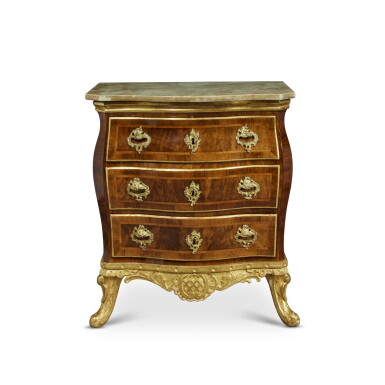
A Danish Rococo Gilt-Bronze Mounted Parcel-Gilt Walnut Parquetry Commode, Attributed to Mathias Ortmann, Mid-18th Century
No reserve
Auction Closed
February 3, 09:38 PM GMT
Estimate
3,000 - 5,000 USD
Lot Details
Description
With beige-white marble top
height 33 in,; width 30 1/4 in.; depth 20 3/4 in.
84 cm.; 77 cm.; 52.7 cm.
La Vie de Château, Collection Jean-Louis Remilleux Christie's Paris, 28-29 September 2015, lot 130
Mathias Ortmann (ca.1700-1757) was born in Sweden as the son of a cabinet-maker. At an early age he became an apprentice in his father's rapidly expanding workshop which was situated in Hyhavn, Copenhagen. Amongst other royal family members, his father counted Frederik IV's brother Prince Carl as a customer buying pieces for his palace Charlottenborg. Two years after the death of Matthias' father in 1723, and acquiring his trade license as furniture-maker, Matthias carried on the business.
From travelling as an apprentice in Europe, mainly in France under Louis XV, Ortmann learned the benefits of signing his furniture. The Ortmann label has since then become the collector's guarantee for a genuine Ortmann. However it is not all Ortmann pieces that actually bear his prized signature. Ortmann only signed his furniture from 1745 to 1757 and part of his production pre-dates this period. There are also a number of Ortmann pieces from that era that can almost certainly be attributed to Ortmann due to their identifiable style.
A characteristic hallmark is his corner ornaments of gilded lead. The most commonly used material for corner ornaments among other cabinet-makers at his time was gilded wood carvings or – when in the French style – gilded bronze mountings, but Ortmann was content with just carving his plinths and using gilded brass mountings for key plates and handles.
Ortmann's early chests of drawers had straight sides, but he later developed his bombé-shaped model with gilded, carved plinth and legs. The typical Ortmann look also includes gilded drawer edges and a gilded plaster frieze with delicate carvings beneath the gilded upper edge. This golden band is placed just beneath the marble top covering the label. A frieze of this sort is not seen on French chests of drawers. It is entirely of Northern European origin.
You May Also Like