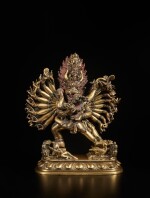

A gilt-bronze group of Vajrabhairava and Vajravetali, Qing dynasty, Qianlong / Jiaqing period
Auction Closed
September 17, 03:45 PM GMT
Estimate
15,000 - 25,000 USD
Lot Details
Description
Himalayan Art Resources item no. 1912.
Height 7⅞ in., 20 cm
Sotheby's New York, 19th September 1996, lot 254.
Florida Private Collection.
This complex and powerfully modeled sculpture depicts Yamantaka Vajrabhairava, the wrathful manifestation of Manjushri, the Bodhisattva of Discriminating Wisdom, together with his consort Vajravetali in ecstatic union. The large and ferocious buffalo head of Vajrabhairava with towering, fiery tresses coiled into thick ropes dominate the sculpture and commands the focal point, as it is the same size as the torso and legs. Six fierce human faces wrap around the back of the buffalo head, and are surmounted by a further fierce human face and the head of wrathful Manjushri. Vajrabhairava, or Adamantine Anger, the destroyer of ignorance and fear of death, is one of the principal yidams of the Geluk sect, the Tibetan Buddhist order founded by Tsongkhapa (1357-1419) that enjoyed increased importance amongst the emperors of the Ming dynasty. From the mid-seventeenth century onwards, favored by the Qing court, the sect and its lineage became the became the dominant theocratic power in Tibet through the Dalai Lama, and the sole represented Tibetan Buddhist lineage at the imperial court of China.
Tsongkhapa, as well as the Manchu emperors, were additionally considered manifestations of the bodhisattva Manjushri, explaining in part the popularity of Vajrabhairava within China. The Qing emperors maintained direct links with the Dalai and Panchen Lamas and propagated the Geluk lineage of Buddhism within China, sponsoring the construction of numerous monasteries and temples around the capital of Beijing. Vajrabhairava, the all-powerful manifestation of Manjushri, was thereby symbolic of ultimate imperial authority. This awe-inspiring statue serves to enforce the imperial mandate while representing the highest ideals of the spiritual path to Buddhist enlightenment.
Another figure of similar size, iconography and workmanship is illustrated in Buddhist Art from Rehol: Tibetan Buddhist images and ritual objects from the Qing dynasty Summer Palace at Chengde, The Chang Foundation, Taipei, and the Kaohsiung Museum of Fine Arts, Kaohsiung, 1999, cat. no. 46. A larger model of Yamantaka with a Jiaqing reign mark in the British Museum, London, is illustrated in Wladamir Zwalf, Heritage of Tibet, London, 1981, pl. 28. See also a closely related figure sold in these rooms, 20th September 2022, lot 110.
You May Also Like