
Property from an Esteemed European Collection
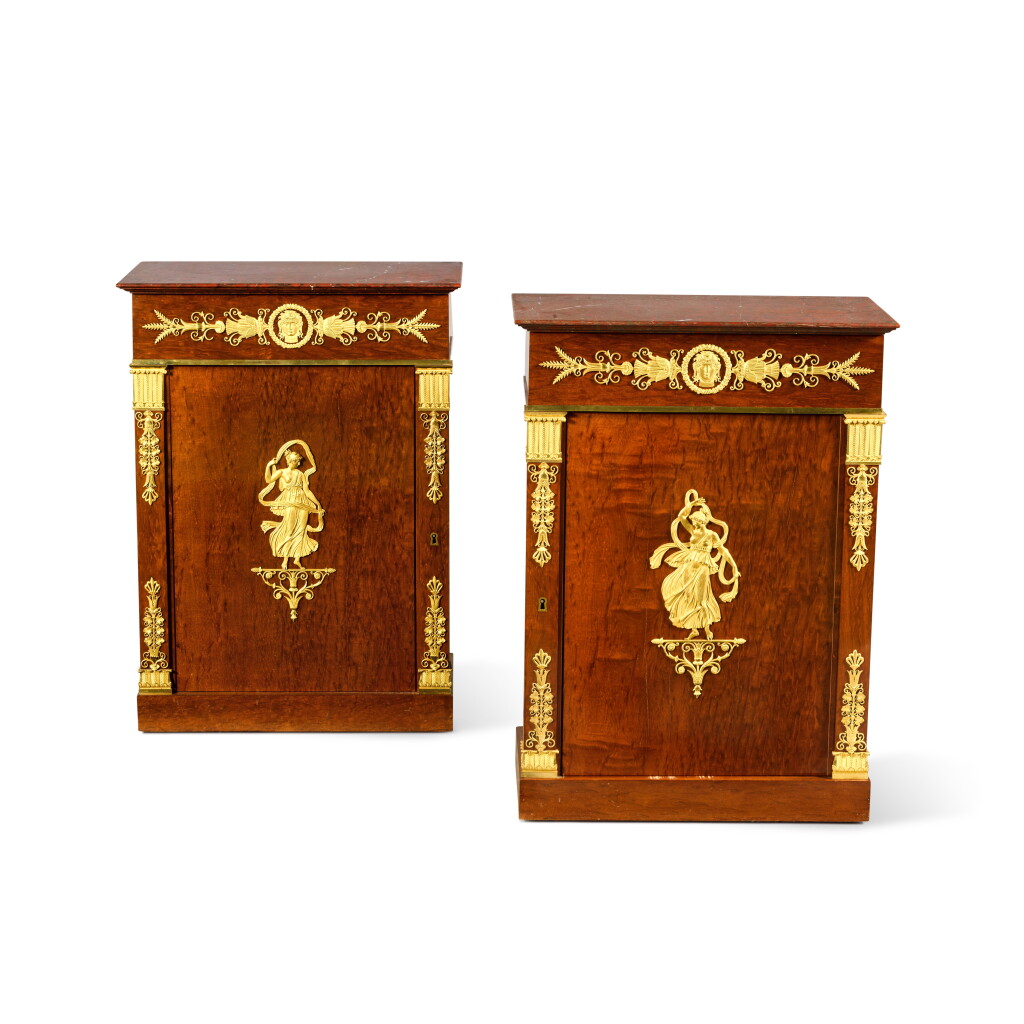
A pair of Empire gilt-bronze mounted mahogany meuble d'appui by Charles-Joseph Lemarchand, early 19th century
Lot Closed
November 12, 02:53 PM GMT
Estimate
10,000 - 15,000 GBP
We may charge or debit your saved payment method subject to the terms set out in our Conditions of Business for Buyers.
Read more.Lot Details
Description
the gilt-bronzes attributed to Thomire, the later rouge griotte marble top above a frieze decorated with a woman's mask in a medallion of flowers and a frieze of foliage and palmettes, the door centred with a draped figure of a Maenad flanked by Corinthian pilasters decorated with vine shoots and palmettes, opening to reveal one shelf, resting on a plinth, both stamped "C. Lemarchand"
93cm high, 67cm wide, 34.5cm deep; 36 5/8in., 26 3/8in., 13 5/8in.
J-P. Samoyault, Mobilier Francais Consulat et Empire, Paris, 2009, p. 200, pl. 343.
Christophe Huchet de Quénetain, Les Styles Consulat et Empire, Paris, 2005, p.86.
Charles-Joseph Lemarchand (1758-1826) was made a maître ébéniste in 1789. His son, Louis-Edouard was also a cabinet maker, taking over his father’s workshop after his death and provided a number of pieces to the monarchy during the Bourbon restoration. Lemarchand furniture – made by both father and son – remains at many of the Imperial residences of the first Empire, including at Malmaison, at the Château de Fontainebleau, as well as the Musée des Arts Décoratifs (ARMEE 2007.2.104) and other major institutions today.
Lemarchand used a similar decorative style to other ébénistes of this period, such as Bernard Molitor and, in particular François-Honoré-Georges Jacob-Desmalter. The archetypal rigidity of architectural form is typical of Lemarchand’s work of the early 1800s, as is the refined use of mahogany adorned with gilt-bronze mounts. Figures in gilt bronze, in this case cast by Pierre-Philippe Thomire-Duterme et Compagnie, feature on many Lemarchand pieces. In this pair of cabinets, the figures are women in Antique dress, positioned as if dancing with a fabric scarf billowing artfully around them. There are cast so that they mirror one another. These particular mount motifs are also found on a commode by Adam Weisweiler, now at the Palazzo Reale in Milan (see P. Lemonnier, Weisweiler, Paris, 1983, p. 53)
This decorative language is characterised by its simplicity, refinement and its references to classicism. It was catalysed, at least in part, by Napoleon’s expeditions to Egypt and the publication of Vivant Denon’s multi-volume study, Description de L’Egypte in 1809. This is evident by the flowing foliate forms emanating from the golden pilaster capitals and the gold-mount frieze running along the cabinets’ upper register.
You May Also Like


