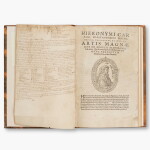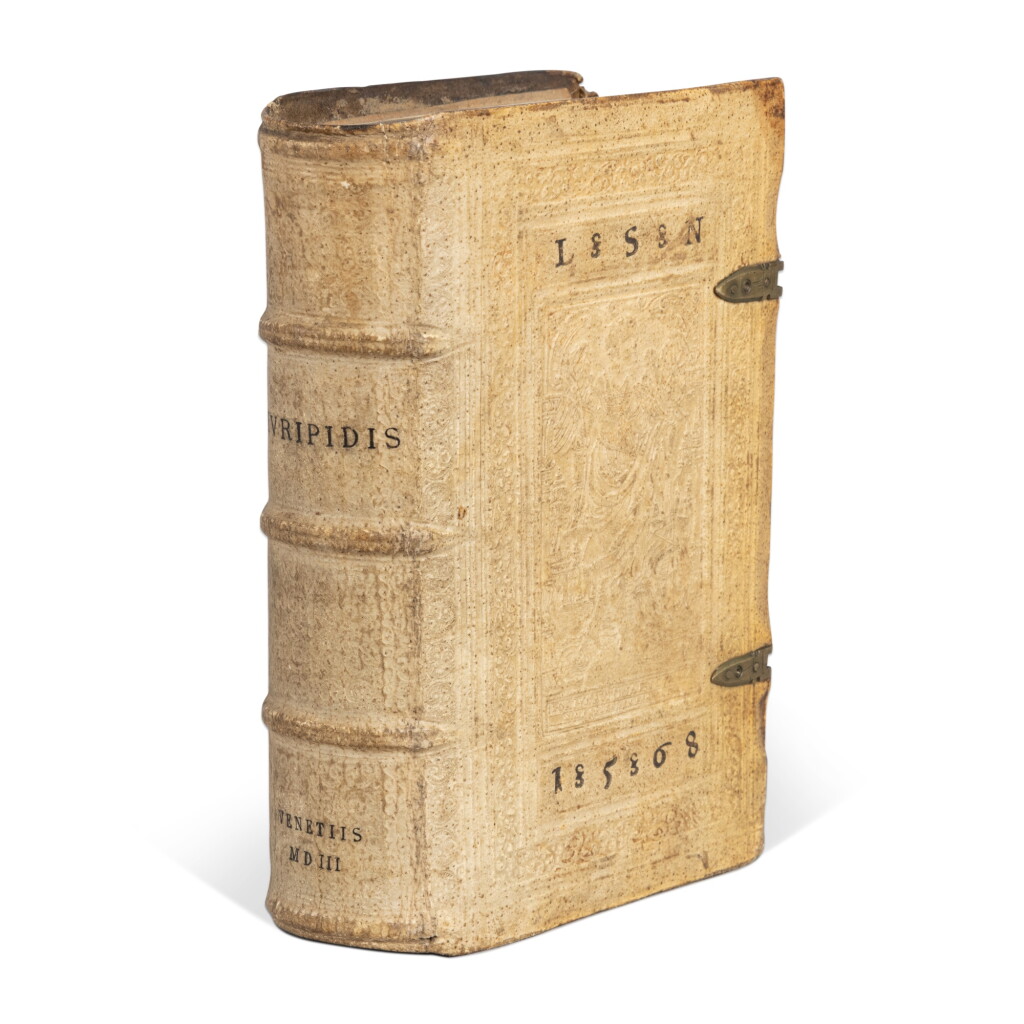
Euripides, Tragodiai, Venice, Aldo, 1503, German sixteenth-century blind-tooled pigskin by Thomas Kruger of Wittenberg
Auction Closed
October 18, 08:42 PM GMT
Estimate
15,000 - 25,000 USD
Lot Details
Description
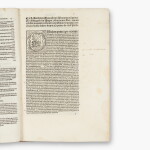
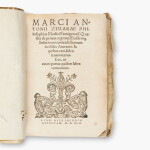
Euripides. Εὐριπιδου Τραγωδιαι επτακαιδεκα ὀν ἐνιαι μετ'εξηγησεων εἰσι δε αὐται … Euripidis Tragoediae septendecim, ex quib. quaedam habent commentaria, et sunt hae. Hecuba Orestes Phoenissae Medea Hippolytys Alcestis Andromache Supplices Iphigenia in Aulide Iphigenia in Tauris Rhesus Troades Bacchae Cyclops Heraclidae Helena Ion. (Venice: Aldo Manuzio, February 1503)
First edition of most of the surviving plays of Euripedes, editio princeps of all but four of the plays; edited by John Gregoropoulos. (Four plays only—Medea, Hippolytus, Alcestis, and Andromache—had been edited by Janus Lascaris and printed by Laurentius Francisci de Alopa in Florence in 1495 [ISTC ie00115000]). Although the title-page lists seventeen tragedies, a manuscript source for Hercules Furens was rediscovered after the book was in the press, and this eighteenth play was appended at the end of the second volume.
George Buchanan (1506-1582) was a Scottish humanist scholar. During his education at the University of Paris he was exposed to the Renaissance and went on to produce celebrated translations of Medea and Alcestis. He is particularly revered for his mastery of the Latin language.
2 volumes in 1, 8vo (166 x 98 mm). Greek types, 30 lines plus headline. collation: Vol. 1: Α-Γ8 Δ4 Ε-Η8 Θ6 Ι-Λ8 Μ6 Ν-Ξ8 Ο10 Π-Ρ8 Σ10 Τ-Υ8 Φ6 Χ-Ω8 ΑΑ-ΒΒ8 ΓΓ6 ΔΔ-ΖΖ8 ΗΗ6 ΘΘ-ΙΙ8 KK10 χ4: 268 leaves (Δ4, Φ6, ΗΗ6 blank). Vol. 2: ΛΛ8 MM10 NN-PP8 ΣΣ10 ΤT8 ΥΥ6 ΦΦ-ΧΧ8 ΨΨ4 ΩΩ8, ΑΑΑ-ΒΒΒ8 ΓΓΓ6 ΔΔΔ-ΖΖΖ8 ΗΗΗ6 ΘΘΘ-ΚΚΚ8 ΛΛΛ4 : 190 leaves (ΣΣ10, ΥΥ6 blank). Woodcut Aldine device on χ4v and ΛΛΛ4v, section-titles, four-line initial spaces with guide letters. (First title-page slightly soiled, some very faint dampstaining at lower margin, several wormholes starting at end and gradually diminishing and disappearing by the middle of the second volume.)
binding: German sixteenth-century blind-tooled pigskin over beveled wooden boards (181 x 125 mm), by Thomas Kruger of Wittenberg, border roll of floral design, L [fleuron] S [fleuron] N above central panel and 1568 below, stamp (94 x 53 mm) on upper cover of Fortuna, with FORTVNA VITREA EST CUM MA | XIME SPLENDET FRANGITVR, in lower right corner initials T.K., lower cover stamp (92 x 54 mm) of arms of Holy Roman Empire flanked by columns of Hercules with DES*HEILEGE* ROMIS(CH)EN*KEIS | ERTVMS* WAPPEN*T*KRUGER (Haebler, 249-254, 250, nos. V & XI), two brass clasps catching on upper cover. (Several wormholes to rear cover, one clasp detached, lightly soiled, endpapers renewed.)
provenance: Unidentified owner, supralibros, initials "L S N." and date 1568 on upper cover — unidentified owner, "Hercules Furens" added in ink in Greek and Latin to title — George Buchanan (1506–1582), translator of Medea (Paris: Michel Vascosan, 1544) and Alcestis ([n.p.]: Henri Estienne, 1567), inscription on front pastedown — Charles W. Clark (1871–1933), The Library of Charles W. Clark (San Francisco 1914), I, p. 51 — presumably The Rosenbach Company, Philadelphia. acquisition: Purchased from John Fleming, New York, 1963. references: UCLA 69; Adams E1030: Aldo Manuzio tipografo 71; Edit16 18373; Grolier/Aldus 38; Renouard 43/10; USTC 828498; for the George Buchanan provenance see P. Henderson Aitkin, "George Buchanan's Marginalia," in George Buchanan: Glasgow Quatercentenary Studies, 1906 (Glasgow: 1907), pp. 382–392 and p. 579