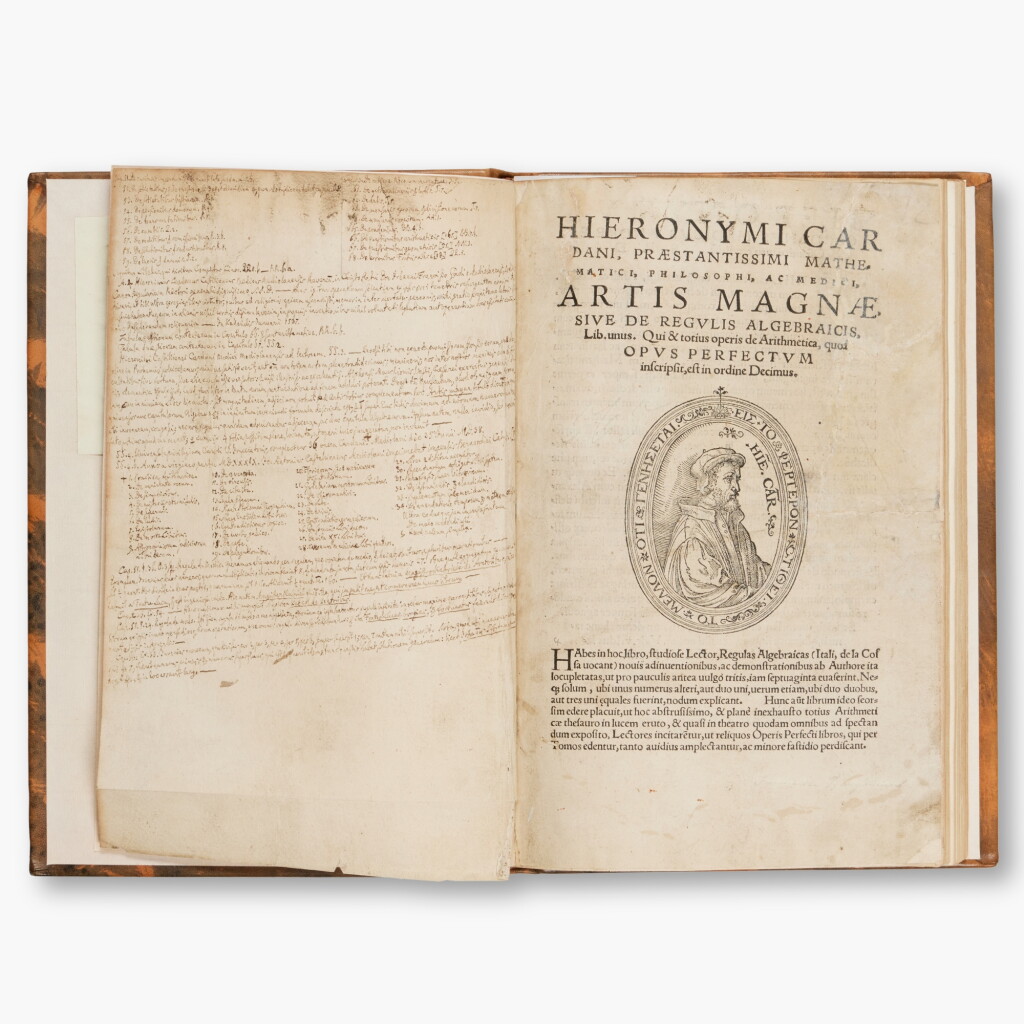
Cardano, Girolamo | Artis magnae, sive de regulis algebraicis, Lib. unus, Nuremberg, 1545, first edition
Live auction begins on:
October 20, 02:00 PM GMT
Estimate
20,000 - 30,000 USD
Bid
18,000 USD
Lot Details
Description
Cardano, Girolamo
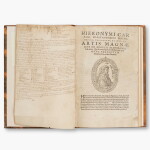
Artis magnae, sive de regulis algebraicis, Lib. unus. Nuremberg: Johannes Petreius, 1545
First edition of Cardano’s magnum opus, one of the great landmarks in the history of mathematics; very rare.
“The most important contribution to algebra in the 1500s” (Dibner), the Ars magna gave the first systematic printed treatment of methods for solving cubic and quartic equations, transforming algebra from a collection of individual rules and problems into a more general mathematical discipline. Cardano published the solution of the cubic that he had learned from his contemporary Niccolò Tartaglia, while also acknowledging its earlier discovery by Scipione del Ferro; the method for solving quartic equations was devised by Cardano’s brilliant pupil Ludovico Ferrari. The work also advanced the treatment of negative quantities and confronted, however uneasily, calculations involving square roots of negative numbers—an important step toward the later development of complex numbers.
The publication of Tartaglia’s method provoked one of the most celebrated disputes in mathematical history. Tartaglia had revealed his rule to Cardano only after extracting a promise of secrecy. Cardano later concluded that the prior discovery of the solution by del Ferro released him from that undertaking and included it here, with attribution. Tartaglia nevertheless regarded the publication as an act of betrayal and answered in his Quesiti et inventioni diverse (1546). The increasingly acrimonious exchange culminated in the celebrated public mathematical contest between Tartaglia and Ferrari at Milan in 1548. Despite the contested history of its discovery, the solution of the cubic remains commonly associated with Cardano’s name.
With early provenance by a scholarly reader: A systematic descriptive bibliography of the two books that stand immediately behind the Ars Magna is written on the endleaves. At front, in Latin, is a full bibliographical description of Cardano's Practica arithmetice et mensurandi singularis (Milan: Io. Antonius Castellioneus for Bernardino Calusco, 1539). At end, a leaf written in German provides the same treatment applied to Christoph Rudolff's Coss (Strasbourg: Wolfgang Köpfel for Johann Jung, 1525). The reader was clearly a native German-speaker with access to copies of both the 1525 Coss and the 1539 Practica, both scarce books, and was building a comparative record of the pre-1545 algebra literature keyed to signatures—the method of an early historian or bibliographer of mathematics rather than a working mathematician. An historically interesting copy, annotated by a scholar reconstructing the sources of the Ars Magna.
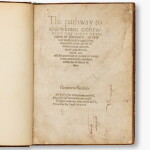
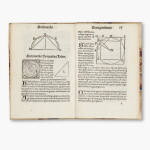
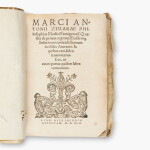
Folio (271 x 175 mm). 82 leaves, including terminal blank. Fine oval woodcut portrait of Cardano on title-page, numerous woodcut mathematical diagrams, ornamental initials, notes in Latin and German on flyleaves; title restored and with trace of inkstamp, other occasional marginal restoration, some occasional browning. Modern mottled calf.
REFERENCES
Adams C-651; BM/STC German, p. 182; Dibner, Heralds 103; Norman 400; USTC 662810
PROVENANCE
Early notes on endleaves in an unidentified hand (see above) — M. Favia del Core (bookplate)

![Euclid | Geometricorum elementorum libri xv, Paris, [1517], first edition of Euclid to be printed outside of Italy, extensive early modern marginalia](https://sothebys-md.brightspotcdn.com/dims4/default/8662503/2147483647/strip/true/crop/2000x2000+0+0/resize/150x150!/quality/90/?url=http%3A%2F%2Fsothebys-brightspot.s3.amazonaws.com%2Fmedia-desk%2Fwebnative%2Fimages%2F62%2F7c%2F8b628e9a4ce981cee9cab085d772%2Fn12451-bkf9m-t2-03.jpg)