
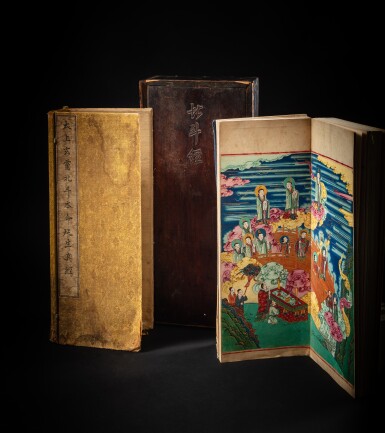
A rare album of illuminated Daoist sutra ‘Taishang xuanling beidou benming yansheng benming zhenjing’, Jiajing period, dated to the renyin year (in accordance with 1542) | 明嘉靖壬寅年(1542年) 《太上玄靈北斗本命延生真經》
Lot Closed
April 30, 08:51 AM GMT
Estimate
100,000 - 150,000 EUR
Lot Details
Description
A rare album of illuminated Daoist sutra ‘Taishang xuanling beidou benming yansheng benming zhenjing’
Jiajing period, dated to the renyin year (in accordance with 1542)
illuminated manuscript on paper, 130 leaves, 25 paintings (9 double-page) with a colophon in the end states that it was commissioned the empress on the twenty-eighth day of the seventh lunar month in the twenty-second year of the Jiajing Emperor's reign (1543), bound concertina-style, yellow silk upper cover, cloth label on upper cover, housed in custom wood box
36.5 x 14 cm, 14⅜ x 5 ½ in.
__________________________________________________________________________
Rare album de sutras taoïstes enluminés 'Taishang xuanling beidou benming yansheng benming zhenjing', époque Jiajing, daté de l'année renyin (1542)
manuscrit enluminé sur papier, 130 feuilles, 25 peintures (9 à double page) avec un colophon à la fin indiquant qu'il a été commandé à l'impératrice le vingt-huitième jour du septième mois lunaire de la vingt-deuxième année du règne de l'empereur Jiajing (1543), reliure de style concertina, couverture supérieure en soie jaune, étiquette en tissu sur la couverture supérieure, conservée dans un coffret en bois personnalisé
__________________________________________________________________________
明嘉靖壬寅年(1542年) 《太上玄靈北斗本命延生真經》
對開本,紙本泥金彩繪,130頁(摺),25幅插圖(9幅連頁),經摺式開本,黃絹封面,貼布題簽,附木製書匣
Collection of Father Émile Ducarme (1884 - 1955).
__________________________________________________________________________
杜嘉梅神父(1884-1955)收藏
This extraordinary manuscript contains an important scripture from the Daoist canon. Composed during the Song dynasty, the Taishang xuanling beidou benming yansheng zhenjing [‘True Scripture of Tai Shang Xuan Ling Bei Dou of Fate and Prolonging Life’], or Beidoujing, is one of a set of five scriptures recording a revelation of the legendary Laozi to Zhang Daoling (traditionally 34-156), generally considered to be the founder of religious Daoism. The text describes how the Northern Dipper (Beidou) constellation influences one’s fate and stresses the importance of rituals and chanting to improve one’s fortune. As the central illuminated pages explain, even simply owning the Beidoujing is purported to bring good fortune to the household:
“If one has the Beidoujing at home, one’s residence will attain peace and serenity / If one has the Beidoujing at home, one’s parent will live out long lives / If one has the Beidoujing at home, all that one dislikes will turn to dust…”
This message of redemption, skillfully written in bold calligraphy, is accompanied by 24 beautifully rendered illustrations. For a manuscript of this significance, consulted and treasured for almost five hundred years, the paintwork remains in remarkably good condition. With luminous, almost surrealist colours in detailed brushwork, the court painters masterfully blend a sense of mystical awe from clouds and natural imagery with the richly detailed opulence of court fabrics and pavilions. Ming dynasty manuscripts boasting this level of technical mastery are extremely rare.
Beyond its phenomenal beauty, this album is also a remarkable historical document, drawing back the curtain on life in the Ming court. Given the immensity of a project of this quality, it comes as no surprise that this album was commissioned to imperial orders. A colophon at the end of the manuscript notes that it was presented by the empress on the twenty-eighth day of the seventh lunar month in the twenty-second year of the Jiajing Emperor's reign (1543). The official records of the Jiajing Emperor’s reign, included in the Ming shilu (‘Veritable Records of the Ming’), note that this date was, in fact, the birthday of Empress Xiaolie. Looking at the body of the text itself, which notes that the manuscript was started on the same date a year prior (in the renyin year; 1542), the story of this manuscript’s creation reveals itself: a glorious celebration of an imperial birthday.
However, the imperial significance of this album poses further questions. Who was the empress presenting this album to? Why did she commission copies of the Beidoujing specifically? Diving further into the imperial annals, a clearer picture is revealed. The twelve-month period between this album’s commencement and completion was one of the most significant in the Jiajing Emperor’s reign. Known today as the ‘Palace Plot of the Renyin Year’, just three months after work had begun on this album, sixteen palace concubines conspired to assassinate the Jiajing Emperor. This assassination attempt, bringing the emperor to the verge of death and foiled only by the loyalty of Empress Xiaolie, who had the perpetrators killed, had a profound impact on the emperor’s reign and led him to retreat to the seclusion of the Yongshou Palace in the West Park for the rest of his life.
Already a fanatic believer in Daoism, this life-shattering event pushed the emperor to delve even deeper into the world of supernaturalism. Trusting no-one other than his oracles and spending his fortune on elaborate Daoist temples, the Jiajing Emperor became more and more superstitious and reliant on the mystical powers of Daoism. Despite Empress Xiaolie’s unwavering fealty, the Emperor remained suspicious of her and bemoaned the loss of his favourite concubine at her hands. From that point on, their relationship would never recover. When a fire broke out in her chambers in 1547, the Emperor refused to order her rescue and she was killed in the flames.
Although we will never know for certain why this album was made, the events of the renyin year start to paint a heartbreaking picture of one possible chain of events. Shunned by an increasingly distant husband she had risked everything to protect, Empress Xiaolie sought ways to bridge the gap between them. On the occasion of her birthday, venturing out to the West Park with gloriously painted albums of Daoist wisdom in hand, the empress tried desperately to make peace with her husband – to no avail.
Only one other album of this type has appeared before at sale. Seemingly part of the same group presented in August 1543, this almost identical copy of the Beidoujing, without silk cover, was sold in our London rooms, 7th November 2016, lot 226.
__________________________________________________________________________
《太上玄靈北斗本命延生真經》亦稱《北斗經》,成書於宋代,為道教外修五經之一,是道教重要經籙。據傳本經由太尚老君授予道教創始人張道陵(傳34-156 年)。經文內容講述北斗七星對命運之影響,並強調供奉及誦經對運勢改善之重要性。正如本卷中彩繪插圖文所釋,家中供奉《北斗經》即可增加福分:
「家有北斗經。本命降真靈。家有北斗經。宅捨得安寧。家有北斗經。父母保長生。家有北斗經。諸厭化為塵。家有北斗經。萬邪自歸正。家有北斗經。營業得稱情。家有北斗經。闔門自康健。家有北斗經。子孫保榮盛。家有北斗經。五路自通達。家有北斗經。眾惡永消滅。家有北斗經。六畜保興生。家有北斗經。疾病得痊癒。家有北斗經。財物不虛耗。家有北斗經。橫事永不起。家有北斗經。長保亨利貞。」
本卷字體為墨筆楷書,風格工整規範,並搭配二十四幅彩繪插圖,構圖細膩繁複,色彩絢麗明,雖歷經近五百年之光陰,神采依舊,品項甚佳。宮廷畫師慧心巧思,祥雲輝映世間,人物細節生動,其畫功精湛,為罕見明代手寫彩繪插圖本。
本拍品不僅蘊含強烈地藝術美感,同時亦是一部重要的歷史文獻,掀開明代宮廷生活之帷幕。經書製作選材精心、內容詳盡生動,處處展現明代內府匠心巧思。本卷末頁落款為「大明嘉靖二十二年七月二十八日中宮皇后施」(1543年),據《明實錄》此日為孝烈皇后之壽誕。本卷初序《太上三洞法寶諸品經懺誥咒儀典序》落款大明嘉靖壬寅年同日(1542 年),由此可見耗時一年製作,不計成本。
見一卷相似《太上玄靈北斗本命延生真經》,售於倫敦蘇富比2016年11月7日,編號226。


