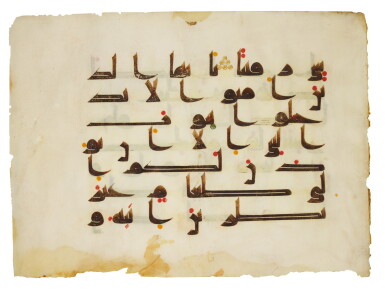
An illuminated Qur'an leaf in Kufic script on vellum, North Africa or Near East, 10th century
Auction Closed
October 23, 01:24 PM GMT
Estimate
20,000 - 30,000 GBP
Lot Details
Description
text: Qur'an, surah al-waq'iah (LVI), middle of verse 19 to end of verse 25
Arabic manuscript on vellum, 3 lines to the page written in Kufic script in dark brown ink, diacritics in red and green, verses separated by triangular clusters of 6 gold dots, khams and 'ashr marked by gold and polychrome illuminated roundels, framed
22.8 by 31.8cm.
The large size and powerful script of this Qur’an leaf exemplifies the beauty of Abbasid Qur’an production in the ninth century. It is perhaps possible to define this style (equating to Déroche's group 'D' styles) as the mature 'Abbasid Kufic', with the script displaying the 'sober beauty' that Déroche mentions in the catalogue of the Nasser D. Khalili Collection (Déroche 1992, no.21). This type of script was used on manuscripts bearing waqf inscriptions dating from 847 to 911 AD (Dércohe 1992, pp.36-37), although it may have come into usage slightly earlier in the 9th century.
The visual impact of the script is emphasised by a generous use of horizontal stretching (mashq) and relatively wide and even spacing of the letters along the lines on the page. The confidence execution of the calligraphy underscores the power and significance of the text, resulting in a manuscript of subtle but stately elegance. The graphic intentions of the calligrapher are highlighted by the absence of letter-pointing. The use of letter-pointing (i'jam) was well-established by the 9th century, but here the calligrapher has intentionally omitted the markings in order to enhance the graphic purity of the script. Two further leaves from this manuscript are in the Musée des arts de Kairouan (Paris 1982, p. 245, no. 328).
You May Also Like