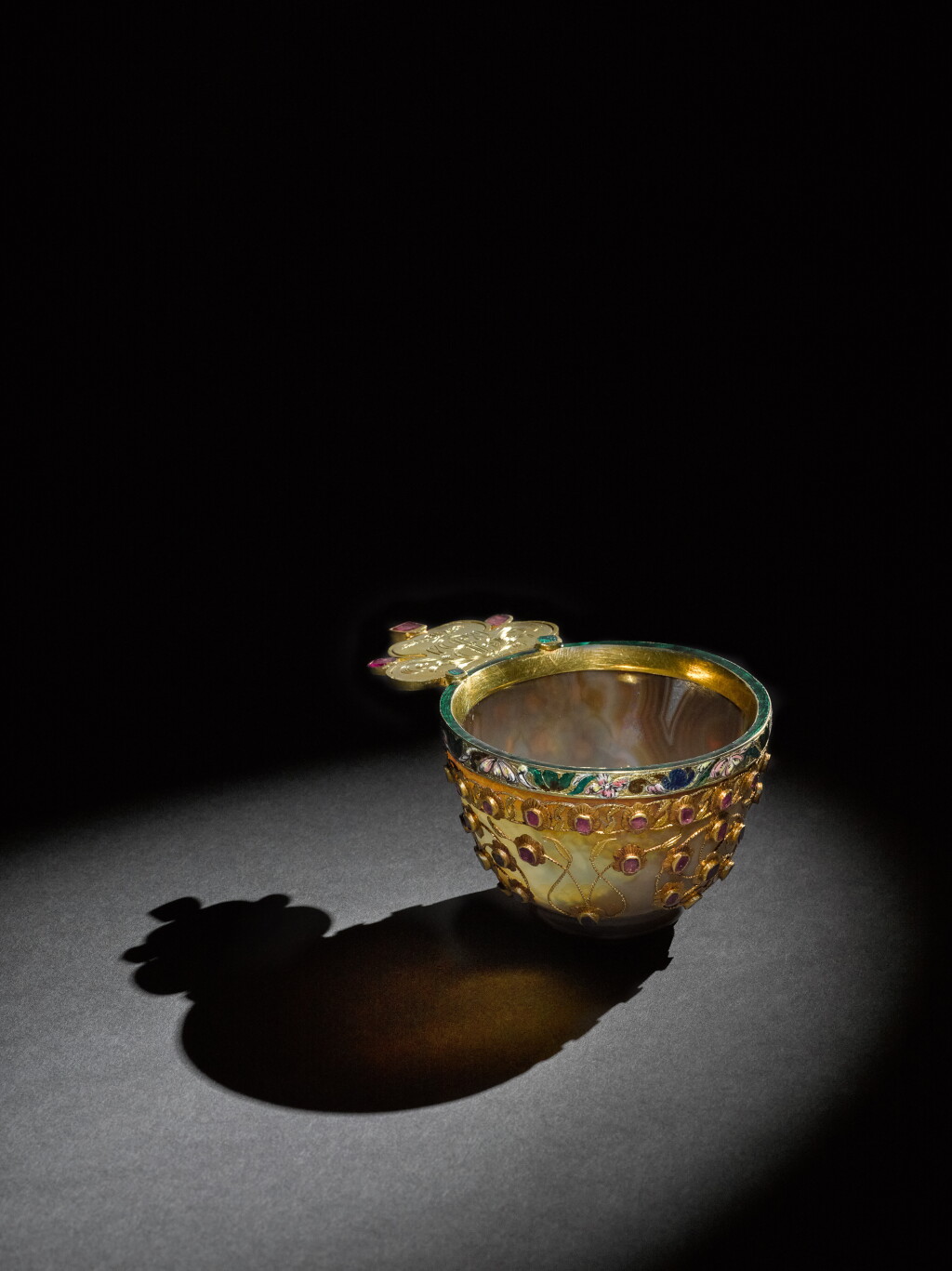
An Ottoman agate cup set with rubies and emeralds, Turkey, 17th century, with enamelled gold-mount with cipher of Empress Catherine II, dated 1789
Auction Closed
April 24, 03:45 PM GMT
Estimate
80,000 - 120,000 GBP
Lot Details
Description
of deep rounded form on a short slightly splayed foot, the agate body inlaid with gold scrolling vines and flowers set with rubies, the gold rim mount enamelled with scrolling leaves and flowers under a green enamel band, the trefoil-shaped handle engraved with the crowned cypher of Empress Catherine II and the date 1789, set with rubies and emeralds, the underside with a floral enamelled flower and leaves
4.9cm. height
7cm. diam.
10.5cm. width incl. mounts
Ex-private collection, USA, acquired circa 1935-1940, thence by descent
Ex-private collection, USA, acquired 2010
This gem-set agate cup is a splendid illustration of Ottoman craftsmanship at the service of foreign diplomatic relations. The sculpting of precious stones was a technique well-established in Ottoman Turkey and underwent notable advancements during the sixteenth and seventeenth centuries. The embellishment of objects created from nephrite, amber, rock crystal, or lazurite attained remarkable levels of grandeur, characterised by the extensive application of gold inlay and vibrant gemstones arranged in intricate scrolling stems and floral motifs. The resulting aesthetic effect evokes a richly embroidered fabric, with the integration of gems enhancing the overall visual appeal. Such objects seemed to have been particularly favoured by Russian sovereigns, with a large number reaching The Kremlin’s Eastern collection as part of diplomatic and trade contacts.
The treasury of the Russian tsars is home to an impressive group of Turkish jewelled artefacts, widely attributed to workshops operating in Istanbul. According to records from Russian archives, the Turkish capital was systematically recognised as both the place where luxury wares were produced and the departure point from which they were dispatched (A. Konstantinovich Leykin 2009, p.11). The Moscow Kremlin State Historical and Cultural Museum houses a large number of gem-set pieces made of semi-precious stones, including a squat spherical nephrite bowl brought by a Greek merchant to the court of Tsar Mikhail Fedorovich in 1632 (inv. no.DK-267; ibid., pp.92-93, cat. no.42); a crystal tankard offered by Patriarch Cyril I Lukaris of Constantinople to the Muscovite court that same year (inv. no.DK-82; ibid., pp.94-95, cat. no.43); a scent bottle for rose water presented in 1656 (inv. no.DK-270; ibid., pp.98-99, cat. no.47); a lazurite writing set (inv. no.DK-41; ibid., pp.100-1, cat. no.48); another scent bottle with lid (inv. no.DK-272) and a delicate agate bowl (inv. no.DK-265; ibid., pp.96-97, cat. no.44), all dated to the seventeenth century and presenting a similar gold inlay encrusted with gems to the cup at hand. Furthermore, the addition of polychrome enamels to the present cup’s mount echoes its floral gold and gem inlays, creating an aura of wealth and opulence. A gold pocket watch in the Kremlin offers a similar rendition coupling polychrome enamels with gold-inlaid insets (inv. no.МЗ-4089/1; ibid., pp.102-3, cat.49).
The rim mount of the present cup is enamelled in a European style and terminated by a trefoil-shaped handle engraved with Catherine the Great’s monogram, dated 1789. It is a later addition, almost certainly of Ottoman manufacture, applied with the aim to turn the cup into a charka, a Russian wine cup. See, for example, a seventeenth-century example in the Kremlin National Museum, Moscow (inv. no.DK-154) and another in the Metropolitan Museum of Art, New York (inv. 1979.174). The year 1789 corresponds to the enthronement of the Ottoman Sultan Selim III (r.1789-1807), suggesting that the agate cup could have been mounted as part of a diplomatic gesture from the Sultan to acknowledge the Russian empress upon his accession to the throne. This was part of the tradition of cülus bahşisi (enthronement gifts), in which the sultan would present gifts to high-ranking officials.
The period is one of friction between the empires, with a resurgence of the Russo-Turkish conflict from 1787-92. Whilst the precise political intentions behind such present-giving are unknown, this would not be the only recorded object presented by Selim III to Catherine the Great. A horse forehead decoration (reshma) was gifted to the Russian sovereign in 1793, and remains in the Kremlin National Museum (inv. no.K-171). Similarly, his predecessor Abdul Hamid I (r.1774-1789) presented a gem-set gold and silver aigrette to Catherine II in 1775 (inv. no.K-187), just a year after his own enthronement and the end of the Russo-Turkish War of 1768-1774.
You May Also Like