Property from the Ferber Collection
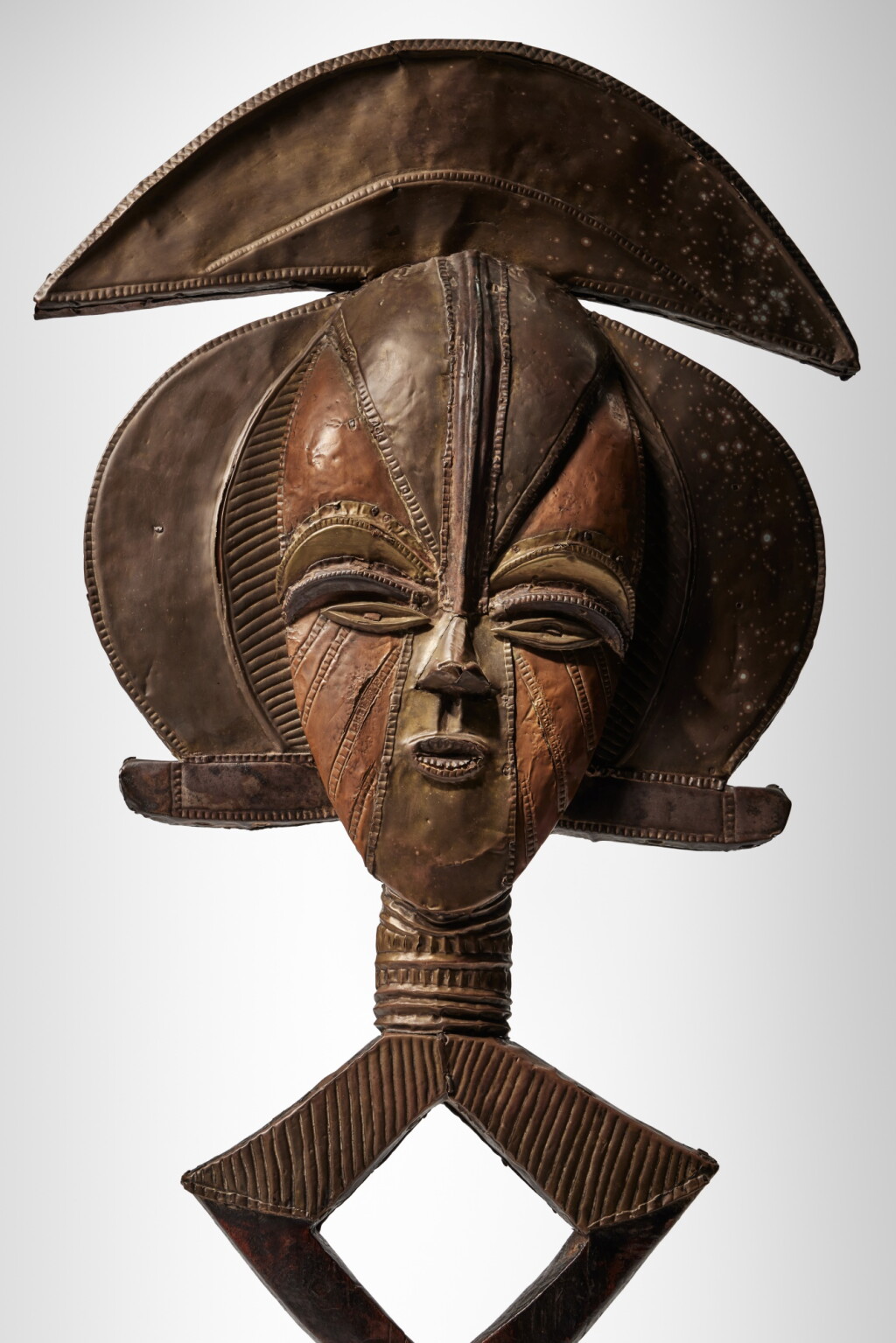
Kota-Ndassa Janiform Reliquary Guardian Figure, Gabon
Auction Closed
December 12, 04:12 PM GMT
Estimate
200,000 - 400,000 EUR
Lot Details
Description
Kota-Ndassa Janiform Reliquary Guardian Figure, Gabon
Height: 26 ½ in (68 cm)
Simone de Monbrison, Paris
Merton D. Simpson, New York
Baron Frédéric "Freddy" Rolin (1919-2001) Collection, Brussels / New York
Private Collection, West Germany, acquired from the above
F. Rolin & Co., New York, reacquired from the above
Herbert and Edith Ferber, New York, acquired from the above in October 8, 1981
Thence by descent to the present owners
Alain and Françoise Chaffin, L'art Kota. Les figures de reliquaire, Meudon, 1979, p. 207, cat. n° 108
Of the great number of styles and variations in the corpus of Kota reliquary sculpture, the large-scale Kota Ndassa figures, which often reach heights of 60 centimeters and more, are among the most celebrated. Distinguished first and foremost by their especially large scale and ornate richness of decoration, these Ndassa figures also share what Louis Perrois has described as “a certain graphic naturalism, contrasting with the stylizing impulse of most other Kota variants.” (Sotheby’s, ed., African, Oceanic & Pre-Columbian Art, May 2012, lot 131, p. 116). Further to this ‘naturalism’, the hallmarks of the Ndassa style are seen in the convex face of the present Janus example: a generally oval face, surmounted by a broad crescent and flanked by ample side-coiffures, terminating in “duck tails”, all atop a cylindrical neck and well-proportioned diamond-shaped lozenge. Ndassa sculptor-blacksmiths mastered the use of multi-colored metals to create dazzling visual contrasts, employing reddish copper, yellow brass, and grey-black iron; the artist who created the present figure from the Ferber collection was particularly adept at the mixing of different color metals, with V-shaped sections of alternating color emanating from the center of the face, divided by lines formed in relief. The eyes are centered vertically on the face, and depicted in narrow horizontal lidded coffee-bean shape, beneath arched brows. There are incised lines falling across the copper fields that define the cheeks, from eye to jaw. These have been described as “tears” as they seem to cascade down from the eyes, and can be read as if the subject is weeping.
Discussing the probable geographic origins of the related Ndassa figure from the collection of the sculptor Arman, Perrois (ibid.) continues: “In his monumental 1953 work Contribution à l'ethnographie des Kuta I, pastor-ethnographer Efraim Andersson, the great expert on the ‘Kuta’, or ‘Kota’ peoples of equatorial Africa, illustrated a closely reliquary figure with a convex face, a broad transverse headcrest, and side-coiffures terminating in volutes [Andersson, Contribution à l'ethnographie des Kuta I, 1953, p. 341, fig. 37] […]. He noted that this important mbuli-viti had been collected in situ in the 1920s by the pastor Karl Laman for the Svenska Missionförbundets Museum in Stockholm. The same object, with its convex face, is also seen in a photograph taken by The Reverend Jacobson before 1912, showing young Kota men wearing bark cloth aprons, carrying traditional weapons, and displaying reliquary figures (see fig. 1). […] Particularly significant to our study is Andersson's indication that the related work comes from the Mossendjo region of the former French Congo (southwest of present-day Congo-Brazzaville), the epicenter of the missionary activities of Swedish evangelists before the Second World War. It was also in the southern part of the Kota region that The Reverend Efraim Andersson conducted the bulk of his ethnographic surveys from 1935 until the 1950s, amongst the Wumbu, the Ndassa, and the Obamba [see Andersson, Contribution à l'ethnographie des Kuta I, 1953 and Andersson, Contribution à l'ethnographie des Kuta II, 1974]. The area within the triangle formed by the towns of Mossendjo, Sibiti, and Zanaga (all in present-day Republic of Congo) was among others populated by Kota groups, namely the Wumbu and the Ndassa. In this context it is worth remembering that the designation ‘Kota’ is only a collective name of convenience, as each cultural group of equatorial Africa referred to by the name ‘Kota’ also bears a more specific name. The Ndassa are culturally and linguistically distant cousins of the Northern Kota, the Mahongwe, the Shamaye, and the Shaké of the Ivindo basin. Already centuries ago, their migratory movement had already brought them from Southern Cameroon to present-day Congo, traversing the whole of eastern Gabon from North to South. Some Ndassa communities, with small populations, remained behind in the region of the Upper Ogooué River in Gabon.”
It was an Ndassa figure that helped to introduce America and the world to the genius of African art, as an example from this small corpus sourced by Paul Guillaume was shown as a highlight in the photographer Alfred Stieglitz’s Gallery 291 in 1914. The exhibition held there, which Stieglitz called “possibly the most important show we have ever had", was one of the very first exhibitions to show African sculptures as art, rather than as mere specimens of ethnographical interest, more than 20 years before James Johnson Sweeney’s legendary exhibition African Negro Art was held at the Museum of Modern Art in New York. In 1930 in Paris, an Ndassa Kota was shown at the legendary exhibition at Galerie Pigalle which served similarly to introduce African art “as art” to a wider Parisian audience. Thus from the very beginning of the Western avant-garde’s love affair with African sculpture, Ndassa figures have been among its icons.
The well-known Kota figure selected by Sweeney to represent the category for the 1935 exhibition at the Museum of Modern Art from the collection of Helena Rubinstein was later owned by William Rubin, the important MoMA curator and champion of the Abstract Expressionists. Rubin was a great admirer of the group of artists known as the New York School and contributed to their canonization, acquiring their work for his own collection and for the MoMA. Many of the artists in this group are today household names: Franz Kline, Robert Motherwell, Jackson Pollock, Barnett Newman, Hans Hoffman, Willem de Kooning, Clyfford Still, and Mark Rothko. Among them as a close friend, theorist, and fellow artist was the sculptor Herbert Ferber. Though less famous today than his contemporaries, Ferber was “a driving force of the New York school”, known best for his theoretical contributions and for the style of abstract metal sculpture he developed. In 1949, Clement Greenberg wrote that Isamu Noguchi, David Smith, and Herbert Ferber were “sculptor-constructors who have a chance…to contribute something ambitious, serious and original” to a “new genre” of American metal sculpture. Ferber’s work became ubiquitous in American museums and was represented by many public commissions before tastes shifted toward Pop Art, Minimalism, and Conceptual Art in the 1960s.
It was William Rubin who encouraged Herbert Ferber to acquire the present Kota, sharing the enthusiasm for African art which had propelled Ferber’s development as an abstract sculptor. Rubin would organize another generational event for the fields of African, Oceanic, Pre-Columbian, and American Indian art with the 1984 publication and exhibition “Primitivism” in 20th Century Art held at the Museum of Modern Art, to which he lent his famous Kota. It is fitting that the most significant work in Ferber’s personal collection of African Art would also be a Kota figure, with its refined abstraction and expressive use of metal. Ferber displayed his Kota prominently in the living room of his home on MacDougal Street in Manhattan, alongside his own works and paintings by his famous friends.
Discussing the Ndassa group, which they classified as Group 16 in their landmark publication L’Art Kota, Alain and Françoise Chaffin observed: “These pieces are among the most sought after by lovers of Kota art. […] One finds sculptures from the Rassmussen, Ratton, Chadourne and Girardin collections that are known the world over.” Kota Ndassa reliquary figures have found their way into a number of museum collections such as the Musée du Quai Branly - Jacques Chirac, Paris (inv. n° 70.2010.17.1), as well as in important private collections such as the collection of Heinz Berggruen (see Rubin 1984: vol.I, p. 270). The rarest of these are the Janus, or two-sided Kota Ndassa figures, of which only a handful of major examples are known to survive. These include:
- A Janus figure in the collection of Laura and James Ross, New York, which was formerly in the collection of Georges de Miré, Paris (see Eternal Ancestors. The Art of the Central African Reliquary, New York, 2007, p. 257, cat. n° 81).
- A Janus figure in the collection of the Fondation Dapper, Paris, which was collected before 1917 (see Les Forêts natales, Arts d'Afrique équatoriale atlantique, Paris, 2017:pp. 98 and 297, cat. n° 212).
- A Janus figure in the Ethnologisches Museum (SMPK), Berlin, acquired from Carl Einstien in 1926 (inv. n° IIIC 33268, see Eternal Ancestors. The Art of the Central African Reliquary, New York, 2007, p. 259, cat. n° 82).
- A Janus figure in the Art Gallery of Ontario (AGO), Toronto, which was also previously in the collection of Georges de Miré, Paris (see Alain and Francoise Chaffin, L'Art Kota. Les figures de reliquaire, 1979, p. 210, cat. n° 112).
The Kota Ndassa reliquary figure from the collection of Herbert Ferber is a tour-de-force of Central African sculpture and metalwork, and as a Janus figure is one of the rarest and most elaborate types in the corpus of Kota art. Its scale and richness of color, repoussé, form and volume are undeniably impressive. Its connection to world of avant-garde artists and thinkers in New York confirms the enduring legacy of the artist that created it.
You May Also Like