
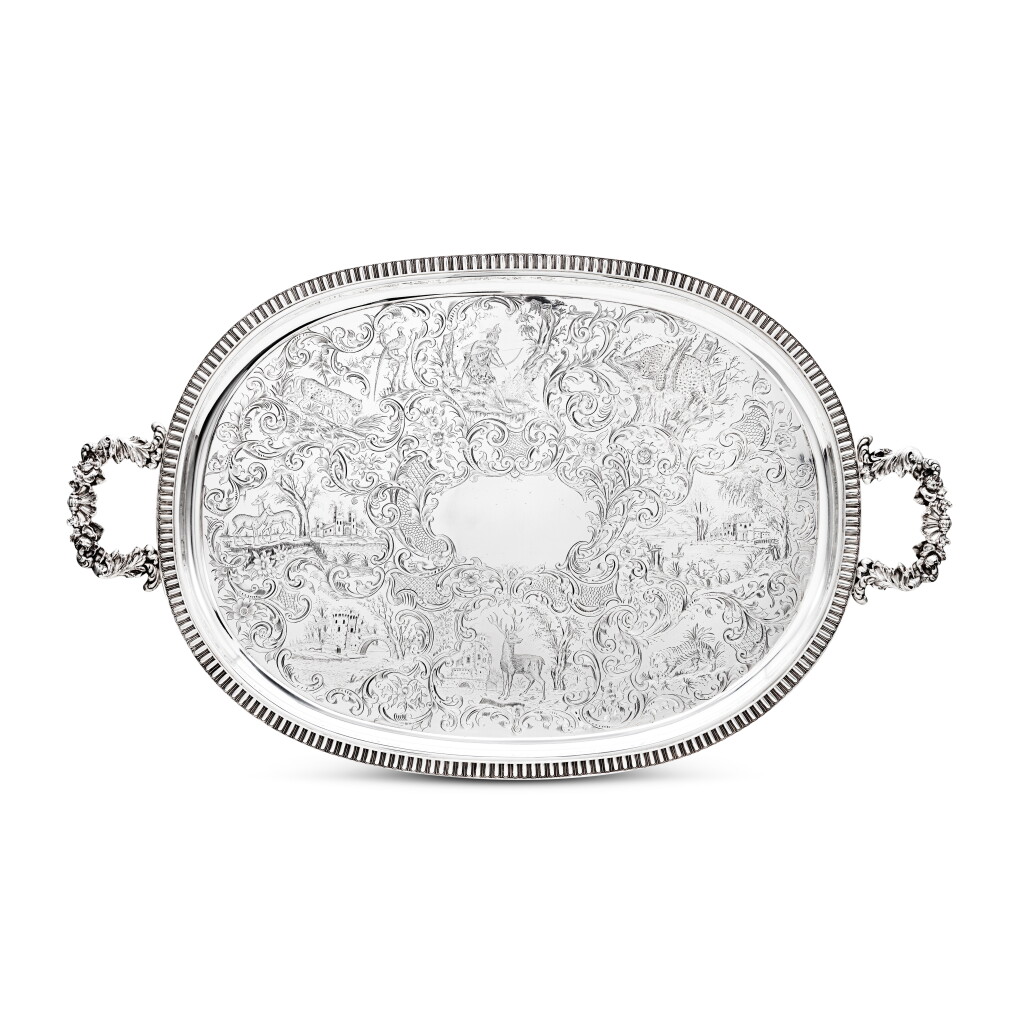
A Massive American Silver Two-Handled Tray with Engraved Zoological Scenes, William Gale & Son, New York, 1851
Lot Closed
January 20, 05:59 PM GMT
Estimate
7,000 - 10,000 USD
Lot Details
Description
oval with lobed rim and shell and scroll handles, the surface engraved with a tiger, two leopards, pheasant and deer spaced by romantic castles within scrolling foliage, at the top an Indian aiming his bow, marked on back Wm. Gale & Son, 116 Fulton St, New-York, and G &S in oval and 1851 in lozenge
239 oz., 7432 g
Length over handles: 39 ¼ in., 99.6 cm
Other examples of such elaborate scenic engraving are found with the mark of William Gale and Son. One with similar scenes of animals but including Mount Vernon and Monticello was sold Sotheby’s New York, Jan. 25-26, 2013, lot 207 and resold Heritage Auctions, May 8 2014, lot 68001, from the collection of Dr. Charles L. Venable. The catalogue entry noted that most of the animals depicted were based on engravings in Oliver Goldsmith’s A History of the Earth and Animated Nature, first published in 1774. One however, also depicted on the present tray, the leopard in a tree, was found as a mirror image on the front page of the Penny Magazine, of the Society for the Diffusion of Useful Knowledge Jan. 5, 1833.
William Gale, Sr.(1799-1864), received a patent on December 7, 1826 for roller dies which vastly improved the production of spoons and forks. His expanded business as well as investment in real estate made him a wealthy man. His estate in 1867 was valued at several hundred thousand dollars, the equivalent of many millions today (Charles L. Venable, Silver in America, 1840-1940, A Century of Splendor, 1994, p.319).
You May Also Like


