
Élisabeth Louise Vigée Le Brun
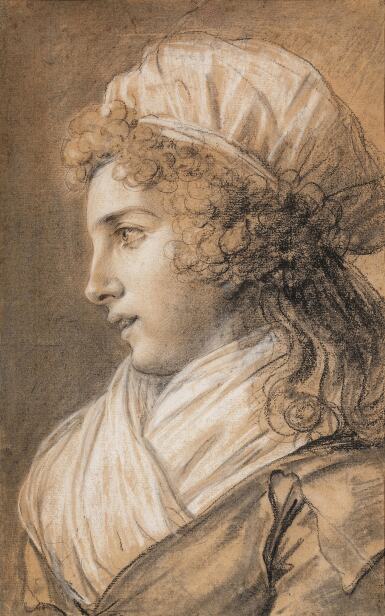
Profile Portrait of the Duchesse de Polignac
Auction Closed
January 31, 03:58 PM GMT
Estimate
120,000 - 180,000 USD
Lot Details
Description
Élisabeth Louise Vigée Le Brun
Paris 1755 - 1842
Profile Portrait of the Duchesse de Polignac
Black and white chalk with stumping over traces of graphite, within red and black chalk framing lines
17 by 11 ⅛ in.; 432 by 282 mm
Private collection;
Anonymous sale, London, Christie’s, 4 July 2000, lot 18;
Where acquired by the present owner.
Paris, Galeries Nationales du Grand Palais; New York, Metropolitan Museum of Art; Ottawa, National Gallery of Canada, Élisabeth Louise Vigée Le Brun, 2015-16, no. 112 (Paris) and no. 41 (New York and Ottawa).
J. Baillio and X. Salmon, Élisabeth Louise Vigée Le Brun, exh. cat., Paris 2015, pp. 260-261, 357, cat. no. 112, reproduced p. 261;
J. Baillio, K. Baetjer, and P. Lang, Elisabeth Louise Vigée Le Brun, exh. cat., New York and Ottawa 2016, pp. 140, 248, cat. no. 41, reproduced.
This exquisite drawing, executed in an energetic yet delicate combination of black and white chalk with passages of stumping and graphite depicts Marie Antoinette's chosen friend, Gabrielle Yolande Claude Martine de Polastron, Duchesse de Polignac (1749-1793). As Xavier Salmon noted in his accompanying catalogue entry for this important drawing when it was exhibited at the Grand Palais, the Metropolitan Museum of Art and the National Gallery of Canada (see Exhibited), Vigée Le Brun's admiration for the Duchesse de Polignac is well documented. Indeed, in her Souvenirs the artist describes, whilst defending Polignac’s reputation from those who would slander her, that she was a woman of ravishing beauty, angelic sweetness, and solid mind.1 Despite some detractors, Vigée was not alone in her admiration for Madame de Polignac who, shortly after her arrival at Versailles in 1775 became an intimate of Marie-Antoinette. This led, in 1782, to the Queen appointing Polignac to the highly prestigious position of governess to the royal children, the outcome of which Vigée documents: “The fury of all the women desiring that appointment assailed her (Polignac), and a thousand calumnies were hurled at her. But what no courtier could believe was that Madame de Polignac had not coveted the position. She had accepted it out of respect for the queen's wishes and the king's entreaties. What she aspired to above all was her freedom, so much so that life at court did not suit her. Indolent and lazy, she would have been delighted to be left in peace, and the duties of her position appeared to her the heaviest of burdens.”
Vigée Le Brun goes on to recall:
“One day as I was doing her profile at Versailles, not five minutes had gone by before our door opened; someone had come to ask for her orders and for a thousand things needed for the children. “Well!” she told me finally, looking overwhelmed, “every morning it’s the same demands, I no longer have a moment to myself until dinnertime, and in the evening other trials await me.”2
It is tempting, if perhaps a little optimistic, to speculate that the “profile” Vigée Le Brun mentions may have been one of two extant profiles of Polignac. In addition to the present work, there also survives a striking pastel, in which Polignac is presented in profile wearing a white negligee and a black hat. As Salmon observes, the pastel must predate the Polignac family's emigration of July 1789, as the hairstyle, the hat and the chemise dress correspond to fashions prior to the onset of the Revolution.3 Other works in which Vigée depicts Polignac include a 1782 oil in the National Museum of the Château de Versailles 4 and a 1783 painting now at Waddesdon.5 Finally, Vigée Le Brun made a posthumous portrait of the Duchesse de Polignac, a pastel study in the Rijksmuseum, Amsterdam.6
The elegant drawing in question here, which is thought to have been produced in Rome circa 1790, that is to say at the beginning of the Polignac family’s emigration, like the aforementioned pastel once again shows Madame de Polignac in profile. The Duchesse is wearing a dress with large lapels and a substantial white kerchief, a travel costume similar to that worn by Madame Le Brun in her pastel self-portrait also dating from her stay in Rome (see lot 11). Polignac’s curly hair, rendered with small, curved strokes thrown quickly across the coarse-grained paper, is styled with a muslin bonnet, while her face is sensitively modelled with the soft application of black and white chalk.
Drawings of this type are rare survivals within Vigée Le Brun’s graphic oeuvre, with only one other comparable example, depicting the comtesse de Narbonne Lara, still in private hands. Likewise, the importance of the Duchesse de Polignac as a sitter cannot be overstated and her appearance on the market, alongside Mme Le Brun's beguiling pastel of her daughter, the Duchesse de Guiche (see lot 19) is a rare and important event, both from an art historical perspective and within the context of this fascinating but harrowing period of French history.
1 Vigée Le Brun 1835-37, vol. 1, pp. 237-41
2 Vigée Le Brun 1835-37, vol. 1, pp. 239-40
3 J. Baillio, K. Baetjer, and P. Lang, Elisabeth Louise Vigée Le Brun, exh. cat., New York and Ottawa 2016, p. 140, cat. no. 41
4 J. Baillio and X. Salmon, Élisabeth Louise Vigée Le Brun, exh. cat., Paris 2015, p. 170, cat. no. 55, reproduced p. 171
5 Ibid., p. 170, fig. 1, reproduced
6 Inv. no. SK-A-3898; see P. J. J. van Thiel et al., All the paintings of the Rijksmuseum in Amsterdam. A completely illustrated catalogue, Amsterdam 1976, p. 800, cat. no. SK-A-3898
You May Also Like


