
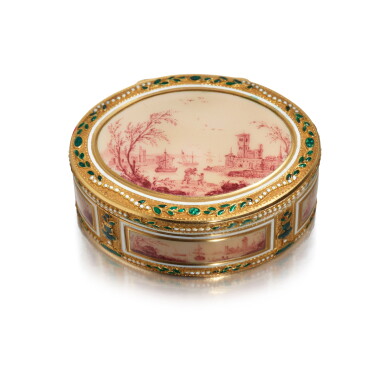
A Small Oval Gold and Enamel Snuff Box, Les Frères Toussaint, Hanau, Circa 1775
No reserve
Auction Closed
June 18, 05:01 PM GMT
Estimate
5,000 - 7,000 USD
Lot Details
Description
oval, all sides painted in crimson camaïeu with marine subjects and harbor scenes within white bead and translucent green enamel leaf borders on a sablé ground, Hanau marks including maker's mark and bird's head standard mark for 19 ct gold, in modern leather case
Length 2 1/4 in.
5.8 cm
Sotheby's Paris, 15 April 2010, lot 25
A ground-breaking change to the perception of the high number of gold and enamel boxes struck with so-called ‘prestige marks’ was introduced by Lorenz Seelig in 2007 (Lorenz Seelig, Golddosen des 18. Jahrhunderts aus dem Besitz der Fürsten von Thurn und Taxis, Munich: Hirmer, 2007). Two members of one of the most successful bijouterie families active in Hanau, Charles (1720-1790) and Pierre-Etienne Toussaint (1726-1806), were the key figures for this revelation. Seelig was able to prove that the Berlin-born brothers and Huguenot immigrants to Hanau were in fact one of the most important bijoutiers producing many high-quality gold boxes in the late eighteenth century.
The discovery of a ledger belonging to Adrian Morin (c. 1727-1800) was vital: Morin was the valet for Prince Carl Anselm of Thurn and Taxis (1733-1805) who had accumulated one of the finest collections of gold boxes in Germany, documented in an inventory from 1796 and now located in the Princely Treasury in Regensburg, Bavaria (Lorenz Seelig, ‘Eighteenth century Hanau gold boxes’, Silver Society of Canada Journal, vol. 18, 2015, pp. 32-55, p. 39). According to Morin’s account book, the Prince purchased six Wedgwood stoneware plaques representing subjects from Homer’s Iliad and Odyssey at the Frankfurt fair in 1791, which were then immediately handed over to another exhibitor - the goldsmiths Les Frères Toussaint – to be mounted as a box. The cagework mounts of the corresponding box in the Thurn and Taxis collection are struck with a corresponding maker's mark formed of the initials LFT (Seelig, 2007, op. cit., no. 39, p. 280).
Previously, the same set of marks was found on many gold boxes around the world; until then they were usually recorded simply as ‘marked LFT’ and believed to be of Paris or Geneva origin, mostly in absence of a better alternative.
You May Also Like


