
Property from a Distinguished Private Collection
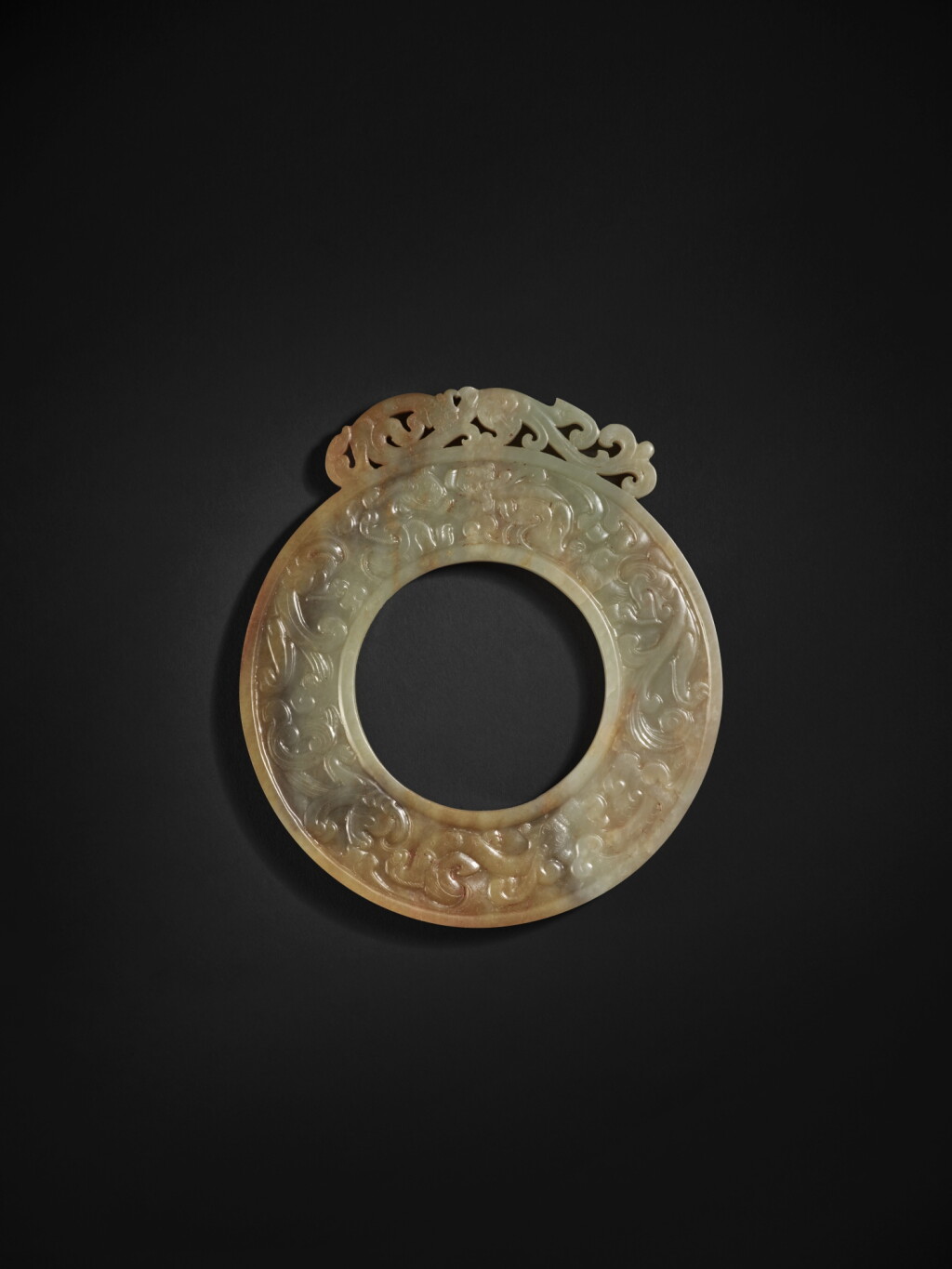
An extremely rare and important archaic green jade 'chilong' disc (Bi), Han dynasty | 漢 玉螭龍紋璧
Auction Closed
September 19, 02:55 PM GMT
Estimate
300,000 - 500,000 USD
Lot Details
Description
An extremely rare and important archaic green jade 'chilong' disc (Bi)
Han dynasty
漢 玉螭龍紋璧
Length 6 in., 15.4 cm
Acquired prior to 2000.
得於2000年之前
The present piece is an elegant example of the mastery of Han jade carving. The production of jade discs, known as bi, can be traced back to the Neolithic period. In the Han Dynasty, the design became more elaborate, with an openwork extension added to the circular shape.
This bi disc is notably distinguished by the beautifully carved chi dragon in low relief. Examples featuring the design of chi dragons frolicking within the clouds are mostly found in openwork, as illustrated in Yang Boda, Guanshi suocang Zhongguo guyu / Chinese Archaic Jades from the Kwan Collection, Hong Kong, 1994, pls 204, 205 and 207.
Dynamic carving of chi dragon is also found on other types of jade works, see a jade arc pendant with dragon and phoenix patterns, attributed to the second century B.C., excavated at Shizishan site in the Jiangsu Province, illustrated in The Search for Immortality. Tomb Treasures of Han China, Fitzwilliam Museum, Cambridge, 2012, cat. no. 67.
Compare a related example but with a more exaggerated openwork extension, unearthed at Majiazhong site in Shandong Province, illustrated in Zhongguo yuqi quanji [Complete collection of Chinese jades], vol. 4, Shijiazhuang, 1993, pl. 265; see also two further examples of this type, carved with siling (four spiritual animals) motifs, one from the collection of the Victoria & Albert Museum and attributed to the Eastern Han dynasty, illustrated in Ming Wilson, Chinese Jades, London, 2004, pl. 17 (accession no. A22-1935) (fig. 1), the other without an extension, from the Qing imperial collection and still in Beijing, illustrated in Gugong Bowuyuan cang wenwu zhenpin quanji. Yu qi (shang) / The Complete Collection of Treasures of the Palace Museum. Jadeware (I), Hong Kong, 1995, pl. 210.
此璧古雅秀麗,乃漢代玉雕典範。玉璧製作可遠溯至新石器時代,至漢朝時其紋飾變得更為精緻繁縟。
龍在漢代被認為是吉祥象徵,寓意福澤綿長,並代表智、勇、和平。因此,玉璧與皇權關係密切,龍紋玉璧尤甚。觀察漢代古墓出土珍貴玉璧,足可證此。
本品玉璧最出衆之處,在於其淺浮雕螭龍紋飾。刻劃螭龍游於雲間者多屬透雕,參考數例,圖載楊伯達,《關氏所藏中國古玉》 ,香港,1994年,圖版204、205及207。
螭龍雕飾並可比較其他作例,如江蘇獅子山遺址出土公元前二世紀龍鳳紋玉璜,圖載《追尋不朽:中國漢代墓葬精華》,菲茨威廉博物館,劍橋,2012年,編號 67。
再比一相關作例,山東馬家塚遺址出土,璧上部透雕紋飾處更為複雜,圖載 《中國玉器全集》,卷 4,石家莊,1993年,圖版265;尚有兩相類例,雕四靈紋飾,其一現為維多利亞及阿爾伯特博物館收藏,斷代東漢,圖見劉明倩,《中國玉器》,倫敦,2004 年,圖版 17(藏品編號 A22-1935)(圖一),其二清宮舊藏,現存於北京,圖載《故宮博物院藏文物珍品全集:玉器(一)》, 香港,1995年,圖版210。
You May Also Like


