Master of the Vote Imperatorum
The Massacre of the Innocents
Lot Closed
October 27, 02:46 PM GMT
Estimate
6,000 - 8,000 GBP
Lot Details
Description
The Massacre of the Innocents
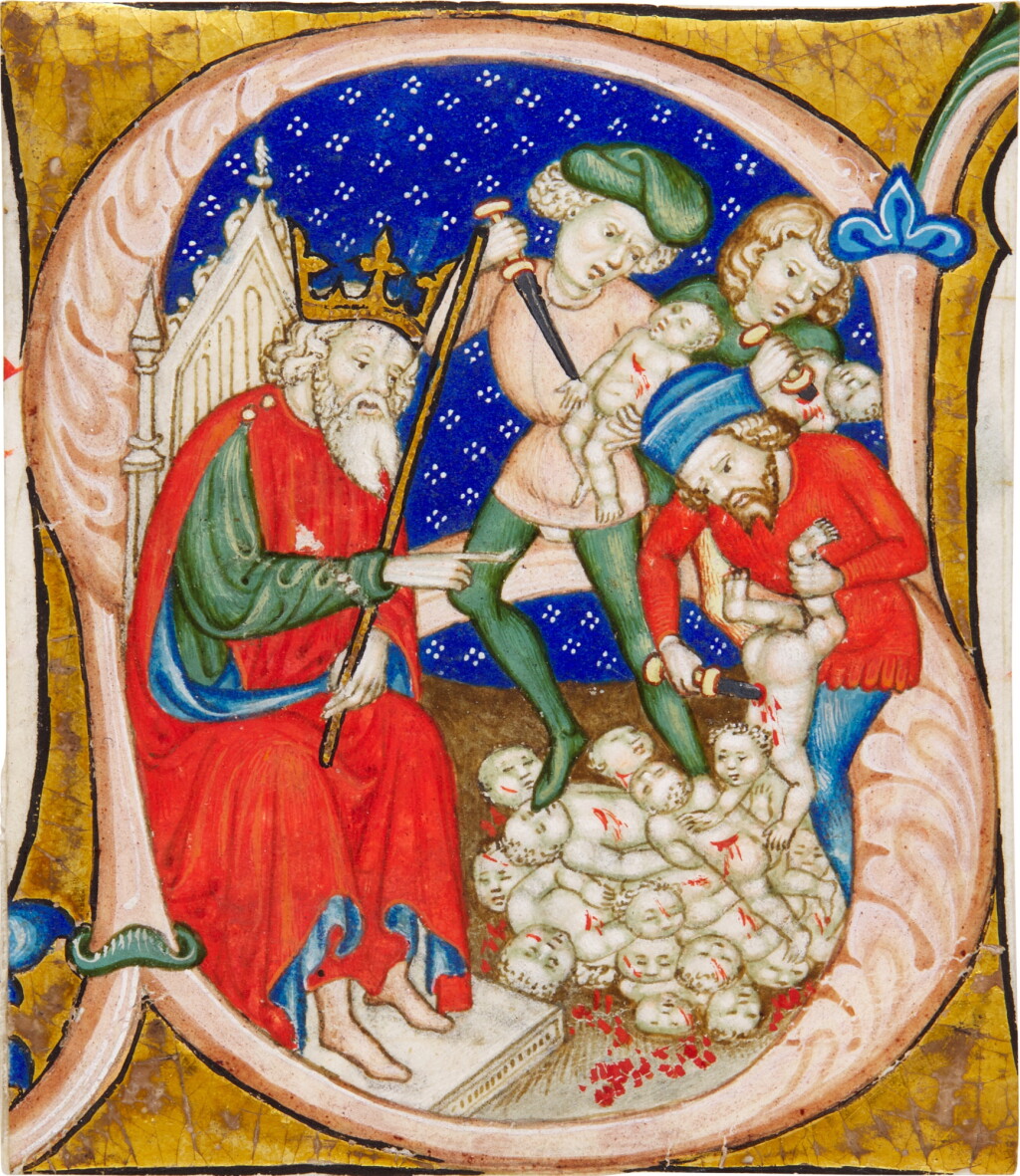
The Massacre of the Innocents in a historiated initial S cut from an Antiphonary in Latin, illuminated manuscript on vellum. [Italy, Lombardy (Milan), 15th century (c.1440)]
c. 67 × 55 mm, the initial S doubtless from the first Matins responsory "Sub altare dei" for the feast of the Holy Innocents (28 December), the initial depicting King Herod, enthroned, with crown and sceptre, directing three men who stab infants with daggers, creating a pile of corpses in the foreground, the reverse, probably the recto, with a four-line stave, one line in yellow and one in red, with a few musical notes in square notation and part of a word "don[...]" or "dom[...]" in rounded gothic script, the extremities of the foliate ornament cropped, the gold with some cracking, and with a small abrasion to Herod's torso and forearm, but otherwise in fine condition; the frame c. 230 × 190 mm
PROVENANCE
(1) Perhaps from the same manuscript as two leaves offered in Les Enluminures, Catalogue 3, 1995, no 9, one depicting Three Martyrs, the other depicting St Helen (re-sold at Christie's, 12 July 2017, lot 6), citing another partial leaf with St Mary of Egypt sold at Sotheby’s, 14 December 1977, lot 17.
(2) Acquired by Cary Welch by 1960: the reverse of the frame with several labels, the oldest from Holman's Print Shop, Boston, inscribed "Cary from P[..]t. 1 June 1960"; later labels record three successive loans to the Fogg Art Museum, the most recent for a loan starting in 1983.
Despite the gruesome subject-matter, this is an extremely attractive and finely painted initial by the so-called Master of the Vitae Imperatorum, one of the foremost Lombard illuminators of the second quarter and middle of the 15th century (on whom see Pia Palladino, Treasures of a Lost Art (New York: The Metropolitan Museum of Art, 2003), pp. 107-09, and F. Lollini in Dizionario biografico dei miniatori italiani, ed. by Milvia Bollati (Milan, 2004), pp. 587-89).
You May Also Like