Sebastien Vrancx
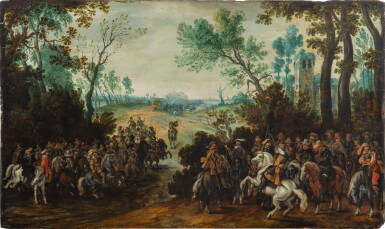
Horsemen in a landscape | Cavaliers dans un paysage
Lot Closed
November 14, 03:21 PM GMT
Estimate
40,000 - 60,000 EUR
Lot Details
Description
Sebastian Vrancx
Antwerp 1573 - 1647
Horsemen in a landscape
Oil on panel
55 x 92,4 cm ; 21⅝ by 36⅜ in.
____________________________________________
Sebastien Vrancx
Anvers 1573 - 1647
Cavaliers dans un paysage
Huile sur panneau
55 x 92,4 cm ; 21⅝ by 36⅜ in.
Private collection, Belgium.
____________________________________________
Collection particulière, Belgique.
Like his contemporaries, Hendrick van Balen and Peter Paul Rubens, Sébastien Vrancx learnt to paint with Adam van Noort. He completed his training with a brief stay in Italy, during which he made the acquaintance of Paul Bril and Jan Brueghel the Elder. He moved to Brussels in 1600 and became a master of the Guild of St Luke. From the 1620s onwards, Vrancx specialized in scenes of battle and looting: he was a pioneer in these subjects in the Netherlands and they brought him success.
This dynamic and detailed depiction of a battle is typical of the genre Vrancx introduced, which found a following. Two cavalry regiments are in a clearing at the edge of a wood, one setting off to join the battle in the distance while the other remains concealed. It was probably Sébastien Vrancx’s military experience, as an officer of the Antwerp civic guard and then as a captain, which enabled him to create scenes such as this without heroics, describing the circumstances of battle in great detail despite the fact that they are mostly imagined scenarios. This is a work of his maturity, painted when he had perfectly mastered his art: this is manifested in the attention he has paid to creating an atmospheric perspective which gives the painting depth, as well as in the varied poses of the horsemen and their mounts.
____________________________________________
Après avoir appris la peinture auprès d'Adam van Noort comme ses contemporains, Hendrick van Balen et Pierre Paul Rubens, et complété sa formation par un bref voyage en Italie durant lequel il se lie avec Paul Bril et Jan Brueghel l’Ancien, Sebastien Vrancx s'installe à Bruxelles en 1600 et devient maître de la guilde de Saint-Luc. A partir des années 1620, Vrancx se spécialise dans les scènes de bataille et de pillage dont il est le précurseur aux Pays-Bas et qui ont fait son succès.
Cette représentation dynamique et détaillée de bataille est typique du genre initié par Vrancx et qui fera école. Deux régiments de cavalerie sont dans une clairière à l'orée d'un bois, l’une s’élance pour rejoindre une bataille au loin tandis que l’autre reste dissimulée. C’est sans doute l’expérience militaire de Sebastien Vrancx, officier dans la garde civique d'Anvers puis capitaine, qui lui permet de créer ce type de scène sans héroïsation et qui décrivent au plus près des situations de bataille bien que dans la plupart des cas, il s'agit de scènes fictives. Œuvre de maturité, Vrancx la réalise alors qu’il maîtrise parfaitement son métier : le soin apporté à la perspective atmosphérique qui donne de la profondeur au tableau ainsi que la diversité des poses des cavaliers et des chevaux en témoignent.
You May Also Like