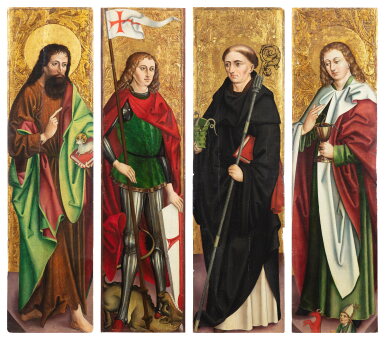
Master of the Karlsruhe Hohenlandenberg Altarpiece | Maître du retable Hohenlandenberg de Karlsruhe
Four saints | Quatre saints
Lot Closed
November 14, 03:12 PM GMT
Estimate
120,000 - 180,000 EUR
Lot Details
Description
Master of the Karlsruhe Hohenlandenberg Altarpiece (Michel Haider and his workshop)
Active in Constance 1479 - 1516
(I) Saint John the Baptist
(II) Saint George
(III) Saint Benedict
(IV) Saint John with Donator
Oil and gold ground on panel, a set of four
(I) 94,3 x 25 cm ; 37⅛ by 9⅞ in. ; (II) 94,4 x 23,3 cm (panel: 94,4 x 24,6 cm) ; 37⅛ by 9⅛ in.; (III) 94,3 x 25,7 cm ; 37⅛ by 10⅛ in. ; (IV) 94,1 x 24,6 cm ; 37 by 9¾ in.
(4)
____________________________________________
Maître du retable Hohenlandenberg de Karlsruhe (Michel Haider et son Atelier)
Actif à Constance 1479 - 1516
(I) Saint Jean Baptiste
(II) Saint Georges
(III) Saint Benoît
(IV) Saint Jean avec un donateur
Huile et fond d'or sur panneau, ensemble de quatre
(I) 94,3 x 25 cm ; 37⅛ by 9⅞ in. ; (IV) 94,4 x 23,3 cm (panneau entier : 94,4 x 24,6 cm) ; 37⅛ by 9⅛ in. ; (III) 94,3 x 25,7 cm ; 37⅛ by 10⅛ in. ; (IV) 94,1 x 24,6 cm ; 37 by 9¾ in.
(4)
Probably executed for the Monastry of Reichenau, near Constance, commissioned by its abbot Johannes Pfuser von Nordstetten (officiate 1464-1492);
Belgium Art Market, in 1949 (as per A. Stange, op. cit., 1970);
Private collection, Belgium.
____________________________________________
Probablement exécutés pour le monastère de Reichenau, près de Constance, à la demande de son abbé Johannes Pfuser von Nordstetten (officiant entre 1464 et 1492) ;
Marché de l'art belge, en 1949 (selon A. Stange, op. cit., 1970) ;
Collection particulière, Belgique.
A. Stange, Deutsche Malerei der Gotik, tome VIII, Munich– Berlin 1957, p. 132 (without images, as Studio of Yvo Strigel, Memmingen);
A. Stange, Die deutschen Tafelbilder vor Dürer. Kritisches Verzeichnis, tome II, Munich 1970, p. 197, no. 871 (without images, as Studio of Yvo Strigel);
B. Konrad, A. Stange, Die deutschen Tafelbilder vor Dürer. Kritisches Verzeichnis, tome II, interactive DVD, Radolfzell 2009, NW 256_7 (not as Circle of Yvo Strigel, but Master of the Karlsruher Hohenlandenberg Altarpiece (Michel Haider) Constance).
____________________________________________
A. Stange, Deutsche Malerei der Gotik, tome VIII, Munich– Berlin, 1957, p. 132 (non illustré, comme Atelier d'Yvo Strigel, Memmingen) ;
A. Stange, Die deutschen Tafelbilder vor Dürer. Kritisches Verzeichnis, tome II, Munich, 1970, p. 197, n° 871 (non illustré, comme Atelier d'Yvo Strigel) ;
B. Konrad, A. Stange, Die deutschen Tafelbilder vor Dürer. Kritisches Verzeichnis, tome II, DVD interactif, Radolfzell, 2009, NW 256_7 (pas comme Entourage d'Yvo Strigel, mais comme Maître du retable Hohenlandenberg de Karlsruhe, Constance).
We are grateful to Dr. Bernd Konrad for having endorsed the attribution of this work to the Master of the Karlsruhe Hohenlandenberg Altarpiece, and for his help in the redaction of this notice.
These four saints, which have survived in exceptionally fresh condition, originally came from a single panel which was cut up at some point in the past, as is evidenced by the continuous ground that unites the four figures. Now missing, perhaps the Virgin, must have been present in the centre of this large panel.
At all events, these works undoubtedly come from an altarpiece that was once in the Reichenau monastery, on the island of the same name in Lake Constance. This can be established from the presence, at St John’s feet, of the work’s donor, the abbot Johannes Pfuser von Nordstetten (officiate 1464-1492): his emblem, a red bull, is beside him.
They can be compared to a number of other works by the same artist, who has been given the not-name Master of the Hohenlandenberg Altarpiece of Karlsruhe, after a triptych now in the Staatliche Kunsthalle in Karlsruhe (inv. no. 48 a), made for the bishop of Constance, Hugo von Hohenlandenberg (1460-1532). Several names have been proposed for this anonymous master, in particular Matthäus Gutrecht the Elder (who died in Constance in 1505). More recently, Bernd Konrad has suggested Michel Haider (active in the same town between 1479 and 1516) and this identification now seems to have been accepted.
Among other paintings believed to be by this master, several are particularly close to the present panels. Apart from the two panels illustrated by Alfred Stange in 1955 (Deutsche Malerei der Gotik – Oberrhein, Bodensee, Schweiz un Mittelrhein, Munich and Berlin, 1955, figs 101 and 102), whose figures seem close to ours, there appears to be an even more pertinent comparison in the two wings of an altarpiece in the Augustiner Museum in Freiburg-im-Breisgau: The Circumcision (inv. no. M 67/028) and Christ before Pilate (inv. no. M 65/008). There is a clear kinship visible in the intensely coloured flowing draperies and the figures’ physical types, especially their slightly bulging eyes and their solid skin tones, accentuated by fine white highlights. Likewise, the treatment of the gold ground, in which identical floral motifs in relief can be perceived, adds to the likelihood of an association between the four panels of saints and the works in Freiburg. Finally, the present figure of St John the Baptist, with his finger pointing upwards, is notably close to the figure of Pilate, making exactly the same gesture, a detail that does not seem fortuitous.
____________________________________________
Nous remercions le Dr. Bernd Konrad pour avoir confirmé l’attribution de cette œuvre au Maître du retable Hohenlandenberg de Karlsruhe et pour l’aide à la rédaction de cette notice.
Ces quatre saints, parvenus jusqu’à nous dans un état de fraîcheur exceptionnel, sont en réalité issus d’un seul et même panneau découpé par le passé, comme en témoigne le sol continu entre les modèles. Au centre de ce grand panneau, manquant aujourd’hui, devait probablement se trouver la Vierge.
Quoiqu’il en soit, ces œuvres proviennent sans doute d’un retable qui se trouvait initialement dans le monastère de Reichenau, sur l’île du même nom située dans le lac de Constance, comme permet de le préciser la présence, aux pieds de saint Jean, du donateur de l’œuvre, l'abbé Johannes Pfuser von Nordstetten (officiant entre 1464 et 1492), dont on reconnaît le blason, un bœuf rouge, à ses côtés.
Ils sont à rapprocher de plusieurs autres œuvres d’un même artiste que l’on a dénommé le Maître du retable Hohenlandenberg de Karlsruhe, d’après un triptyque conservé à la Staatliche Kunsthalle de Karlsruhe (inv. Nr. 48 a), exécuté pour l’évêque de Constance Hugo von Hohenlandenberg (1460-1532). Plusieurs noms ont été proposés pour ce maître anonyme, en particulier celui de Matthäus Gutrecht l'Ancien (mort à Constance en 1505). Plus récemment, Bernd Konrad a suggéré celui de Michel Haider (actif dans cette même ville entre 1479 et 1516), une identification qui semble aujourd’hui avoir été acceptée.
Parmi les autres tableaux considérés comme de ce maître, plusieurs sont singulièrement proches des présents panneaux. Outre les deux panneaux illustrés par Alfred Stange en 1955 (Deutsche Malerei der Gotik – Oberrhein, Bodensee, Schweiz un Mittelrhein, Munich et Berlin, 1955, fig. 101 et 102), dont les figures semblent proches des nôtres, le rapprochement avec deux volets de retable conservés à l’Augustiner Museum de Fribourg-en-Brisgau : La Circoncision (inv. Nr. M 67/028) et Le Christ devant Pilate (inv. Nr. M 65/008) paraît encore plus pertinent. Les drapés fluides aux coloris denses, les types physiques des protagonistes, en particulier leurs yeux légèrement globuleux et leurs carnations fermes, soulignées par de fins rehauts de blanc, témoignent d’une évidente parenté. De même, le traitement du fond d’or, dont on reconnaît des motifs floraux en relief identiques, contribuent à rapprocher les quatre panneaux de saints des œuvres de Fribourg. En outre, la présente figure de saint Jean-Baptiste, au doigt levé, est singulièrement proche de celle de Pilate, dont elle reprend exactement le geste, un détail qui ne semble pas devoir être fortuit.
You May Also Like