
Jan van Kessel
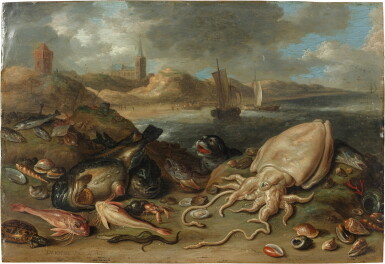
Coastal landscape with seals and squid | Paysage côtier avec phoques et calamars
Auction Closed
June 13, 02:06 PM GMT
Estimate
20,000 - 30,000 EUR
Lot Details
Description
Jan van Kessel
Antwerp 1626 - 1679
Coastal landscape with seals and squid
Oil on copper
Signed and dated lower left I. V. KESSEL. FECIT Ao. 1661.
20,5 x 30,2 cm; 8⅛ by 11⅞ in.
____________________________________________
Jan van Kessel
Anvers 1626 - 1679
Paysage côtier avec phoques et calamars
Huile sur cuivre
Signé et daté en bas à gauche I. V. KESSEL. FECIT Ao. 1661.
20,5 x 30,2 cm ; 8⅛ by 11⅞ in.
Anonymous sale, Palais des Beaux-Arts, Brussels, 29 February 1956, lot 394.
____________________________________________
Vente anonyme, Palais des Beaux-Arts, Bruxelles, 29 février 1956, lot 394.
K. Ertz et C. Nitze-Ertz, Jan van Kessel der Ältere 1626-1679. Kritische Kataloge der gemälde., Lingen, 2012, vol. 8, p. 221, n° 226 (repr.).
Originally a flower painter, in the 1640s Van Kessel rapidly turned to the depiction of butterflies, shells, terrestrial and aquatic animals, creating a collection of motifs that he used for still lifes, as well as for representations of the five senses, the four elements and the continents.
As was also the case for his predecessors Rubens and Snyders, literary and scientific works proved a valuable source: Van Kessel worked from drawings and from living or dead specimens, but also from an important illustrated work of natural history by Conrad Gesner – Historiae animalium, published in the previous century. Science and art were then inextricably linked and Van Kessel’s modernity resided in the way he assembled his compositions, so that they described the animal world and its variety, but also evoked a still life animated by living creatures.
The cuttlefish in the foreground, the fish lying on the left and the surrounding shells create a composition that is very close to Marine animals in the Staatsgalerie in Stuttgart (inv. 1088), dated 1660. The present painting nonetheless has one notable difference: the silhouette of a church and its belltower visible in the background, suggesting that this could be an allegory of a town known to Van Kessel from engravings and maps circulating at that time in Antwerp.
Van Kessel’s works perfectly sum up the Antwerp environment of the seventeenth century, combining knowledge and the instinct for collection, in which art and nature are intimately connected.
____________________________________________
Peintre de fleurs à ses débuts, dans les années 1640, Van Kessel évolue rapidement vers les représentations de papillons, de coquillages, d’animaux marins et terrestres formant un ensemble de motifs qu’il articule pour former des natures mortes, ou des représentations des cinq sens, des quatre éléments ou encore des continents.
Tout comme pour ses prédécesseurs Rubens ou Snyders, les ouvrages littéraires et scientifiques sont une précieuse source : Van Kessel travaille à partir de dessins, de spécimens morts ou vivants, mais aussi de l’important ouvrage d’histoire naturelle illustré de Conrad Gesner Historiae animalium, paru au siècle précédent. Science et art sont alors indissociables et la modernité de Van Kessel tient à sa façon d’assembler ses compositions, de telle sorte qu’elles forment à la fois une description du monde animal et de sa variété, tout en constituant une nature morte animée de créatures bien vivantes.
La seiche visible au premier plan, ainsi que le poisson couché à gauche et les coquillages autour forment une composition très proche des Animaux marins conservée à la Staatsgalerie de Stuttgart (inv. 1088), datée de 1660. Notre tableau présente néanmoins une différence notable : l’on distingue dans l’arrière-plan la silhouette d’une église avec son clocher, suggérant qu’il s’agirait peut-être de l’allégorie d’une ville dont Van Kessel aura eu connaissance à travers les gravures, et plans circulant alors à Anvers…
Les œuvres de Van Kessel résument parfaitement le contexte anversois de ce XVIIe siècle, entre connaissance et collection, dans lequel art et nature sont intimement connectés.
You May Also Like


