Italy, late 19th century/early 20th century
The Temple of Segesta
Lot Closed
January 17, 02:21 PM GMT
Estimate
8,000 - 12,000 GBP
Lot Details
Description
Italy, late 19th century/early 20th century
The Temple of Segesta
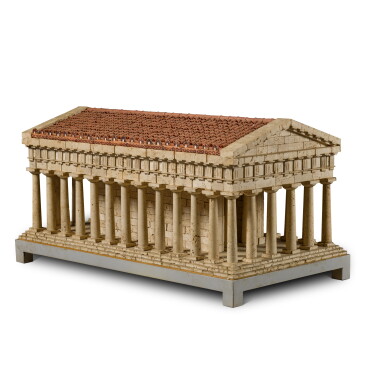
travertine, terracotta, wood
with base: 48.5cm. high, 91.5cm. wide, 51.5cm deep
The present architectural model is a striking reconstruction of the Temple of Segesta in Sicily. Though its construction remained unfinished, it is considered today as one of the most beautiful antique architectural site and this model gives us a unique opportunity to imagine how it would have looked in all its glory when finished.
The Grand Tour and architectural models
For a long time, architectural models have been used for resolving structural problems; for presentation, as three-dimensional records; and for decoration. From the late 1760s, models of antique monuments became a fashion and numerous collectors, and architects alike, enjoyed them for certain qualities. Like many sculptures and decorative objects fashioned from marbles and coloured stones inspired by, copying or emulating the Ancient past, they were coveted by the great collectors and Grand Tourists of the 18th and 19th centuries, some being produced precisely as mementos of their passage through the city. Also including paintings, engravings and drawings, all these mementos served as a symbol and expression of their owner’s sophistication, cultural awareness and appreciation for ancient art and architecture. The architect Sir John Soane (1753-1837) was perhaps one of the most celebrated figures to have promoted architectural models which he esteemed important to educate on the great monuments of the classical past and influenced him in the making of his own designs. He owned many cork models made by Domenico Padiglione of the temples at Paestum and many of these are still conserved in his house today in London.
Since cork was the usual material used for these types of models, the present lot is quite an exciting example, using travertine (a type of limestone), just like the Temple of Segesta in reality.
Segesta
Situated in the middle of a deserted countryside, the ancient Greek city of Segesta has still uncertain origins and is the subject of debate among historians. Nevertheless, historians agree on several aspects, starting with the fact that Segesta was founded if not inhabited by the Elymians in the Antiquity as descendants of the Trojans, according to mythological accounts. But it was the Greeks who really shaped the present face of the site, as the Temple of Segesta testifies, when they arrived in the whole of Sicily in the 9th century BC.
The Greek Temple is an impressive Doric style peripteral building. Built of limestone and with a capacity of about 4,000 people, it stands on a hill at an altitude of 440 metres. With a total surface area of 61 m × 26 m, it features a peristyle formed by 36 columns, six in front and 14 on the longer sides, topped by an architrave and a Doric frieze decorated with metopes and triglyphs.
Though construction began around 420 BC, it was probably interrupted. Indeed, there are indications that the construction of the temple was not completed: the columns were not fluted, which is characteristic of the Doric order, and the temple has no roof.
You May Also Like