
Property of a Gentleman
Attributed to Carl Tegelstein (1798-1852), for Nichols and Plincke
Russia, St Petersburg, second quarter 19th century
Lot Closed
January 17, 02:43 PM GMT
Estimate
30,000 - 50,000 GBP
Lot Details
Description
Attributed to Carl Tegelstein (1798-1852), for Nichols and Plincke
Russia, St Petersburg, second quarter 19th century
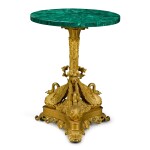
Centre table
malachite, gilt-bronze; the underside of the table painted with a numeral '4' and 4 dots
73.3cm. high, 55.9cm. wide
This spectacular centre table not only showcases a beautiful malachite table top, a stone vivid in its green colour and of great Russian importance, but it is simultaneously an exciting discovery and addition to the work of Carl Tegelstein (1798-1852), whose work and skills are embodied in the present table's bronzes, executed flawlessly.
The attribution to Carl Tegelstein is drawn primarily thanks to two related tables which are firmly associated with his work. The first example is a table supplied to Empress Alexandra Feodorovna in 1842, and in 1844 sent for the use of Grand Duchess Maria Aleksandrovna, future Empress Maria, when it was installed in the Golden Drawing Room, Winter Palace, St Petersburg. The table was subsequently sold by the Soviet administration in the 1920s and was in a German private collection until sold at Bonham’s London, 1 December 2010, lot 210 (£916,000). Though the bases are almost identical, the tops differ and indeed Feodorovna's table featured a pietre dure top within a gilt bronze border. The stem of the present table also display bolder flower mounts just above the swans. The mounts for Feodorovna's table were commissioned at the renowned Nichols and Plincke Company in St. Petersburg: an invoice in the State Historical Archives reveals that the shop was paid 700 rubles for the bronze mounts of this table (RGIA, fond 504, opis 1, delo 275, list 13). Apparently unmarked, the bronze-work most likely was made at the workshop of Tegelstein, who worked under direct commission from Nichols and Plincke's company as well as directly with the architects responsible for remodeling Imperial Palaces in the Russian capital (Igor Sychov, Russkie Svetil'niki aepokhi klassitsizma, 1760-1830, St. Petersburg, 2003, page 197 and Igor Sychov, Russian Bronzes, Moscow, 2003, page 227).
The table from Empress Feodorovna made such an impression on the members of the Russian Imperial family that two years later a very similar table, valued at 5,715 roubles at the time, was made at the factory to be presented to Queen Victoria from Emperor Nicholas I after his state visit to Great Britain in 1844. This is now in the Royal Collection, on display at Osborne House, Isle of Wight (RCIN 1450). With a pietre dure table top, the gilt-bronze base (though of different design) is, this time, marked with C. Tegelstein. This stamp thus confirms, once and for all, that Tegelstein is the master behind the bronzes of these closely related tables.
As a result, the present table appears to be the third re-creation of this celebrated design, possibly at the request of the Russian Imperial family, for their collection or perhaps again as a diplomatic gift to a European statesman.
Interestingly, another Russian table with a canted malachite veneered top and patinated and gilt bronze base, the top with the foundry mark of Carl Tegelstein, was sold at Christie's London, 7 June 2016, lot 186. A pair of gilt-bronze candelabra by Carl Tegelstein in the collections of the Hermitage Museum also display similar qualities and elements to the present table (see respectively inv. no. ЭРМ-213 and ЭРМ-214)
Carl Johan Tegelstein (1798-1852)
The Finnish-born silversmith and bronze-worker Carl Tegelstein (or Tegelsten) qualified as a master craftsman in St Petersburg in 1825. Though many of his works are not stamped, he is celebrated for his fashionable designs and meticulously executed bronzes. From around 1833 much of his work in bronze and silver was retailed by Nichols & Plincke, one of the most fashionable shops in St Petersburg. The legendary establishment had been in existence since 1789 under the name 'English Shop' owned by a succession of Englishmen. At the beginning of the 19th century, William Nichols and Constantine Plincke took over the company and turned it into a landmark establishment, producing bronzes, silver and jewellery according to the latest European fashions and employing the best craftsmen in the Russian capital where they held an Imperial Warrant.
You May Also Like


